
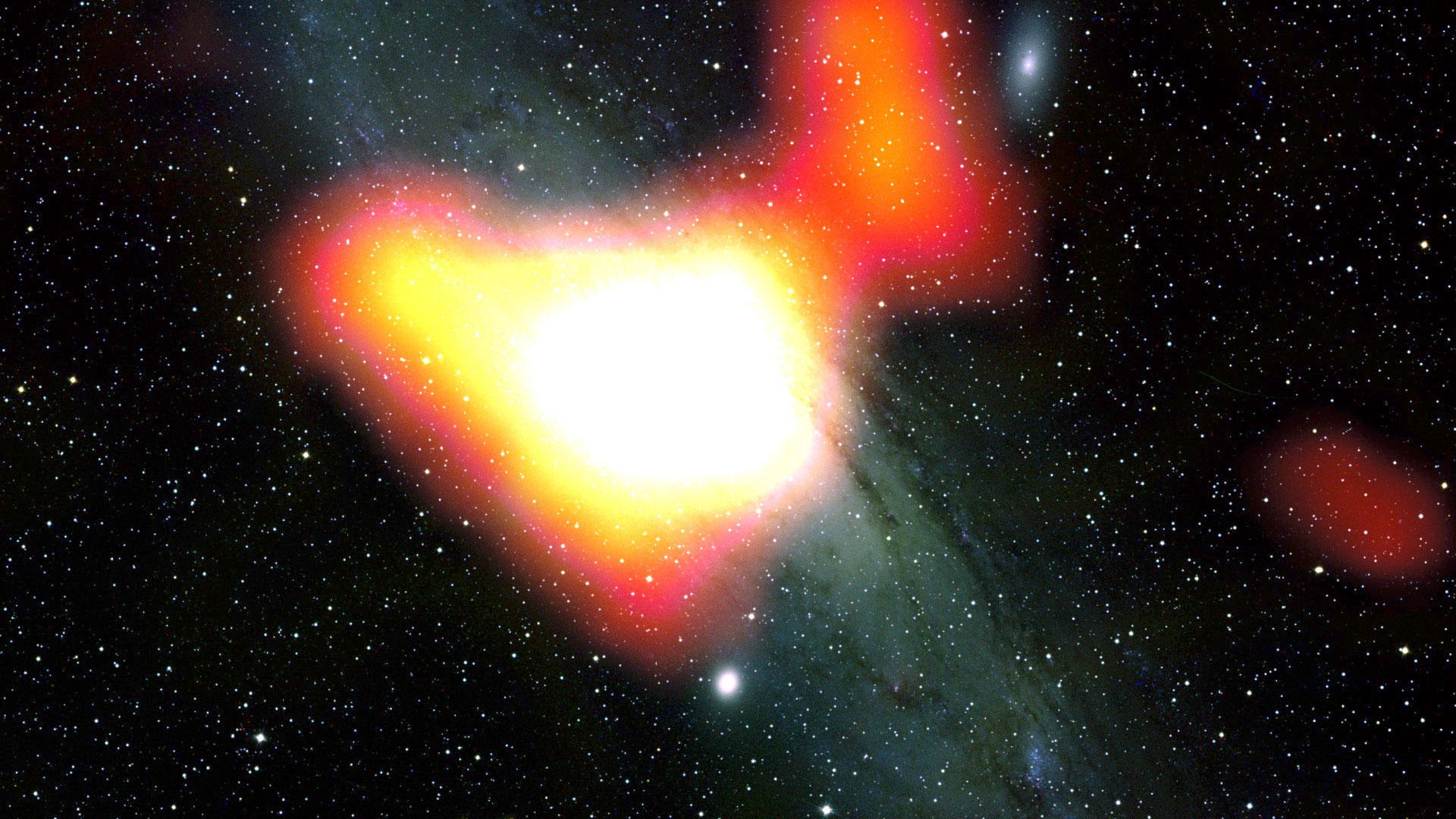
Using NASA’s Fermi Gamma-ray Space Telescope, a team of astronomers has discovered a signal at the center of the neighboring Andromeda galaxy that could indicate the presence of dark matter. The gamma-ray signal is similar to one seen by Fermi at the center of our own Milky Way galaxy.
Gamma rays are the highest-energy form of light, produced by the universe’s most energetic phenomena. They’re common in galaxies like the Milky Way because cosmic rays, particles moving near the speed of light, produce gamma rays when they interact with interstellar gas clouds and starlight.
Surprisingly, the latest Fermi data shows the gamma rays in Andromeda — also known as M31 — are confined to the galaxy’s center instead of spread throughout. To explain this unusual distribution, scientists are proposing that the emission may come from several undetermined sources. One of them could be dark matter, an unknown substance that makes up most of the universe.
NASA’s Fermi telescope has detected a gamma-ray excess at the center of the Andromeda galaxy that’s similar to a signature Fermi previously detected at the center of our own Milky Way. Watch to learn more.
“We expect dark matter to accumulate in the innermost regions of the Milky Way and other galaxies, which is why finding such a compact signal is very exciting,” said lead scientist Pierrick Martin, an astrophysicist at the National Center for Scientific Research and the Research Institute in Astrophysics and Planetology in Toulouse, France. “M31 will be a key to understanding what this means for both Andromeda and the Milky Way.”
A paper describing the results is published in The Astrophysical Journal.
Another possible source for this emission could be a rich concentration of pulsars in M31’s center. These spinning neutron stars weigh as much as twice the mass of the sun and are among the densest objects in the universe. One teaspoon of neutron star matter would weigh a billion tons on Earth. Some pulsars emit most of their energy in gamma rays. Because M31 is 2.5 million light-years away, it’s difficult to find individual pulsars. To test whether the gamma rays are coming from these objects, scientists can apply what they know about pulsars from observations in the Milky Way to new X-ray and radio observations of Andromeda.
Now that Fermi has detected a similar gamma-ray signature in both M31 and the Milky Way, scientists can use this information to solve mysteries within both galaxies. For example, M31 emits few gamma rays from its large disk, where most stars form, indicating fewer cosmic rays roaming there. Because cosmic rays are usually thought to be related to star formation, the absence of gamma rays in the outer parts of M31 suggests either that the galaxy produces cosmic rays differently, or that they can escape the galaxy more rapidly. Studying Andromeda may help scientists understand the life cycle of cosmic rays and how it is connected to star formation.
“We don’t fully understand the roles cosmic rays play in galaxies, or how they travel through them,” said Xian Hou, an astrophysicist at Yunnan Observatories, Chinese Academy of Sciences in Kunming, China, also a lead scientist in this work. “M31 lets us see how cosmic rays behave under conditions different from those in our own galaxy.”
The similar discovery in both the Milky Way and M31 means scientists can use the galaxies as models for each other when making difficult observations. While Fermi can make more sensitive and detailed observations of the Milky Way’s center, its view is partially obscured by emission from the galaxy’s disk. But telescopes view Andromeda from an outside vantage point impossible to attain in the Milky Way.
“Our galaxy is so similar to Andromeda, it really helps us to be able to study it, because we can learn more about our galaxy and its formation,” said co-author Regina Caputo, a research scientist at NASA’s Goddard Space Flight Center in Greenbelt, Maryland. “It’s like living in a world where there’s no mirrors but you have a twin, and you can see everything physical about the twin.”
While more observations are necessary to determine the source of the gamma-ray excess, the discovery provides an exciting starting point to learn more about both galaxies, and perhaps about the still elusive nature of dark matter.
“We still have a lot to learn about the gamma-ray sky,” Caputo said. “The more information we have, the more information we can put into models of our own galaxy.”
NASA’s Fermi Gamma-ray Space Telescope is an astrophysics and particle physics partnership, developed in collaboration with the U.S. Department of Energy and with important contributions from academic institutions and partners in France, Germany, Italy, Japan, Sweden, and the United States.
Reference: “Observations of M31 and M33 with the Fermi Large Area Telescope: A Galactic Center Excess in Andromeda?” by M. Ackermann, M. Ajello, A. Albert, L. Baldini, J. Ballet, G. Barbiellini, D. Bastieri, R. Bellazzini, E. Bissaldi, E. D. Bloom, R. Bonino, E. Bottacini, T. J. Brandt, J. Bregeon, P. Bruel, R. Buehler, R. A. Cameron, R. Caputo, M. Caragiulo, P. A. Caraveo, E. Cavazzuti, C. Cecchi, E. Charles, A. Chekhtman, G. Chiaro, S. Ciprini, F. Costanza, S. Cutini, F. D’Ammando, F. de Palma, R. Desiante, S. W. Digel, N. Di Lalla, M. Di Mauro, L. Di Venere, C. Favuzzi, S. Funk, P. Fusco, F. Gargano, N. Giglietto, F. Giordano, M. Giroletti, T. Glanzman, D. Green, I. A. Grenier, L. Guillemot, S. Guiriec, K. Hayashi, X. Hou, G. Jóhannesson, T. Kamae, J. Knödlseder, A. K. H. Kong, M. Kuss, G. La Mura, S. Larsson, L. Latronico, J. Li, F. Longo, F. Loparco, P. Lubrano, S. Maldera, D. Malyshev, A. Manfreda, P. Martin, M. N. Mazziotta, P. F. Michelson, N. Mirabal, W. Mitthumsiri, T. Mizuno, M. E. Monzani, A. Morselli, I. V. Moskalenko, M. Negro, E. Nuss, T. Ohsugi, N. Omodei, E. Orlando, J. F. Ormes, D. Paneque, M. Persic, M. Pesce-Rollins, F. Piron, T. A. Porter, G. Principe, S. Rainò, R. Rando, M. Razzano, O. Reimer, M. Sánchez-Conde, C. Sgrò, D. Simone, E. J. Siskind, F. Spada, G. Spandre, P. Spinelli, K. Tanaka, L. Tibaldo, D. F. Torres, E. Troja, Y. Uchiyama, J. C. Wang, K. S. Wood, M. Wood, G. Zaharijas and M. Zhou, 23 February 2017, The Astrophysical Journal.
DOI: 10.3847/1538-4357/aa5c3d
Never miss a breakthrough: Join the SciTechDaily newsletter.
Follow us on Google and Google News.
1 Comment
I dislike the title of your article. Its possible they also discovered unicorn farts.