
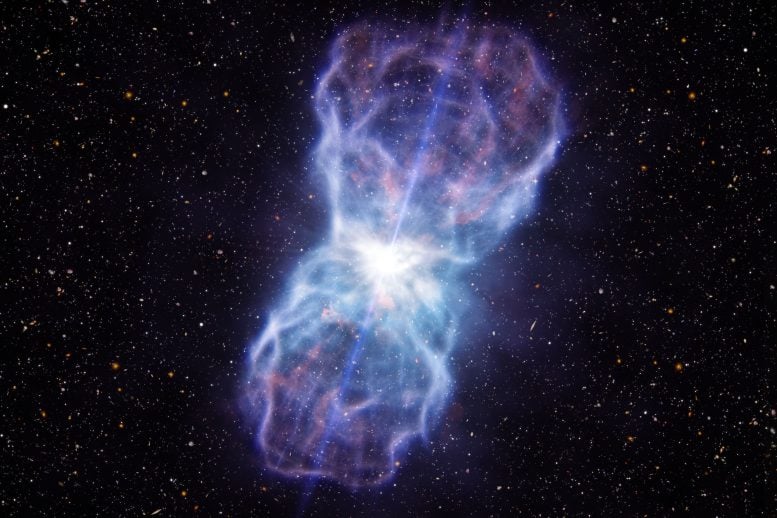
Scientists have discovered a quasar that is at least five times more powerful than any that has been observed to date. Data reveals that a mass of approximately 400 times that of the Sun is streaming away from this quasar per year, moving at a speed of 8000 kilometers per second.
Astronomers using ESO’s Very Large Telescope (VLT) have discovered a quasar with the most energetic outflow ever seen, at least five times more powerful than any that have been observed to date. Quasars are extremely bright galactic centers powered by supermassive black holes. Many blast huge amounts of material out into their host galaxies, and these outflows play a key role in the evolution of galaxies. But, until now, observed quasar outflows weren’t as powerful as predicted by theorists.
Quasars are the intensely luminous centers of distant galaxies that are powered by huge black holes. This new study has looked at one of these energetic objects — known as SDSS J1106+1939 — in great detail, using the X-shooter instrument on ESO’s VLT at the Paranal Observatory in Chile.[1] Although black holes are noted for pulling material in, most quasars also accelerate some of the material around them and eject it at high speed.
“We have discovered the most energetic quasar outflow known to date. The rate that energy is carried away by this huge mass of material ejected at high speed from SDSS J1106+1939 is at least equivalent to two million million times the power output of the Sun. This is about 100 times higher than the total power output of the Milky Way galaxy — it’s a real monster of an outflow,” says team leader Nahum Arav (Virginia Tech, USA). “This is the first time that a quasar outflow has been measured to have the sort of very high energies that are predicted by theory.”
Many theoretical simulations suggest that the impact of these outflows on the galaxies around them may resolve several enigmas in modern cosmology, including how the mass of a galaxy is linked to its central black hole mass, and why there are so few large galaxies in the Universe. However, whether or not quasars were capable of producing outflows powerful enough to produce these phenomena has remained unclear until now.[2]
The newly discovered outflow lies about a thousand light-years away from the supermassive black hole at the heart of the quasar SDSS J1106+1939. This outflow is at least five times more powerful than the previous record holder.[3] The team’s analysis shows that a mass of approximately 400 times that of the Sun is streaming away from this quasar per year, moving at a speed of 8000 kilometers per second.
“We couldn’t have got the high-quality data to make this discovery without the VLT’s X-shooter spectrograph,” says Benoit Borguet (Virginia Tech, USA), lead author of the new paper. “We were able to explore the region around the quasar in great detail for the first time.”
As well as SDSS J1106+1939, the team also observed one other quasar and found that both of these objects have powerful outflows. As these are typical examples of a common, but previously little studied, type of quasars,[4] these results should be widely applicable to luminous quasars across the Universe. Borguet and colleagues are currently exploring a dozen more similar quasars to see if this is the case.
“I’ve been looking for something like this for a decade,” says Nahum Arav, “so it’s thrilling to finally find one of the monster outflows that have been predicted!”
This research was presented in a paper, “Major contributor to AGN feedback: VLT X-shooter observations of SIV BAL QSO outflows,” to appear in The Astrophysical Journal.
Notes
- The team observed SDSS J1106+1939 and J1512+1119 in April 2011 and March 2012 using the X-shooter spectrograph instrument attached to ESO’s VLT. By splitting the light up into its component colors and studying in detail the resultant spectrum the astronomers could deduce the velocity and other properties of the material close to the quasar.
- The powerful outflow observed in SDSS J1106+1939 carries enough kinetic energy to play a major role in active galaxy feedback processes, which typically require a mechanical power input of roughly 5% of the luminosity of the quasar. The rate at which kinetic energy is being transferred by the outflow is described as its kinetic luminosity.
- SDSS J1106+1939 has an outflow with a kinetic luminosity of at least 1046 ergs s−1. The distances of the outflows from the central quasar (300–8000 light-years) was greater than expected suggesting that we observe the outflows far from the region in which we assume them to initially accelerated (0.03–0.4 light-years).
- A class known as Broad Absorption Line (BAL) quasars.
Reference: “Major contributor to AGN feedback: VLT X-shooter observations of SIV BAL QSO outflows” by Benoit C. J. Borguet, Nahum Arav, Doug Edmonds, Carter Chamberlain and Chris Benn, 14 December 2012, The Astrophysical Journal.
DOI: 10.1088/0004-637X/762/1/49
Never miss a breakthrough: Join the SciTechDaily newsletter.
Follow us on Google and Google News.
1 Comment
How true to the real object is this ‘artist’s impression’? How soon are we likely to have a real image? Beautiful, regardless.