
Close Menu
    Facebook X (Twitter) Instagram
    SciTechDaily
    • Biology
    • Chemistry
    • Earth
    • Health
    • Physics
    • Science
    • Space
    • Technology
    Facebook X (Twitter) Pinterest YouTube RSS
    SciTechDaily
    Home»Space»ESO Image of the Week: A Microlensing Mystery
    Space

    ESO Image of the Week: A Microlensing Mystery

    By SciTechDailyOctober 7, 2015No Comments2 Mins Read
    Facebook Twitter Pinterest Telegram LinkedIn WhatsApp Email Reddit
    Share
    Facebook Twitter LinkedIn Pinterest Telegram Email Reddit
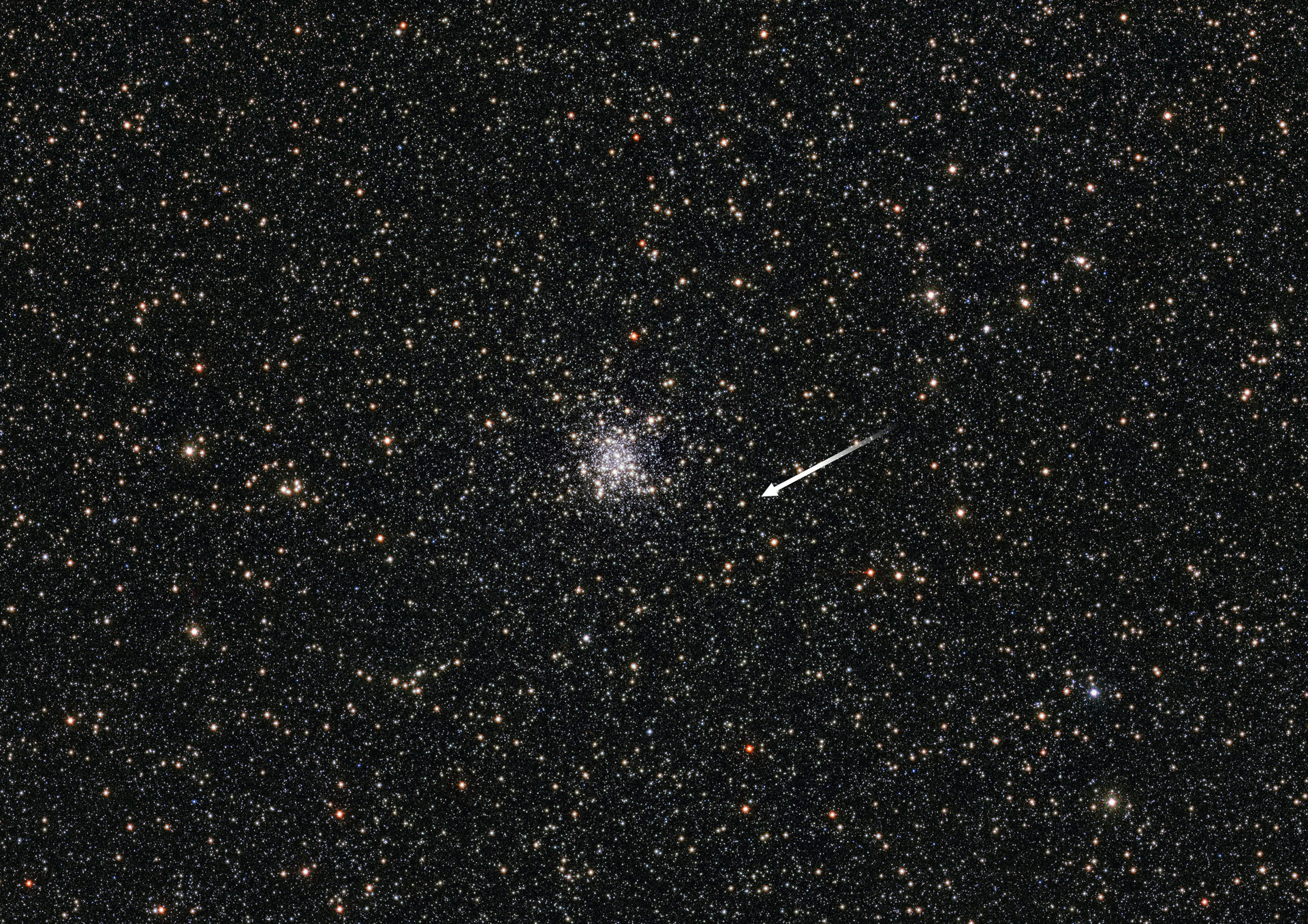
    ESO Image of Globular Cluster NGC 6553
    NGC 6553 is located approximately 19,000 light-years away in the constellation of Sagittarius. Credit: ESO

    This newly released image from the European Southern Observatory shows the globular cluster NGC 6553.

    This spectacular starry field of view shows the globular cluster NGC 6553 which is located approximately 19,000 light-years away in the constellation of Sagittarius. In this field, astronomers discovered a mysterious microlensing event.

    Microlensing is a form of gravitational lensing in which the light from a background source is bent by the gravitational field of a foreground object, creating an amplified image of the background object. The object causing the microlensing in NGC 6553 bent the light of a red giant star in the background (marked with an arrow). If this object lies in the cluster — something the scientists believe might only have a 50/50 chance of being correct — the object could be a black hole with a mass twice that of the Sun, making it the first of its kind to be discovered in a globular cluster. It would also be the oldest known stellar-mass black hole ever discovered. However, further observations are needed to determine the true nature of this lensing object for sure.

    This cosmological curiosity was detected by ESO’s VISTA telescope at the Paranal Observatory in Chile as part of the VISTA Variables in the Vıa Lactea Survey (VVV) — a near-infrared survey aimed at scanning the central parts of the Milky Way.

    Reference: “VVV Survey Observations of a Microlensing Stellar Mass Black Hole Candidate in the Field of the Globular Cluster NGC 6553” by D. Minniti, R. Contreras Ramos, J. Alonso-Garcia, T. Anguita, M. Catelan, F. Gran, V.Motta, G. Muro, K. Rojas and R. K. Saito, 3 September 2015, The Astrophysical Journal.
    DOI: 10.1088/2041-8205/810/2/L20


    Never miss a breakthrough: Join the SciTechDaily newsletter.
    Follow us on Google and Google News.

    Astronomy Astrophysics Black Hole Cosmology European Southern Observatory Microlenses Popular
    Share. Facebook Twitter Pinterest LinkedIn Email Reddit

    Related Articles

    GRAVITY Instrument Captures Observations of Material Orbiting Close to a Black Hole

    Evidence of Galaxy Star Birth Regulated by Black Holes

    VLT/SPHERE Reveal a Star Giving Birth to a Butterfly-Like Planetary Nebula

    Chandra Reveals Evidence of Multiple Eruptions From a Black Hole

    New Research Mathematically Proves Quantum Effects Stop the Formation of Black Holes

    VLT Views a Gas Cloud Being Ripped Apart by a Black Hole

    Astronomers View Distant Galaxy Feeding on Nearby Gas

    NASA Data Suggests Black Holes Abundant Among the Earliest Stars

    Scientists Discover the Most Powerful Quasar Outflow Ever

    Leave A Reply Cancel Reply

    • Facebook
    • Twitter
    • Pinterest
    • YouTube

    Don't Miss a Discovery

    Subscribe for the Latest in Science & Tech!

    Trending News

    Scientists Call for a Complete Rethink of Alzheimer’s Treatment

    Scientists Identify Molecular Switch That Lets Exercise Reverse Muscle Aging

    Why Your Most Vivid Dreams Might Be the Key to Deep, Restful Sleep

    A Bright Star Hid a Massive Secret for 50 Years: Mystery of Gamma Cassiopeiae Finally Solved

    Scientists Identify Protein That Slows Key Effects of Aging

    Revolutionary Submarine Mysteriously Disappears Without a Trace – Scientists Are Now Preparing for a Bold Return

    Why Drinking More Water Isn’t Enough To Stop Kidney Stones

    New Study Reveals Surprising Effect of Drinking Coffee at Night

    Follow SciTechDaily
    • Facebook
    • Twitter
    • YouTube
    • Pinterest
    • Newsletter
    • RSS
    SciTech News
    • Biology News
    • Chemistry News
    • Earth News
    • Health News
    • Physics News
    • Science News
    • Space News
    • Technology News
    Recent Posts
    • AI Uncovers Hidden Signals, Discovering Dozens of New Alien Planets
    • New Discovery Challenges 80-Year-Old Theory About Turbulence
    • Scientists “Bottle the Sun” With Revolutionary Liquid Battery
    • This Ancient Ape Fossil Could Change Where Humans Came From
    • Sperm Get Lost in Space and Scientists Finally Know Why
    Copyright © 1998 - 2026 SciTechDaily. All Rights Reserved.
    • Science News
    • About
    • Contact
    • Editorial Board
    • Privacy Policy
    • Terms of Use

    Type above and press Enter to search. Press Esc to cancel.