

A Discovery That Provides New Insight Into How Galaxies Evolve
At the center of galaxies, like our own Milky Way, lie massive black holes surrounded by spinning gas. Some shine brightly, with a continuous supply of fuel, while others go dormant for millions of years, only to reawaken with a serendipitous influx of gas. It remains largely a mystery how gas flows across the universe to feed these massive black holes.
University of Connecticut Assistant Professor of Physics Daniel Anglés-Alcázar, lead author on a paper published recently in The Astrophysical Journal, addresses some of the questions surrounding these massive and enigmatic features of the universe by using new, high-powered simulations.
“Supermassive black holes play a key role in galaxy evolution and we are trying to understand how they grow at the centers of galaxies,” says Anglés-Alcázar. “This is very important not just because black holes are very interesting objects on their own, as sources of gravitational waves and all sorts of interesting stuff, but also because we need to understand what the central black holes are doing if we want to understand how galaxies evolve.”
Bridging the Scale Gap in Galactic Modeling
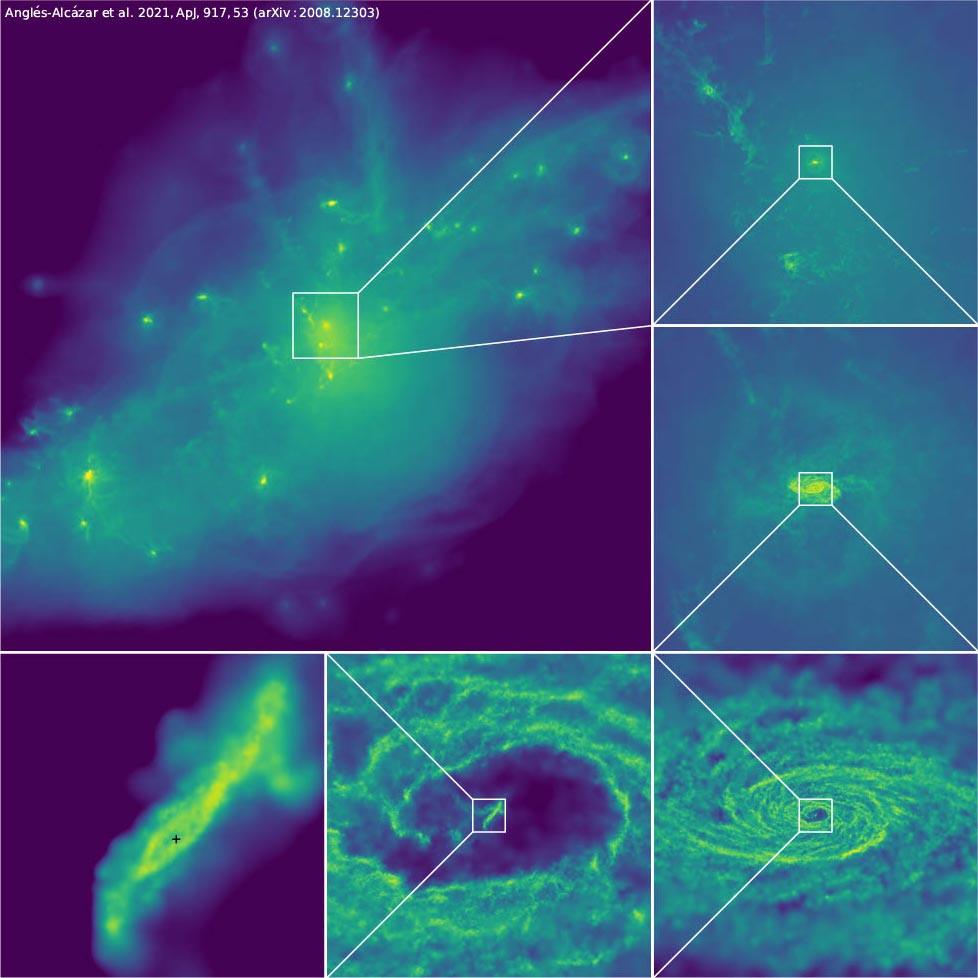
Anglés-Alcázar, who is also an Associate Research Scientist at the Flatiron Institute Center for Computational Astrophysics, says a challenge in answering these questions has been creating models powerful enough to account for the numerous forces and factors that play into the process. Previous works have looked either at very large scales or the very smallest of scales, “but it has been a challenge to study the full range of scales connected simultaneously.”
Galaxy formation, Anglés-Alcázar says, starts with a halo of dark matter that dominates the mass and gravitational potential in the area and begins pulling in gas from its surroundings. Stars form from the dense gas, but some of it must reach the center of the galaxy to feed the black hole. How does all that gas get there? For some black holes, this involves huge quantities of gas, the equivalent of ten times the mass of the sun or more swallowed in just one year, says Anglés-Alcázar.
“When supermassive black holes are growing very fast, we refer to them as quasars,” he says. “They can have a mass well into one billion times the mass of the sun and can outshine everything else in the galaxy. How quasars look depends on how much gas they add per unit of time. How do we manage to get so much gas down to the center of the galaxy and close enough that the black hole can grab it and grow from there?”
The new simulations provide key insights into the nature of quasars, showing that strong gravitational forces from stars can twist and destabilize the gas across scales, and drive sufficient gas influx to power a luminous quasar at the epoch of peak galaxy activity.
In visualizing this series of events, it is easy to see the complexities of modeling them, and Anglés-Alcázar says it is necessary to account for the myriad components influencing black hole evolution.
Simulating Real Physics in High Resolution
“Our simulations incorporate many of the key physical processes, for example, the hydrodynamics of gas and how it evolves under the influence of pressure forces, gravity, and feedback from massive stars. Powerful events such as supernovae inject a lot of energy into the surrounding medium and this influences how the galaxy evolves, so we need to incorporate all of these details and physical processes to capture an accurate picture.”
Building on previous work from the FIRE (“Feedback In Realistic Environments”) project, Anglés-Alcázar explains the new technique outlined in the paper that greatly increases model resolution and allows for following the gas as it flows across the galaxy with more than a thousand times better resolution than previously possible,
“Other models can tell you a lot of details about what’s happening very close to the black hole, but they don’t contain information about what the rest of the galaxy is doing, or even less, what the environment around the galaxy is doing. It turns out, it is very important to connect all of these processes at the same time, this is where this new study comes in.”
The computing power is similarly massive, Anglés-Alcázar says, with hundreds of central processing units (CPUs) running in parallel that could have easily taken the length of millions of CPU hours.
“This is the first time that we have been able to create a simulation that can capture the full range of scales in a single model and where we can watch how gas is flowing from very large scales all the way down to the very center of the massive galaxy that we are focusing on.”
For future studies of large statistical populations of galaxies and massive black holes, we need to understand the full picture and the dominant physical mechanisms for as many different conditions as possible, says Anglés-Alcázar.
“That is something we are definitely excited about. This is just the beginning of exploring all of these different processes that explain how black holes can form and grow under different regimes.”
For more on this research, read New Simulation Reveals How Galaxies Feed Their Supermassive Black Holes.
Reference: “Cosmological simulations of quasar fueling to sub-parsec scales using Lagrangian hyper-refinement” by Daniel Anglés-Alcázar, Eliot Quataert, Philip F. Hopkins, Rachel S. Somerville, Christopher C. Hayward, Claude-André Faucher-Giguère, Greg L. Bryan, Dušan Kereš, Lars Hernquist and James M. Stone, 17 August 2021, Astrophysical Journal.
DOI: 10.3847/1538-4357/ac09e8
In addition to Anglés-Alcázar, the study includes authors from the FIRE and SMAUG (“Simulating Multiscale Astrophysics to Understand Galaxies”) collaborations: Eliot Quataert (University of California Berkeley and Princeton University), Philip F. Hopkins (Caltech), Rachel S. Somerville (Flatiron Institute), Christopher C. Hayward (Flatiron Institute), Claude-André Faucher-Giguère (Northwestern University), Greg L. Bryan (Columbia University), Dušan Kereš (University of California San Diego), Lars Hernquist (Harvard University), and James M. Stone (Institute for Advanced Study).
Never miss a breakthrough: Join the SciTechDaily newsletter.
Follow us on Google and Google News.
4 Comments
“Computational asrrophysics”… about as real as CGI dragons in fantasy movies about wizards.
YOU SHALL NOT PASS!
The energy of a Galaxy is conserved and moves in Space-Time with some ratio.However this motion of galaxy is not constant as specified by the Hubble Constant and ìs increased by some
percentage.A Galaxy can produce hydrogen gas.
Where does the angular momentum of the accretion disk go? Singularities are dimensionless, so not to the black hole. But it has to go somewhere because angular momentum is conserved. Like energy.
Is there any actual evidence that blacksphere’s actually grow or does the gas just get so hot that it lights up. I’m talking about the gas getting hot because of the friction from the actual spin of the sphere?