
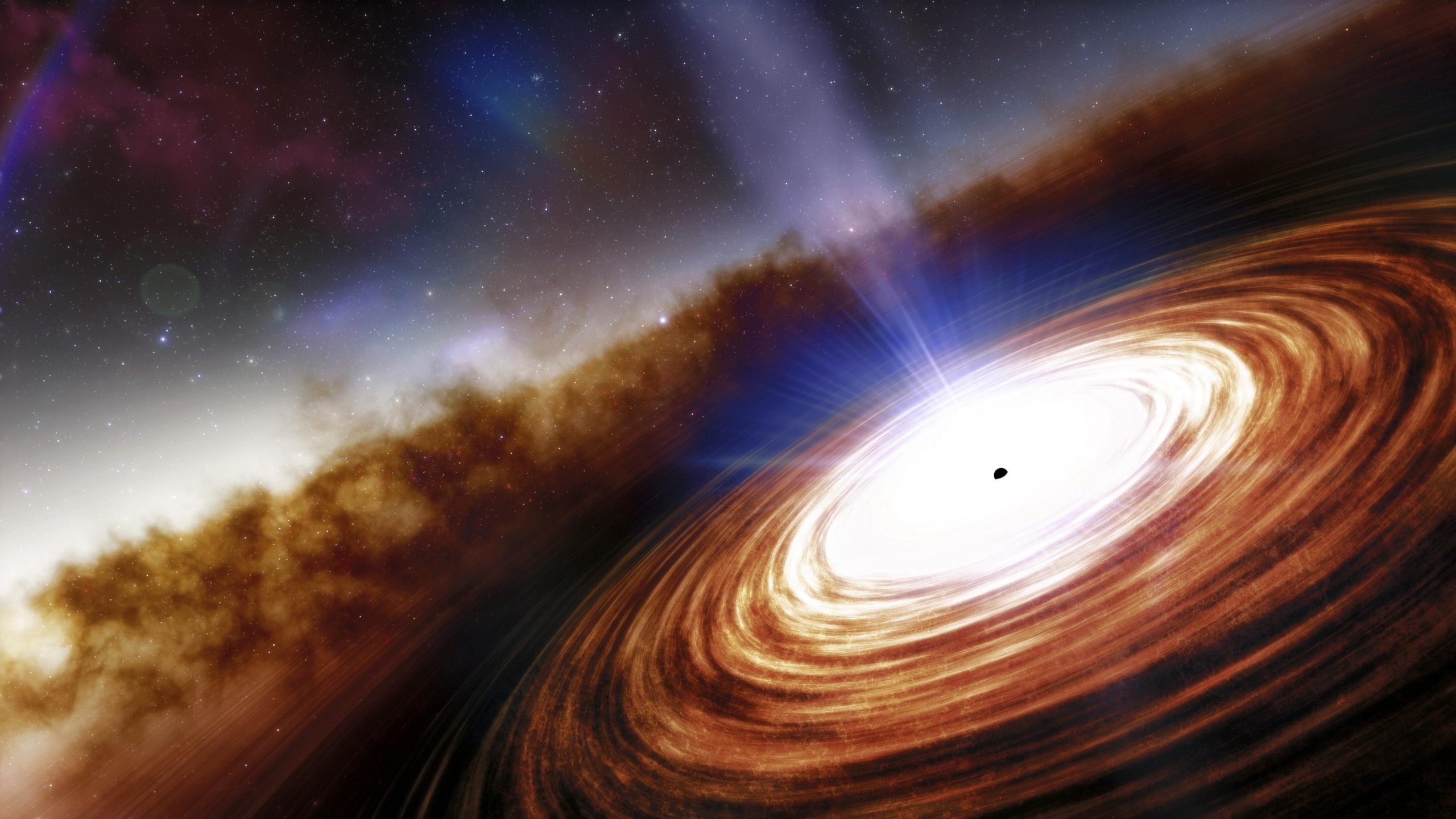
Earliest known quasar J0313-1806 reveals a massive black hole and extreme outflows shaping early galaxy evolution.
The most distant quasar known has been discovered. The quasar, observed just 670 million years after the Big Bang, is 1000 times more luminous than the Milky Way. It is powered by the earliest known supermassive black hole, which weighs in at more than 1.6 billion times the mass of the Sun. Seen more than 13 billion years ago, this fully formed distant quasar is also the earliest yet discovered, providing astronomers with insight into the formation of massive galaxies in the early Universe. The result was released at the January 2021 meeting of the American Astronomical Society.
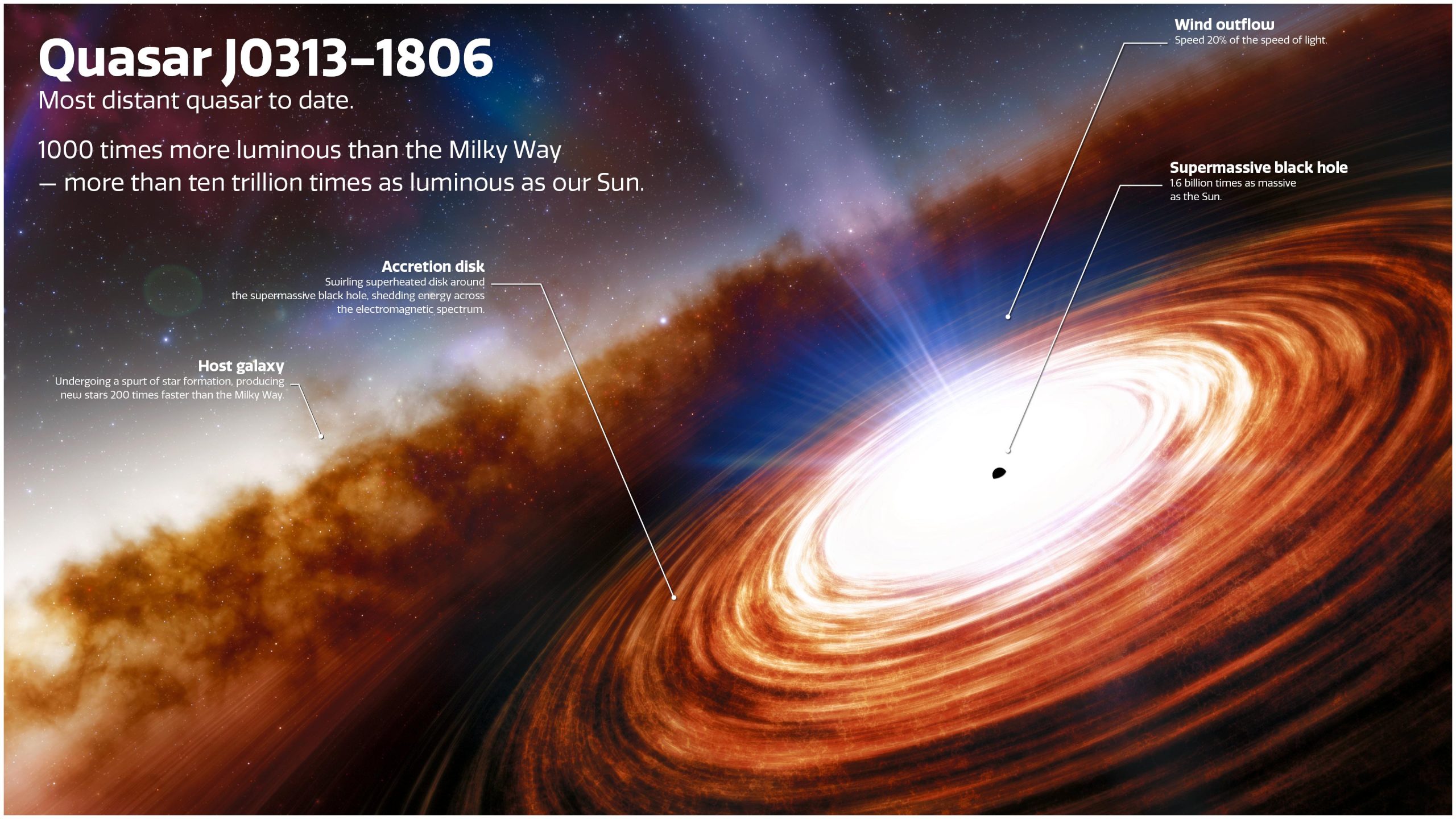
Quasars, which are powered by the feeding frenzies of colossal supermassive black holes, are the most energetic objects in the Universe. They occur when gas in the superheated accretion disk around a supermassive black hole is inexorably drawn inwards, shedding energy across the electromagnetic spectrum. The amount of electromagnetic radiation emitted by quasars is enormous, with the most massive examples easily outshining entire galaxies. Today, an international team of astronomers has announced the discovery of J0313-1806, the most distant quasar known to date.[1]
“The most distant quasars are crucial for understanding how the earliest black holes formed and for understanding cosmic reionization — the last major phase transition of our Universe,” said Xiaohui Fan, study co-author and Regents Professor of Astronomy at the University of Arizona.[2]
J0313-1806 is seen more than 13 billion years ago. As the most distant quasar known, it is also the earliest, being fully formed only about 670 million years after the Big Bang. The new quasar is more than ten trillion times as luminous as our Sun — meaning that it pours out one thousand times more energy than the entire Milky Way Galaxy. The source of this quasar’s power is a supermassive black hole 1.6 billion times as massive as the Sun — the earliest black hole currently known to exist in the Universe.[3]
The presence of such a massive black hole so early in the Universe’s history challenges theories of black hole formation as astronomers need to explain how it came into existence when it barely had the time to do so. Feige Wang, NASA Hubble fellow at the University of Arizona and lead author of the research paper, explains: “Black holes created by the very first massive stars could not have grown this large in only a few hundred million years.”
The observations that led to this discovery were made using a variety of telescopes, including three National Science Foundation NOIRLab facilities — the Víctor M. Blanco 4-meter (13-foot) Telescope at Cerro Tololo Inter-American Observatory, Gemini South, and Gemini North. Data from the Blanco Telescope, taken as part of the DESI Legacy Imaging Surveys, which are served to the astronomical community via the Astro Data Lab at NOIRLab’s Community Science and Data Center (CSDC), helped to first identify J0313-1806, while Gemini South observations were used to confirm its identity as a quasar. High-quality spectra from two Maunakea observatories in Hawai‘i — Gemini North and W. M. Keck Observatory — were used to measure the mass of the central supermassive black hole.
“The most distant quasars and earliest black holes are important markers in the history of the Universe,” said Program Director Martin Still of the National Science Foundation. “The researchers combined several of NSF’s NOIRLab facilities to make this discovery.”
As well as weighing the monster black hole, the Gemini North and Keck Observatory observations uncovered an extremely fast outflow emanating from the quasar in the form of a high-velocity wind, which is traveling at 20% of the speed of light. “The energy released by such an extreme high-velocity outflow is large enough to impact the star formation in the entire quasar host galaxy,” said Jinyi Yang, Peter A. Strittmatter postdoctoral fellow of Steward Observatory at the University of Arizona. This is the earliest known example of a quasar sculpting the growth of its host galaxy, making J0313-1806 a promising target for future observations.
The galaxy hosting J0313-1806 is undergoing a spurt of star formation, producing new stars 200 times faster than the Milky Way. The combination of this intense star formation, the luminous quasar, and the high-velocity outflow make J0313-1806 and its host galaxy a promising natural laboratory for understanding the growth of supermassive black holes and their host galaxies in the early Universe.
“This would be a great target to investigate the formation of the earliest supermassive black holes,” concluded Feige Wang. “We also hope to learn more about the effect of quasar outflows on their host galaxy — as well as to learn how the most massive galaxies formed in the early Universe.”
Notes
- At a redshift of 7.64.
- There are two phase transitions of the Universe.
- Distance and time are closely entwined in astronomy, as the light from distant objects takes time to reach observers here on Earth. We see the Sun as it was 8 minutes ago, and our latest observations of the heart of the Milky Way show it as it was over 25,000 years ago. The further astronomers look from Earth, the further back in time they see.
For more information on this study, read Most Distant Quasar Discovered Sheds Light on How Supermassive Black Holes Grow.
Reference: “A Luminous Quasar at Redshift 7.642” by Feige Wang, Jinyi Yang, Xiaohui Fan, Joseph F. Hennawi, Aaron J. Barth, Eduardo Banados, Fuyan Bian, Konstantina Boutsia, Thomas Connor, Frederick B. Davies, Roberto Decarli, Anna-Christina Eilers, Emanuele Paolo Farina, Richard Green, Linhua Jiang, Jiang-Tao Li, Chiara Mazzucchelli, Riccardo Nanni, Jan-Torge Schindler, Bram Venemans, Fabian Walter, Xue-Bing Wu and Minghao Yue, 14 January 2021, Astrophysical Journal Letters.
DOI: 10.3847/2041-8213/abd8c6
This research was presented in the paper “A Luminous Quasar at Redshift 7.642” at the 237th meeting of the American Astronomical Society. The study has been accepted in The Astrophysical Journal Letters.
The team was composed of Feige Wang (Steward Observatory, University of Arizona), Jinyi Yang (Steward Observatory, University of Arizona), Xiaohui Fan (Steward Observatory, University of Arizona), Joseph F. Hennawi (University of California, Santa Barbara and Max Planck Institute for Astronomy), Aaron J. Barth (University of California, Irvine), Eduardo Banados (Max Planck Institute for Astronomy), Fuyan Bian (European Southern Observatory), Konstantina Boutsia (European Southern Observatory), Thomas Connor (Jet Propulsion Laboratory), Frederick B. Davies (Lawrence Berkeley National Laboratory and Max Planck Institute for Astronomy), Roberto Decarl (INAF), Anna-Christina Eilers (MIT-Kavli Institute for Astrophysics and Space Research), Emanuele Paolo Farina (Max Planck Institute for Astrophysics), Richard Green (Steward Observatory, University of Arizona), Linhua Jiang (Kavli Institute for Astronomy and Astrophysics, Peking University), Jiang-Tao Li (University of Michigan), Chiara Mazzucchelli (European Southern Observatory), Riccardo Nanni (University of California, Santa Barbara), Jan-Torge Schindler (Max Planck Institute for Astronomy), Bram Venemans (Max Planck Institute for Astronomy), Fabian Walter (Max Planck Institute for Astronomy), Xue-Bing Wu (Kavli Institute for Astronomy and Astrophysics and Department of Astronomy, Peking University), Minghao Yue (Steward Observatory, University of Arizona).
Never miss a breakthrough: Join the SciTechDaily newsletter.
Follow us on Google and Google News.
1 Comment
Love the articles keep up the great works that you do. And most important thanks for listening