
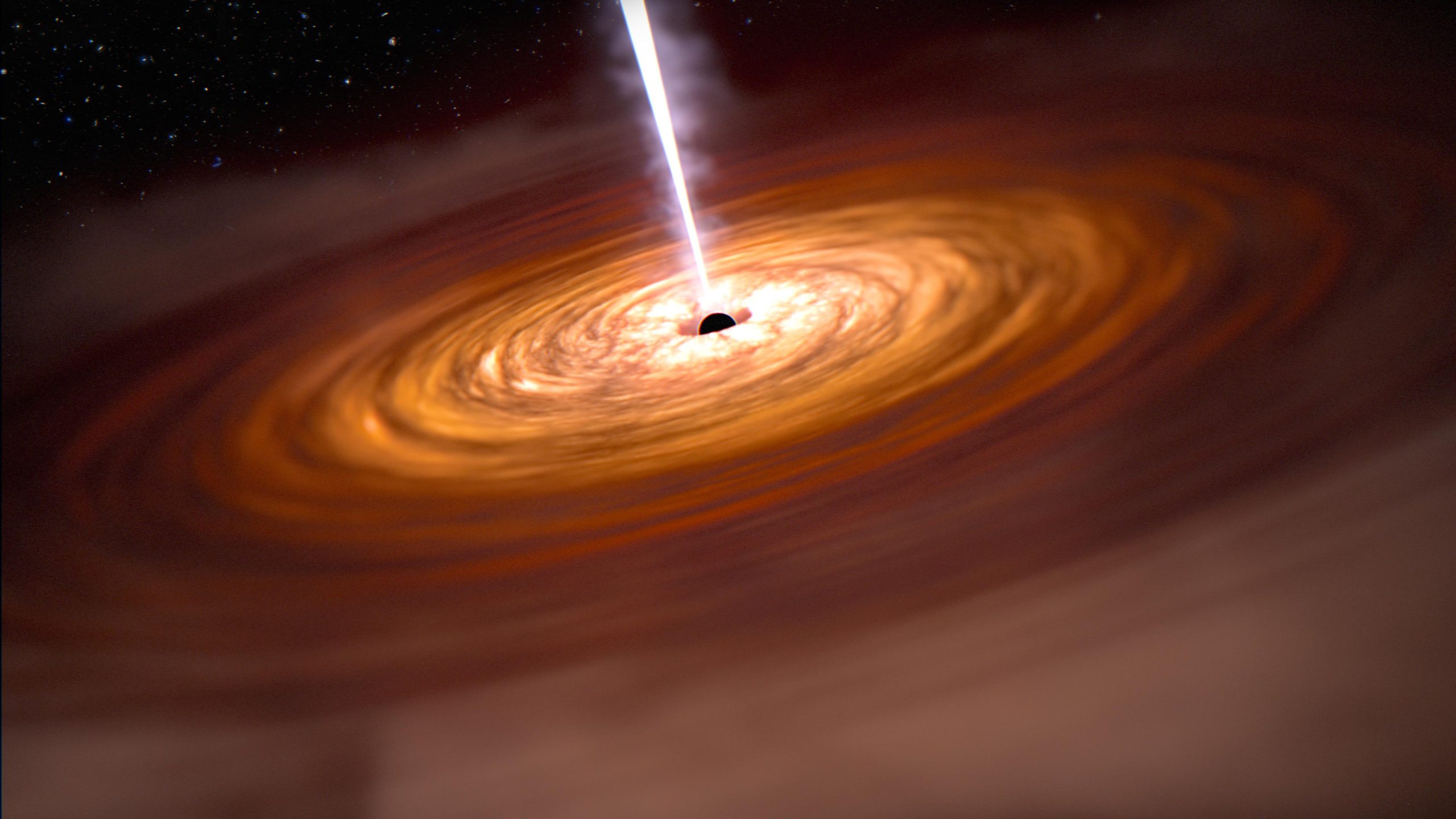
Researchers will examine three active supermassive black holes – known as quasars – their host galaxies, and their neighborhoods to better detail these distant objects and the conditions of the early universe
When astronomers discovered point-like objects in all-sky radio surveys in the 1950s, they weren’t sure how to categorize them. Were they stars, galaxies – or something else altogether? A great new field of exploration opened. These quasi-stellar radio sources became known as quasars, and today we better appreciate how fascinating they truly are: Quasars are active supermassive black holes that reveal themselves through their light shows. Gas and dust orbit these supermassive black holes continuously rubbing together to create heat and light, which we can detect.
The three most distant quasars currently known were discovered since 2018 – each located more than 13 billion light-years away. The James Webb Space Telescope will offer researchers new views of these objects in high-resolution infrared light. With these powerful data, a research team aims to refine the calculations of the masses of their black holes, detail the stars in their host galaxies, and survey the galaxies in their neighborhoods. What’s more, their research may influence how we view this early era of the universe.
Scouting Ancient Supermassive Black Holes With NASA’s Webb
Very distant, active supermassive black holes are the brightest beacons in the universe. Known as quasars, these behemoths are surrounded by equally distant galaxies. In recent decades, researchers have gone on a cosmic treasure hunt and identified the three most distant quasars known over the last three years – each more than 13 billion light-years from Earth. Astronomers theorize that it can take billions of years for supermassive black holes and their accompanying galaxies to form. How is it possible that these quasars became so gigantic, with billions of solar masses, in the first 700 million years of the universe? Once you can see past their glare, what do their accompanying galaxies look like? And what do their “neighborhoods” look like?
These are questions Xiaohui Fan and Jinyi Yang, both of the University of Arizona, and Eduardo Bañados, of the Max Planck Institute for Astronomy in Heidelberg, Germany, with an international team of astronomers, will pursue with observations taken by the James Webb Space Telescope. “These are really valuable objects,” Fan said. “We structured this program to learn everything we could think of so our team and the greater astronomical community can fully explore these quasars.”
Webb’s sensitivity to infrared light – including mid-infrared wavelengths that can only be captured from space – will allow the team to observe these objects, whose light has traveled for 13 billion years and has had its wavelengths stretched from ultraviolet and visible light into infrared light. Webb has unmatched sensitivity and spatial resolution, which will reveal complex structures in these distant objects.
The team plans to observe and analyze the data on three scales: closely examining the quasars themselves, studying the stars in the surrounding host galaxies after removing the quasars’ light, and classifying the galaxies that lie nearby. “These quasars are very special objects,” explained Bañados. “That is why we want to provide the best characterization possible of each with Webb.”
‘Zooming’ In – and Out
Fan, Yang, and Bañados are wasting no opportunity: They will use almost every available instrument on Webb to observe these quasars. First, they will refine the measurements of the mass of each supermassive black hole. “The existence of these black holes challenges theoretical models,” Yang said. “We want to obtain more accurate measurements of their masses to improve our understanding of how they formed and grew so quickly.”
To increase the precision of existing measurements from other observatories, they’ll turn to spectra – data that detail an object’s physical properties, including mass and chemical composition, delivered by Webb’s Near-Infrared Spectrograph (NIRSpec). This will allow the team to produce more accurate black hole masses.
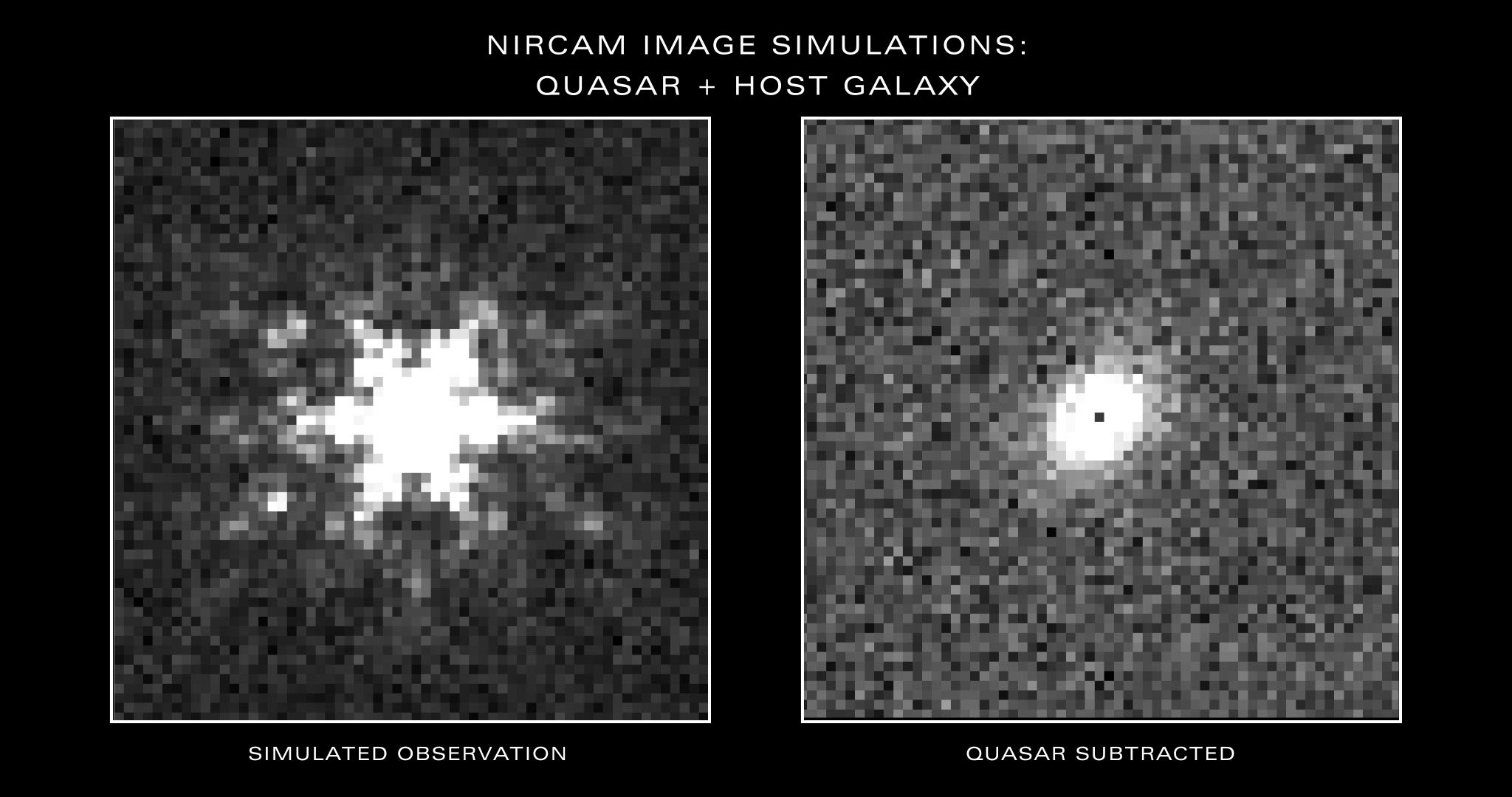
Next, they will focus on revealing the galaxies behind the quasars’ bright light. They will take very deep, detailed images of each target with Webb’s Near-Infrared Camera (NIRCam) and then use computer models to remove the quasars’ light from each. The final, processed images will give them the first views of the light from the stars in the host galaxies. The team will also obtain spectra with Webb’s Mid-Infrared Instrument (MIRI). No one can fully predict what they’ll learn. Were these ancient galaxies more compact? Do their stars contain more than hydrogen and helium? Webb will certainly yield new insights!
The team will also obtain spectra of both the quasars and their host galaxies to trace how gas is moving in the host galaxies and determine if the active supermassive black holes are sending out hot winds that heat the galaxies’ gas. Although no one can watch a complete feedback loop in real time (it takes millions of years!), they can sample what’s present with NIRSpec and begin to observe the connections between the quasars and their host galaxies.
They will also “zoom out” to see galaxies near these quasars. Webb’s expansive, high-resolution observations will help the team characterize the galaxies that are in the neighborhood by employing Webb’s Near-Infrared Imager and Slitless Spectrograph (NIRISS) and NIRCam.
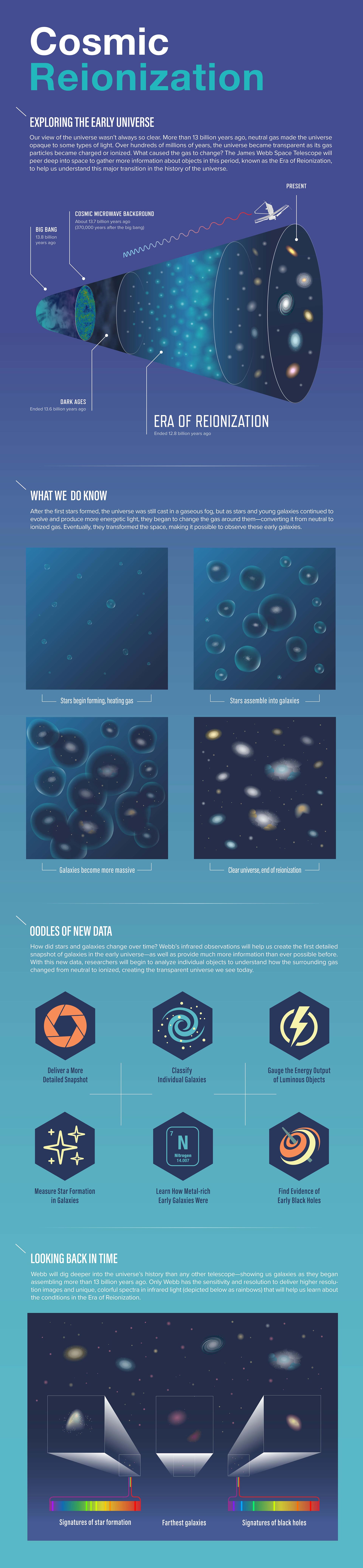
Finally, the researchers will also sample the large-scale environments around the quasars – the characteristics of the gas and dust. What was the universe like 700 or 800 million years after the Big Bang? This was a period known as the Era of Reionization (see image above), when the gas between galaxies was largely opaque. Only after the first billion years of the universe did the gas become fully transparent, allowing light to travel more easily. The team will measure everything that is between us and the quasars with NIRSpec. “We know that these quasars exist when the universe was about fifty percent neutral,” Bañados explained. “These targets represent an important age of the universe – essentially the peak of this transition. Webb will provide new constraints about what this period was like.”
Fan, Yang, and Bañados will share the riches of this thorough observation program by releasing data and tools to the astronomical community to accelerate overall research of quasars in the early universe. “Webb will help us make the next quantum leap in understanding these objects,” said Fan.
This research will be conducted as part of Webb’s General Observer (GO) programs, which are competitively selected using a dual-anonymous review system, the same system that is used to allocate time on the Hubble Space Telescope.
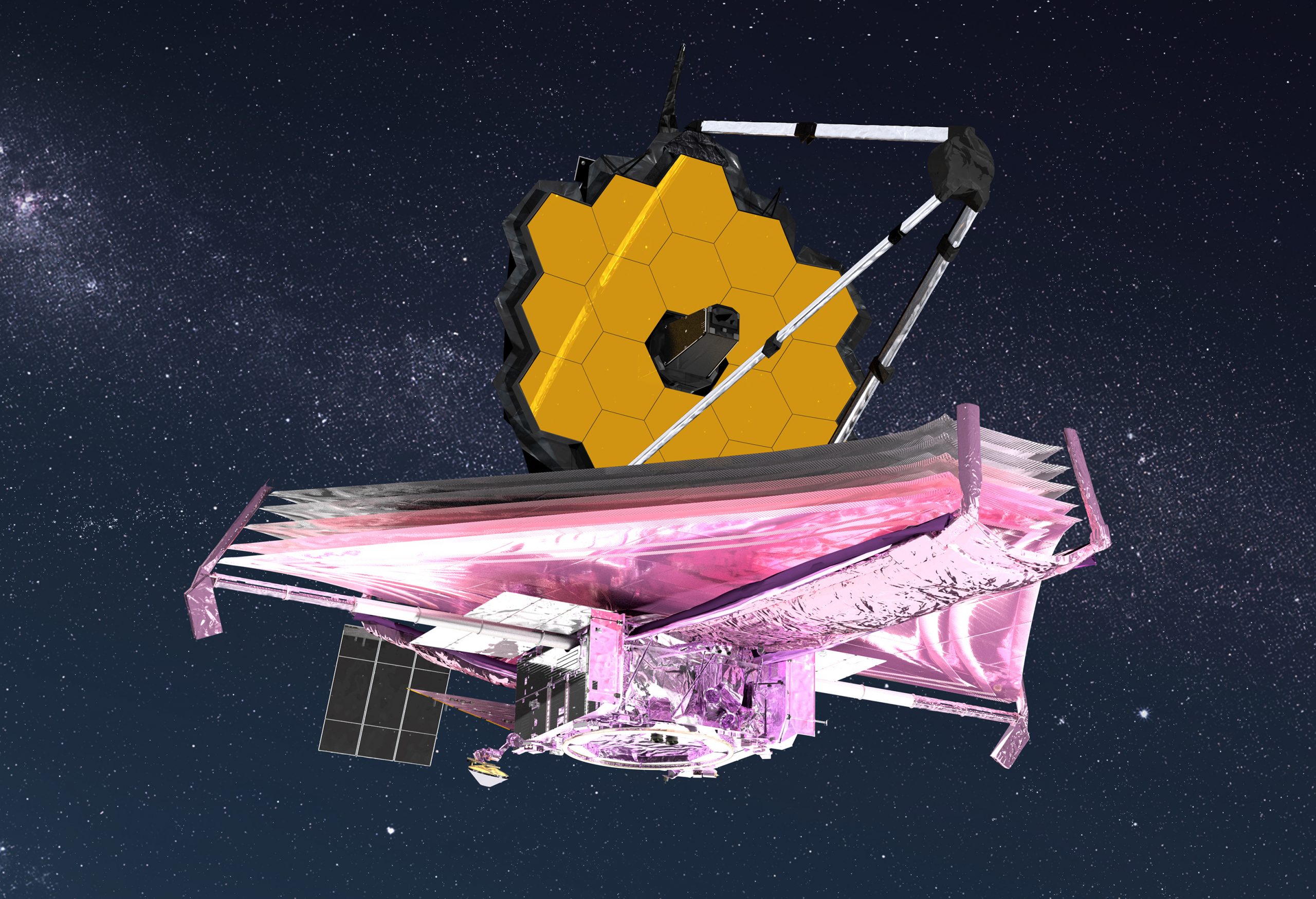
The James Webb Space Telescope will be the world’s premier space science observatory when it launches in 2021. Webb will solve mysteries in our solar system, look beyond to distant worlds around other stars, and probe the mysterious structures and origins of our universe and our place in it. Webb is an international program led by NASA with its partners, ESA (European Space Agency) and the Canadian Space Agency.
Never miss a breakthrough: Join the SciTechDaily newsletter.
Follow us on Google and Google News.
1 Comment
What is the best way to get to know that what’s going to