
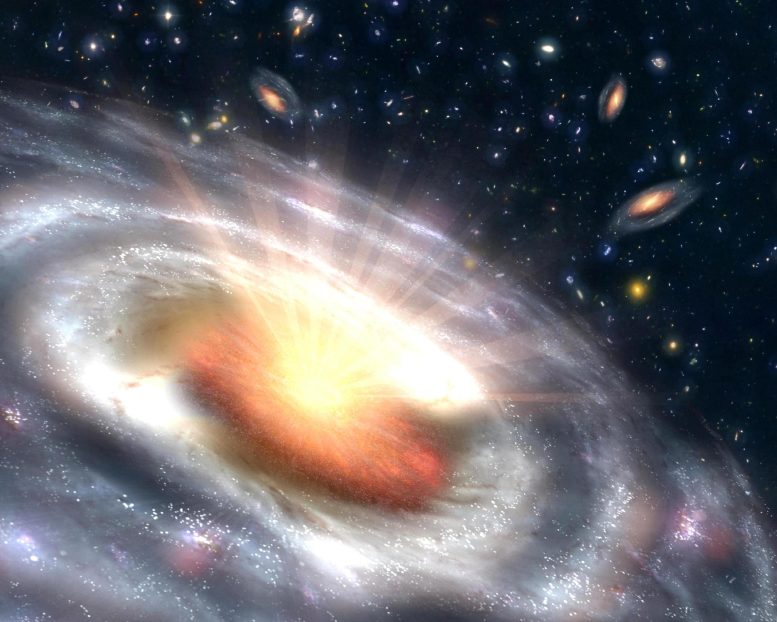
New Discovery Sheds Light on Very Early Supermassive Black Holes
Astronomers from the University of Texas and the University of Arizona have discovered a rapidly growing black hole in one of the most extreme galaxies known in the very early Universe. The discovery of the galaxy and the black hole at its center provides new clues on the formation of the very first supermassive black holes. The new work is published in Monthly Notices of the Royal Astronomical Society.
Using observations taken with the Atacama Large Millimeter Array (ALMA), a radio observatory sited in Chile, the team have determined that the galaxy, named COS-87259, containing this new supermassive black hole is very extreme, forming stars at a rate 1000 times that of our own Milky Way and containing over a billion solar masses worth of interstellar dust. The galaxy shines bright from both this intense burst of star formation and the growing supermassive black hole at its center.
The black hole is considered to be a new type of primordial black hole – one heavily enshrouded by cosmic “dust,” causing nearly all of its light to be emitted in the mid-infrared range of the electromagnetic spectrum. The researchers have also found that this growing supermassive black hole (frequently referred to as an active galactic nucleus) is generating a strong jet of material moving at near light speed through the host galaxy.
Insights into Early Supermassive Black Holes
Today, black holes with masses millions to billions of times greater than that of our own Sun sit at the center of nearly every galaxy. How these supermassive black holes first formed remains a mystery for scientists, particularly because several of these objects have been found when the Universe was very young. Because the light from these sources takes so long to reach us, we see them as they existed in the past; in this case, just 750 million years after the Big Bang, which is approximately 5% of the current age of the Universe.
What is particularly astonishing about this new object is that it was identified over a relatively small patch of the sky typically used to detect similar objects – less than 10 times the size of the full moon – suggesting there could be thousands of similar sources in the very early Universe. This was completely unexpected from previous data.
The only other class of supermassive black holes we knew about in the very early Universe are quasars, which are active black holes that are relatively unobscured by cosmic dust. These quasars are extremely rare at distances similar to COS-87259, with only a few tens located over the full sky. The surprising discovery of COS-87259 and its black hole raises several questions about the abundance of very early supermassive black holes, as well as the types of galaxies in which they typically form.
Ryan Endsley, the lead author of the paper and now a Postdoctoral Fellow at The University of Texas at Austin, says “These results suggest that very early supermassive black holes were often heavily obscured by dust, perhaps as a consequence of the intense star formation activity in their host galaxies. This is something others have been predicting for a few years now, and it’s really nice to see the first direct observational evidence supporting this scenario.”
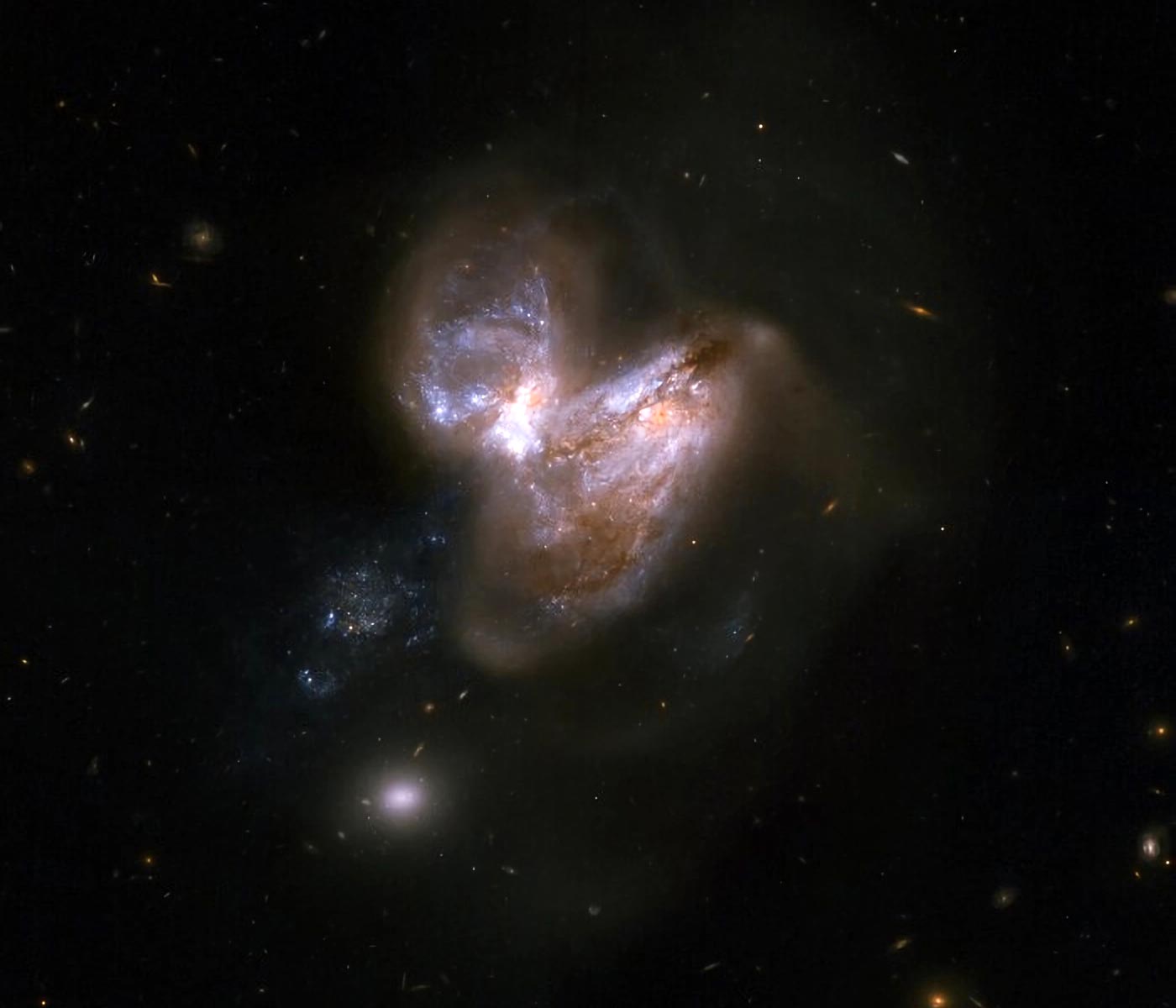
Similar types of objects have been found in the more local, present-day Universe, such as Arp 299 shown above. In this system, two galaxies are crashing together generating an intense starburst as well as heavy obscuration of the growing supermassive black hole in one of the two galaxies.
Endsley adds, “While nobody expected to find this kind of object in the very early Universe, its discovery takes a step towards building a much better understanding of how billion solar mass black holes were able to form so early on in the lifetime of the Universe, as well how the most massive galaxies first evolved.”
Reference: “ALMA confirmation of an obscured hyperluminous radio-loud AGN at z = 6.853 associated with a dusty starburst in the 1.5 deg2 COSMOS field” by Ryan Endsley, Daniel P Stark, Jianwei Lyu, Feige Wang, Jinyi Yang, Xiaohui Fan, Renske Smit, Rychard Bouwens, Kevin Hainline and Sander Schouws, 24 February 2023, Monthly Notices of the Royal Astronomical Society.
DOI: 10.1093/mnras/stad266
Never miss a breakthrough: Join the SciTechDaily newsletter.
Follow us on Google and Google News.
4 Comments
Where is God in all this? In Genesis1:1 He claims He created the universe. So according to Him, No big bang was involved.
This article has some questions that need answers. The last I heard was that the only stars visible to our telescopes, including Hubble, were in the Milky Way and Andromeda. All the other galaxies are just too darn far away to distinguish individual stars. But now we’re talking about new start (and gas, no less) in galaxies in the early universe!
Ever wonder why (and how) supermassive Black Holes expel jets of anything rather than sucking them in? One view of String Theory suggests that active galaxies, including radio galaxies, Seyfert galaxies, and Quasars, may be explained with branes (dimensional membranes) at their centers rather than Black Holes. This view also explains those curious low surface brightness galaxies like Malin 1. Specifics on this can be found by searching YouTube for “Active Galaxies – A String Theory Way”
… the dark days of the dark matter!
… ahead!