
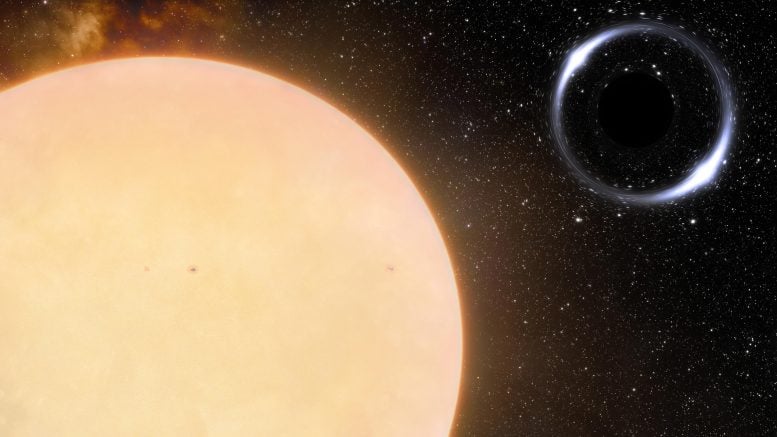
Gemini North telescope on Hawai‘i reveals the first dormant, stellar-mass black hole in our cosmic backyard.
Using the International Gemini Observatory, astronomers have discovered the closest-known black hole to Earth. This is the first unambiguous detection of a dormant stellar-mass black hole in the Milky Way. Located a mere 1600 light-years away, its close proximity to Earth offers an intriguing target of study to advance our understanding of the evolution of binary systems.
“Take the Solar System, put a black hole where the Sun is, and the Sun where the Earth is, and you get this system.” Kareem El-Badry
Black holes are the most extreme objects in the Universe. It is believed that supermassive versions of these unimaginably dense objects reside at the centers of all large galaxies. Stellar-mass black holes — which weigh approximately five to 100 times the mass of the Sun — are much more common. In fact, there are an estimated 100 million stellar-mass black holes in the Milky Way alone. However, only a handful have been confirmed to date, and nearly all of these are ‘active’. This means that they shine brightly in X-rays as they consume material from a nearby stellar companion, unlike dormant black holes which do not.
Astronomers have now discovered the closest black hole to Earth, which the researchers have dubbed Gaia BH1. To find it, they used the Gemini North telescope in Hawai‘i, one of the twin telescopes of the International Gemini Observatory, operated by NSF’s NOIRLab.
Gaia BH1 is a dormant black hole that is about 10 times more massive than the Sun and is located about 1600 light-years away in the constellation Ophiuchus. This means it is three times closer to Earth than the previous record holder, an X-ray binary in the constellation of Monoceros. The new discovery was made possible by making exquisite observations of the motion of the black hole’s companion, a Sun-like star that orbits the black hole at about the same distance as the Earth orbits the Sun.
This animation shows a Sun-like star orbiting Gaia BH1, the closest black hole to Earth, located about 1600 light-years away. Observations by Gemini North, one of the twin telescopes of the International Gemini Observatory, operated by NSF’s NOIRLab, were crucial to constraining the orbital motion and hence masses of the two components in the binary system, allowing the team to identify the central body as a black hole roughly 10 times as massive as our Sun. Credit: T. Müller (MPIA), PanSTARRS DR1 (K. C. Chambers et al. 2016), ESA/Gaia/DPAC
Unique Detection Method for Dormant Black Holes
“Take the Solar System, put a black hole where the Sun is, and the Sun where the Earth is, and you get this system,” explained Kareem El-Badry, an astrophysicist at the Center for Astrophysics | Harvard & Smithsonian and the Max Planck Institute for Astronomy, and the lead author of the paper describing this discovery that was published on November 2 in Monthly Notices of the Royal Astronomical Society.
“While there have been many claimed detections of systems like this, almost all these discoveries have subsequently been refuted. This is the first unambiguous detection of a Sun-like star in a wide orbit around a stellar-mass black hole in our Galaxy.”
Though there are likely millions of stellar-mass black holes roaming the Milky Way Galaxy, those few that have been detected were uncovered by their energetic interactions with a companion star. As material from a nearby star spirals in toward the black hole, it becomes superheated and generates powerful X-rays and jets of material. If a black hole is not actively feeding (i.e., it is dormant) it simply blends in with its surroundings.
“I’ve been searching for dormant black holes for the last four years using a wide range of datasets and methods,” said El-Badry. “My previous attempts — as well as those of others — turned up a menagerie of binary systems that masquerade as black holes, but this is the first time the search has borne fruit.”
“While this potentially augurs future discoveries of the predicted dormant black hole population in our Galaxy, the observations also leave a mystery to be solved — despite a shared history with its exotic neighbor, why is the companion star in this binary system so normal?” Martin Still
Detecting Gaia BH1 with Gaia and Gemini Observations
The team originally identified the system as potentially hosting a black hole by analyzing data from the European Space Agency’s Gaia spacecraft. Gaia captured the minute irregularities in the star’s motion caused by the gravity of an unseen massive object. To explore the system in more detail, El-Badry and his team turned to the Gemini Multi-Object Spectrograph instrument on Gemini North, which measured the velocity of the companion star as it orbited the black hole and provided precise measurement of its orbital period. The Gemini follow-up observations were crucial to constraining the orbital motion and hence masses of the two components in the binary system, allowing the team to identify the central body as a black hole roughly 10 times as massive as our Sun.
“Our Gemini follow-up observations confirmed beyond reasonable doubt that the binary contains a normal star and at least one dormant black hole,” elaborated El-Badry. “We could find no plausible astrophysical scenario that can explain the observed orbit of the system that doesn’t involve at least one black hole.”
The team relied not only on Gemini North’s superb observational capabilities but also on Gemini’s ability to provide data on a tight deadline, as the team had only a short window in which to perform their follow-up observations.
“When we had the first indications that the system contained a black hole, we only had one week before the two objects were at the closest separation in their orbits. Measurements at this point are essential to make accurate mass estimates in a binary system,” said El-Badry. “Gemini’s ability to provide observations on a short timescale was critical to the project’s success. If we’d missed that narrow window, we would have had to wait another year.”
Puzzling Evolution of Gaia BH1 System
Astronomers’ current models of the evolution of binary systems are hard-pressed to explain how the peculiar configuration of Gaia BH1 system could have arisen. Specifically, the progenitor star that later turned into the newly detected black hole would have been at least 20 times as massive as our Sun. This means it would have lived only a few million years. If both stars formed at the same time, this massive star would have quickly turned into a supergiant, puffing up and engulfing the other star before it had time to become a proper, hydrogen-burning, main-sequence star like our Sun.
It is not at all clear how the solar-mass star could have survived that episode, ending up as an apparently normal star, as the observations of the black hole binary indicate. Theoretical models that do allow for survival all predict that the solar-mass star should have ended up on a much tighter orbit than what is actually observed.
This could indicate that there are important gaps in our understanding of how black holes form and evolve in binary systems, and also suggests the existence of an as-yet-unexplored population of dormant black holes in binaries.
“It is interesting that this system is not easily accommodated by standard binary evolution models,” concluded El-Badry. “It poses many questions about how this binary system was formed, as well as how many of these dormant black holes there are out there.”
“As part of a network of space- and ground-based observatories, Gemini North has not only provided strong evidence for the nearest black hole to date but also the first pristine black hole system, uncluttered by the usual hot gas interacting with the black hole,” said NSF Gemini Program Officer Martin Still. “While this potentially augurs future discoveries of the predicted dormant black hole population in our Galaxy, the observations also leave a mystery to be solved — despite a shared history with its exotic neighbor, why is the companion star in this binary system so normal?”
Reference: “A Sun-like star orbiting a black hole” by Kareem El-Badry, Hans-Walter Rix, Eliot Quataert, Andrew W Howard, Howard Isaacson, Jim Fuller, Keith Hawkins, Katelyn Breivik, Kaze W K Wong, Antonio C Rodriguez, Charlie Conroy, Sahar Shahaf, Tsevi Mazeh, Frédéric Arenou, Kevin B Burdge, Dolev Bashi, Simchon Faigler, Daniel R Weisz, Rhys Seeburger, Silvia Almada Monter and Jennifer Wojno, 2 November 2022, Monthly Notices of the Royal Astronomical Society.
DOI: 10.1093/mnras/stac3140
Gemini North observations were made as part of a director’s discretionary time program (program id: GN-2022B-DD-202).
The International Gemini Observatory is operated by a partnership of six countries, including the United States through the National Science Foundation, Canada through the National Research Council of Canada, Chile through the Agencia Nacional de Investigación y Desarrollo, Brazil through the Ministério da Ciência, Tecnologia e Inovações, Argentina through the Ministerio de Ciencia, Tecnología e Innovación, and Korea through the Korea Astronomy and Space Science Institute. These Participants and the University of Hawaii, which has regular access to Gemini, each maintain a “National Gemini Office” to support their local users.
Never miss a breakthrough: Join the SciTechDaily newsletter.
Follow us on Google and Google News.
2 Comments
Heaven is on the other side and through that black hole want to go see i;ll wait for your return
I am a Ordained Minister & Spiritually Sensitive Counselor. I was:
Driving from Kansas City to Lincoln Nebraska
I heard, look I turned my head to the left & witnessed a Black Hole opening up,
and like a Baseball throne there was a Meteor real, bright like a Star,came up out of the Black Hole Flipped Over & turned into a Cascade of Stars…
Getting to the Holiday Inn in Lincoln Nebraska
I Shared This With Everyone There, They All Thanked Me for Sharing it & had Wonderful Things Happen for Quite Some Time!!!