

Close Menu
    Facebook X (Twitter) Instagram
    SciTechDaily
    • Biology
    • Chemistry
    • Earth
    • Health
    • Physics
    • Science
    • Space
    • Technology
    Facebook X (Twitter) Pinterest YouTube RSS
    SciTechDaily
    Home»Space»NASA’s Kepler Mission Discovers 11 New Extrasolar Systems with 26 Exoplanets
    Space

    NASA’s Kepler Mission Discovers 11 New Extrasolar Systems with 26 Exoplanets

    By SciTechDailyJanuary 26, 20121 Comment2 Mins Read
    Facebook Twitter Pinterest Telegram LinkedIn WhatsApp Email Reddit
    Share
    Facebook Twitter LinkedIn Pinterest Telegram Email Reddit
    extra-solar-planet
    NASA’s Kepler mission has found 11 new planetary systems and confirmed 26 more planets, doubling the number of verified Kepler planets and tripling the stars known to have multiple planets.

    NASA’s Kepler mission has discovered 11 new planetary systems, with an additional 26 confirmed planets, which actually doubles the number of verified Kepler planets and triples the number of stars known to have more than one planet. It’s hoped that such systems might elucidate how planets are formed.

    The newly discovered planets, that range in size from 1.5 times the radius of Earth to larger than Jupiter, will need to be observed further to determine which are rocky, Earth-like planets and which have thick, gaseous atmospheres like Neptune. Fifteen are between the Earth and Neptune in size. Their orbits around their stars vary from 6 to 143 days. All of the planets are closer to their star than Venus is to Sol.
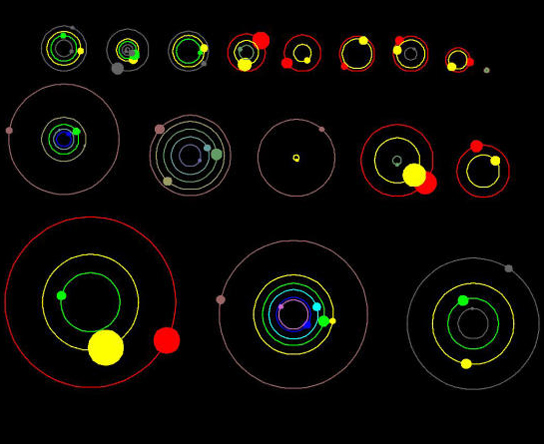
    extra-solar-planet-orbit

    Prior to the Kepler mission, astronomers knew of about 500 exoplanets across the whole sky. In two years, while observing a small patch of sky, no bigger than a fist, Kepler discovered more than 60 planets and more than 2,300 candidates. This could mean that the galaxy is loaded with planets of all sizes and orbits.

    Kepler identifies potential planet candidates by repeatedly measuring the change in brightness of more than 150,000 stars to detect when a planet passes in front of its host star. This passage creates a shadow toward Earth and the Kepler spacecraft.

    Confirming this takes additional observations and time-consuming analysis. The new planets were confirmed using new techniques. Kepler detected the gravitational pull of the planets on each other, in tightly packed planetary systems, which causes some planets to accelerate and others to decelerate. This is called Transit Timing Variations (TTVs).

    Planetary systems with TTVs can be quickly verified without extensive observations. Kepler-33, an older star that’s more massive than Sol, had the most planets. The discoveries were published in four different papers in the Astrophysics Journal and the Monthly Notices of the Royal Astronomical Society.

    Never miss a breakthrough: Join the SciTechDaily newsletter.
    Follow us on Google and Google News.

    Astronomy Astrophysics Exoplanet Kepler Space Telescope NASA
    Share. Facebook Twitter Pinterest LinkedIn Email Reddit

    Related Articles

    Cosmic Vanishing Acts: NASA Unraveling the Mystery of Shrinking Exoplanets

    Jupiter’s Twin: NASA’s Kepler Space Telescope Delivers New Planetary Discovery From the Grave

    Kepler Discovers Bigger, Older Cousin to Earth

    Kepler Discovers Earth-Size Planet Orbiting a Star in the ‘Habitable Zone’

    Kepler Data Reveal the Discovery of 833 New Candidate Planets

    Scientists Detected Exoplanetary System With Regularly Aligned Orbits Similar to Our Solar System

    NASA Data Reveals Significant Changes in Exoplanet’s Atmosphere

    Astronomers Obtain Precise Measurements of the Two Kepler-16 Stars

    Three Earthlike Planets Could be Hospitable to Life

    Leave A Reply Cancel Reply

    • Facebook
    • Twitter
    • Pinterest
    • YouTube

    Don't Miss a Discovery

    Subscribe for the Latest in Science & Tech!

    Trending News

    Bone-Strengthening Discovery Could Reverse Osteoporosis

    Scientists Uncover Hidden Trigger Behind Stem Cell Aging

    Scientists Find Way to Reverse Fatty Liver Disease Without Changing Diet

    Could Humans Regrow Limbs? New Study Reveals Promising Genetic Pathway

    Scientists Reveal Eating Fruits and Vegetables May Increase Your Risk of Lung Cancer

    Scientists Reverse Brain Aging With Simple Nasal Spray

    Scientists Uncover Potential Brain Risks of Popular Fish Oil Supplements

    Scientists Discover a Surprising Way To Make Bread Healthier and More Nutritious

    Follow SciTechDaily
    • Facebook
    • Twitter
    • YouTube
    • Pinterest
    • Newsletter
    • RSS
    SciTech News
    • Biology News
    • Chemistry News
    • Earth News
    • Health News
    • Physics News
    • Science News
    • Space News
    • Technology News
    Recent Posts
    • Alzheimer’s Symptoms May Start Outside the Brain, Study Finds
    • Cancer’s Secret Weapon? Scientists Reveal How Tumors “Learn” To Survive Treatment
    • Millions Take This Popular Supplement – Scientists Discover a Concerning Link to Heart Failure
    • What Makes Rubber So Strong? Scientists Finally Solve 100-Year-Old Mystery
    • Scientists Decode Mysterious Magnetic “Maze Domains” To Boost EV Efficiency
    Copyright © 1998 - 2026 SciTechDaily. All Rights Reserved.
    • Science News
    • About
    • Contact
    • Editorial Board
    • Privacy Policy
    • Terms of Use

    Type above and press Enter to search. Press Esc to cancel.