
Close Menu
    Facebook X (Twitter) Instagram
    SciTechDaily
    • Biology
    • Chemistry
    • Earth
    • Health
    • Physics
    • Science
    • Space
    • Technology
    Facebook X (Twitter) Pinterest YouTube RSS
    SciTechDaily
    Home»Space»Curiosity Rover Image Confirms First Drilled Mars Rock Sample
    Space

    Curiosity Rover Image Confirms First Drilled Mars Rock Sample

    By Guy Webster, Jet Propulsion LaboratoryFebruary 21, 2013No Comments4 Mins Read
    Facebook Twitter Pinterest Telegram LinkedIn WhatsApp Email Reddit
    Share
    Facebook Twitter LinkedIn Pinterest Telegram Email Reddit
    Curiosity Confirms First Drilled Mars Rock Sample
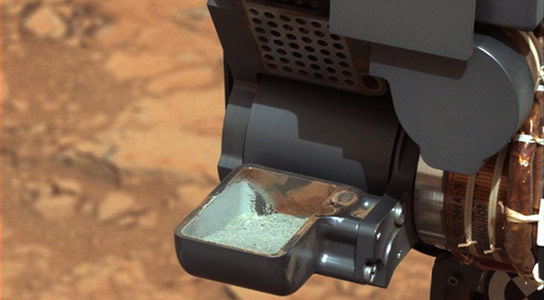
    This image from NASA’s Curiosity rover shows the first sample of powdered rock extracted by the rover’s drill. The image was taken after the sample was transferred from the drill to the rover’s scoop. In planned subsequent steps, the sample will be sieved, and portions of it delivered to the Chemistry and Mineralogy instrument and the Sample Analysis at Mars instrument. The scoop is 1.8 inches (4.5 centimeters) wide. The image was obtained by Curiosity’s Mast Camera on February 20, or Sol 193, Curiosity’s 193rd Martian day of operations. The image has been white-balanced to show what the sample would look like if it were on Earth. A raw-color version is also available. Credit: NASA/JPL-Caltech/MSSS

    New images from NASA’s Curiosity rover confirm that it has successfully drilled and collected the first-ever rock sample from the interior of a rock on another planet.

    NASA’s Mars rover Curiosity has relayed new images that confirm it has successfully obtained the first sample ever collected from the interior of a rock on another planet. No rover has ever drilled into a rock beyond Earth and collected a sample from its interior.

    Transfer of the powdered rock sample into an open scoop was visible for the first time in images received Wednesday at NASA’s Jet Propulsion Laboratory in Pasadena, California.

    “Seeing the powder from the drill in the scoop allows us to verify for the first time the drill collected a sample as it bore into the rock,” said JPL’s Scott McCloskey, drill systems engineer for Curiosity. “Many of us have been working toward this day for years. Getting final confirmation of successful drilling is incredibly gratifying. For the sampling team, this is the equivalent of the landing team going crazy after the successful touchdown.”

    The drill on Curiosity’s robotic arm took in the powder as it bored a 2.5-inch (6.4-centimeter) hole into a target on flat Martian bedrock on February 8. The rover team plans to have Curiosity sieve the sample and deliver portions of it to analytical instruments inside the rover.

    The scoop now holding the precious sample is part of Curiosity’s Collection and Handling for In-Situ Martian Rock Analysis (CHIMRA) device. During the next steps of processing, the powder will be enclosed inside CHIMRA and shaken once or twice over a sieve that screens out particles larger than 0.006 inches (150 microns) across.

    Small portions of the sieved sample later will be delivered through inlet ports on top of the rover deck into the Chemistry and Mineralogy (CheMin) instrument and Sample Analysis at Mars (SAM) instrument.

    In response to information gained during testing at JPL, the processing and delivery plan has been adjusted to reduce the use of mechanical vibration. The 150-micron screen in one of the two test versions of CHIMRA became partially detached after extensive use, although it remained usable. The team has added precautions for use of Curiosity’s sampling system while continuing to study the cause and ramifications of the separation.

    The sample comes from a fine-grained, veiny sedimentary rock called “John Klein,” named in memory of a Mars Science Laboratory deputy project manager who died in 2011. The rock was selected for the first sample drilling because it may hold evidence of wet environmental conditions long ago. The rover’s laboratory analysis of the powder may provide information about those conditions.

    NASA’s Mars Science Laboratory Project is using the Curiosity rover with its 10 science instruments to investigate whether an area within Mars’ Gale Crater ever has offered an environment favorable for microbial life. JPL, a division of the California Institute of Technology, Pasadena, manages the project for NASA’s Science Mission Directorate in Washington.

    Never miss a breakthrough: Join the SciTechDaily newsletter.
    Follow us on Google and Google News.

    Astronomy Curiosity Rover Mars NASA Planetary Science
    Share. Facebook Twitter Pinterest LinkedIn Email Reddit

    Related Articles

    Mineralogy of Martian Soil Is Similar to Soils of Volcanic Origin in Hawaii

    Curiosity Rover Photographs Diverse Rocks

    Curiosity Prepares to Take Its First Scoop of Soil for Analysis

    Curiosity Finds Ancient Streambed on Mars

    NASA’s Curiosity Prepares for Use of Its Arm and Tools

    Curiosity Sends Back Radioed Words and New Telephoto View of Mars

    NASA’s Curiosity Readies for First Drive on Mars

    Color HiRISE Image of Curiosity Rover on Mars

    First 360-Degree Color Panorama From NASA’s Curiosity Mars Rover

    Leave A Reply Cancel Reply

    • Facebook
    • Twitter
    • Pinterest
    • YouTube

    Don't Miss a Discovery

    Subscribe for the Latest in Science & Tech!

    Trending News

    Could Low Vitamin D Be Making Your Pain Worse?

    Scientists Discover Once-Weekly Workout That Melts Belly Fat Surprisingly Effectively

    Scientists Just Tested a Thruster Powerful Enough for Human Missions to Mars

    Doctors Say Your Ice Pack Might Be Making Injuries Worse

    Scientists Discover 43-Foot Sea Reptile Twice the Size of a Great White Shark

    Bees and Birds Are Drinking Alcohol From Flowers

    Scientists Discover How Obesity May Trigger Alzheimer’s Disease

    Scientists Confirm Alcohol Causes Widespread Health Damage

    Follow SciTechDaily
    • Facebook
    • Twitter
    • YouTube
    • Pinterest
    • Newsletter
    • RSS
    SciTech News
    • Biology News
    • Chemistry News
    • Earth News
    • Health News
    • Physics News
    • Science News
    • Space News
    • Technology News
    Recent Posts
    • Ancient Goose Fossil Challenges Long-Held Theories About New Zealand Birds
    • A Tiny Bright-Blue Octopus Found in the Galápagos Is Completely New to Science
    • Scientists Stop Pancreatic Cancer Before It Starts in Landmark Preclinical Study
    • Scientists Discover Surprising Anti-Aging Power Hidden in Aged Garlic
    • Just Minutes of Intense Exercise Could Slash Disease Risk by 50%
    Copyright © 1998 - 2026 SciTechDaily. All Rights Reserved.
    • Science News
    • About
    • Contact
    • Editorial Board
    • Privacy Policy
    • Terms of Use

    Type above and press Enter to search. Press Esc to cancel.