
Close Menu
    Facebook X (Twitter) Instagram
    SciTechDaily
    • Biology
    • Chemistry
    • Earth
    • Health
    • Physics
    • Science
    • Space
    • Technology
    Facebook X (Twitter) Pinterest YouTube RSS
    SciTechDaily
    Home»Space»Cassini’s Deepest-Ever Dive Through the Enceladus Plume
    Space

    Cassini’s Deepest-Ever Dive Through the Enceladus Plume

    By Preston Dyches, Jet Propulsion LaboratoryOctober 27, 2015No Comments3 Mins Read
    Facebook Twitter Pinterest Telegram LinkedIn WhatsApp Email Reddit
    Share
    Facebook Twitter LinkedIn Pinterest Telegram Email Reddit

    NASA’s Cassini spacecraft is set to take the deepest dive ever through the plume of Saturn’s moon Enceladus.

    NASA’s Cassini spacecraft will sample the ocean of Saturn’s moon Enceladus on Wednesday, October 28, when it flies through the moon’s plume of icy spray.

    Cassini launched in 1997 and entered orbit around Saturn in 2004. Since then, it has been studying the huge planet, its rings and its magnetic field. Here are some things to know about the mission’s upcoming close flyby of Enceladus:
    Cassini Spacecraft to Dive Through the Plume of Saturn's Moon Enceladus
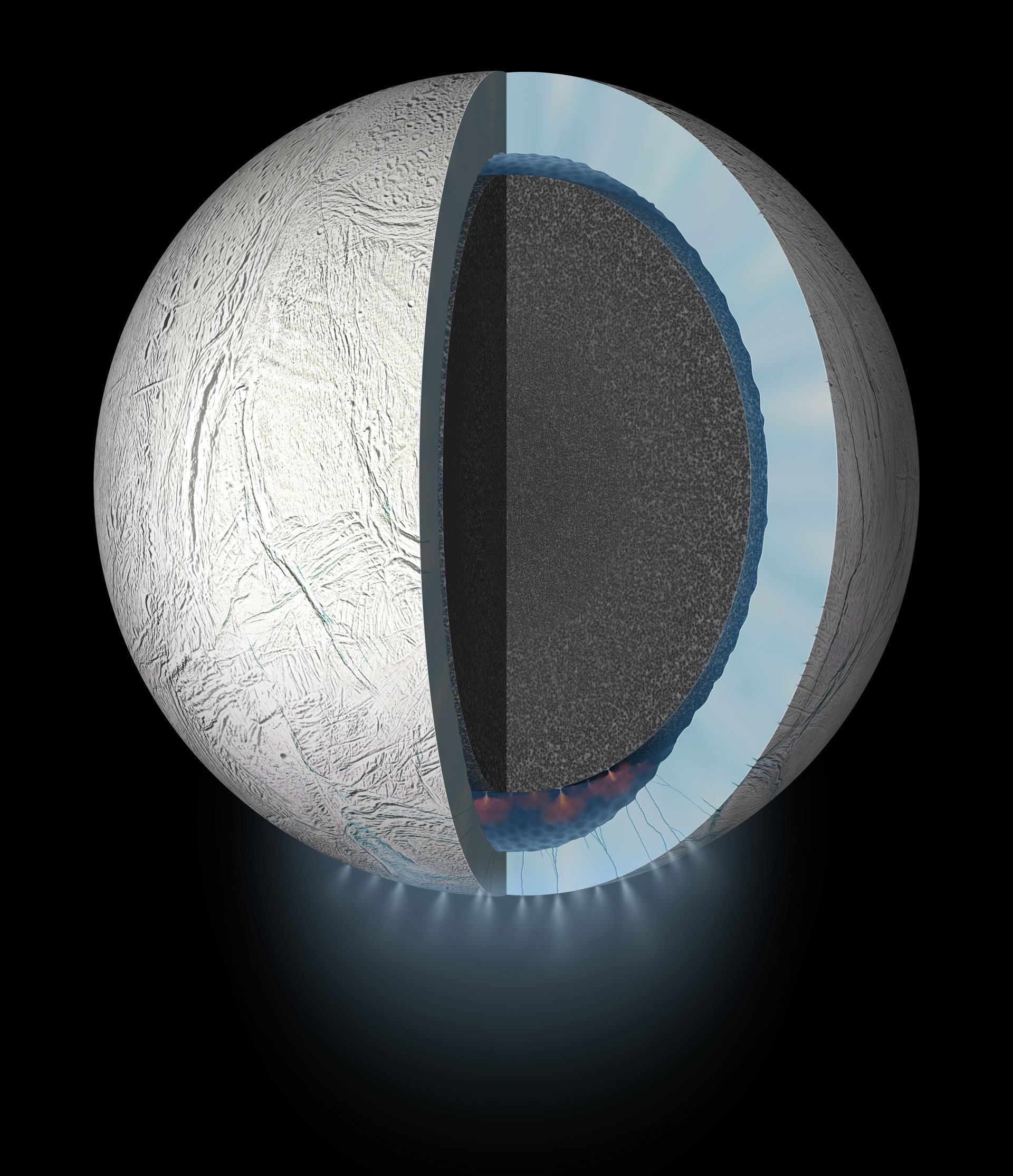
    This artist’s rendering showing a cutaway view into the interior of Saturn’s moon Enceladus. NASA’s Cassini spacecraft discovered the moon has a global ocean and likely hydrothermal activity. A plume of ice particles, water vapor and organic molecules sprays from fractures in the moon’s south polar region. Credit: NASA/JPL-Caltech
    • Enceladus is an icy moon of Saturn. Early in its mission, Cassini discovered Enceladus has remarkable geologic activity, including a towering plume of ice, water vapor and organic molecules spraying from its south polar region. Cassini later determined the moon has a global ocean and likely hydrothermal activity, meaning it could have the ingredients needed to support simple life.
    • The flyby will be Cassini’s deepest-ever dive through the Enceladus plume, which is thought to come from the ocean below. The spacecraft has flown closer to the surface of Enceladus before, but never this low directly through the active plume.
    • The flyby is not intended to detect life, but it will provide powerful new insights about how habitable the ocean environment is within Enceladus.
    • Cassini scientists are hopeful the flyby will provide insights about how much hydrothermal activity – that is, chemistry involving rock and hot water – is occurring within Enceladus. This activity could have important implications for the potential habitability of the ocean for simple forms of life. The critical measurement for these questions is the detection of molecular hydrogen by the spacecraft.
    • Scientists also expect to better understand the chemistry of the plume as a result of the flyby. The low altitude of the encounter is, in part, intended to afford Cassini greater sensitivity to heavier, more massive molecules, including organics, than the spacecraft has observed during previous, higher-altitude passes through the plume.
    • The flyby will help solve the mystery of whether the plume is composed of column-like, individual jets, or sinuous, icy curtain eruptions – or a combination of both. The answer would make clearer how material is getting to the surface from the ocean below.
    • Researchers are not sure how much icy material the plumes are actually spraying into space. The amount of activity has major implications for how long Enceladus might have been active.


    NASA’s Cassini spacecraft will sample an extraterrestrial ocean on Wednesday, October 28, when it flies directly through a plume of icy spray coming from Saturn’s moon Enceladus. The agency held a news teleconference to discuss plans for and anticipated science results from the historic flyby.

    Never miss a breakthrough: Join the SciTechDaily newsletter.
    Follow us on Google and Google News.

    Astronomy Cassini-Huygens Mission Enceladus NASA Planetary Science Saturn
    Share. Facebook Twitter Pinterest LinkedIn Email Reddit

    Related Articles

    Cassini Spacecraft Captures a Half-Lit View of Enceladus

    Cassini Views Dione and Enceladus

    NASA Prepares for Historic Flyby of Icy Saturn Moon Enceladus

    Cassini Spacecraft to Begin Flyby of Saturn’s Moon Enceladus

    Cassini Reveals Global Ocean in Saturn’s Moon Enceladus

    NASA Detects Ocean Inside Saturn’s Moon Enceladus

    Cassini Views a Spinning Vortex at Saturn’s North Pole

    Cassini Observes Meteors Colliding With Saturn’s Rings

    Storm Spawns the Largest Tropospheric Vortex Ever Seen on Saturn

    Leave A Reply Cancel Reply

    • Facebook
    • Twitter
    • Pinterest
    • YouTube

    Don't Miss a Discovery

    Subscribe for the Latest in Science & Tech!

    Trending News

    Mezcal “Worm” in a Bottle Mystery: DNA Testing Reveals a Surprise

    New Research Reveals That Your Morning Coffee Activates an Ancient Longevity Switch

    This Is What Makes You Irresistible to Mosquitoes

    Shockingly Powerful Giant Octopuses Ruled the Seas 100 Million Years Ago

    Scientists Stunned by New Organic Molecules Found on Mars

    Rewriting Dinosaur Evolution: Scientists Unearth Remarkable 150-Million-Year-Old Stegosaur Skull

    Omega-3 Supplements Linked to Cognitive Decline in Surprising New Study

    First-of-Its-Kind Discovery: Homer’s Iliad Found Embedded in a 1,600-Year-Old Egyptian Mummy

    Follow SciTechDaily
    • Facebook
    • Twitter
    • YouTube
    • Pinterest
    • Newsletter
    • RSS
    SciTech News
    • Biology News
    • Chemistry News
    • Earth News
    • Health News
    • Physics News
    • Science News
    • Space News
    • Technology News
    Recent Posts
    • A Common Vitamin Could Hold the Key to Treating Fatty Liver Disease
    • New Research Shows Vitamin B12 May Hold the Key to Healthy Aging
    • Scientists Map Thousands of Brain Connections With RNA Barcodes
    • This Gene Tweak Turns Strawberries Into Healthier, Tastier Superfruit
    • This New Chip Could Make GPUs Far More Efficient
    Copyright © 1998 - 2026 SciTechDaily. All Rights Reserved.
    • Science News
    • About
    • Contact
    • Editorial Board
    • Privacy Policy
    • Terms of Use

    Type above and press Enter to search. Press Esc to cancel.