
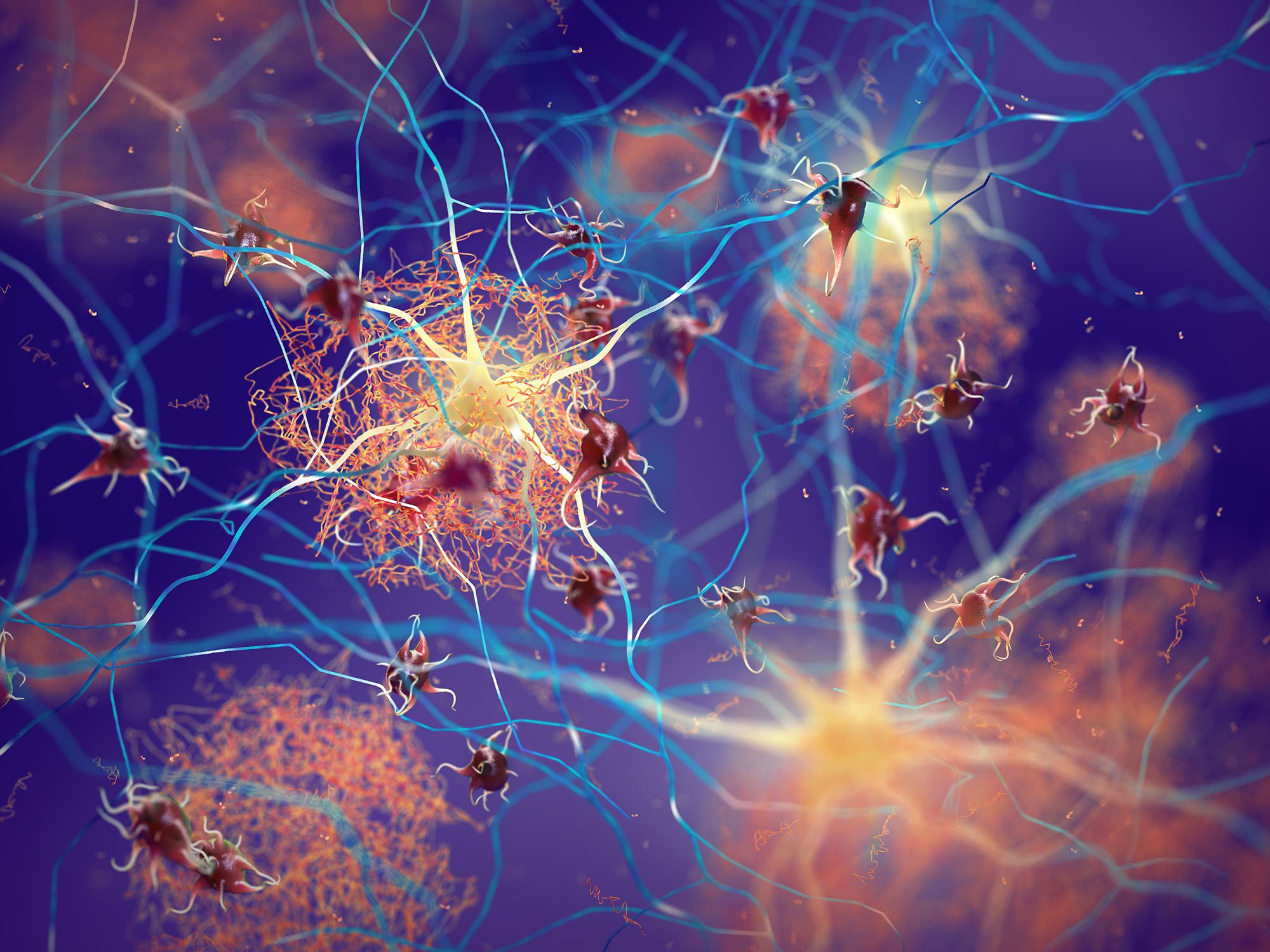
A new study suggests that subtle changes in the brain’s immune cells could help explain why some people remain mentally sharp despite Alzheimer’s pathology.
For decades, Alzheimer’s research has focused on the buildup of amyloid plaques and tau tangles, the two hallmark features of the disease. Yet a puzzling reality has continued to challenge scientists: some people die with brains filled with these abnormalities but never develop dementia. A new study may help explain why.
Researchers from VIB, KU Leuven, the UK Dementia Research Institute (UK-DRI), and Muna Therapeutics have identified a crucial biological transition that appears to separate people whose Alzheimer’s pathology progresses to dementia from those who remain cognitively resilient. The work, published in Nature Medicine, points to dramatic shifts in microglia, the brain’s immune cells, as a potential driver of this difference and a promising target for future therapies.
Rather than focusing solely on plaques and tangles, the researchers examined how brain cells respond to them. They analyzed donated brain tissue from older adults with and without cognitive decline, as well as cognitively healthy centenarians. The results suggest that resilience may depend less on the amount of pathology present and more on how the brain reacts to it.
“This has been an exciting journey with many partners. The study, entirely based on human donor material, provides insight into one type of resilience mechanism in the progression of AD to dementia,” says Prof. Bart De Strooper (VIB-KU Leuven Center for Neuroscience, KU Leuven), ERC grantee and one of the co-senior authors of the study.
Looking Beyond Plaques and Tangles
Alzheimer’s disease affects more than 55 million people worldwide, making it the most common cause of dementia. Although amyloid and tau have dominated research efforts for years, recent findings increasingly suggest they are only part of the story.
Many people accumulate substantial amounts of these proteins as they age, yet their cognitive abilities remain largely intact. This observation has fueled growing interest in the brain’s own defense mechanisms and why some individuals appear naturally protected against cognitive decline.
One of the strongest candidates is microglia. These specialized immune cells constantly patrol the brain, clearing debris, responding to injury, and helping maintain healthy neural networks. However, their role in Alzheimer’s has proven complex. Depending on their state, microglia may either help protect the brain or contribute to damage.
The new study provides one of the clearest pictures yet of how these cells change during disease progression.
A Biological Tipping Point
Using spatial transcriptomics and single-cell sequencing, technologies that allow scientists to examine gene activity at the level of individual cells while preserving their location within brain tissue, the team mapped six distinct tissue states associated with different stages of Alzheimer’s disease.
What emerged was evidence of a major biological turning point.
Early stages were dominated by amyloid plaque accumulation and an inflammatory microglial response. Later stages showed the appearance of tau pathology, neurodegeneration, and a fundamentally different microglial state.
Instead of simply becoming more active, the immune cells appeared to switch roles. They transitioned into an antigen-presenting state, a form of immune activity typically involved in communicating threats to other immune cells.
The researchers believe this transition may represent a critical step that influences whether Alzheimer’s pathology ultimately progresses into dementia.
“Understanding better how the brain resists the disease will provide new avenues towards therapies to prevent neurodegeneration and dementia,” said Prof. Mark Fiers (VIB-KU Leuven), a co-senior author of the study.
Not Everyone Follows the Same Path
One of the study’s most intriguing discoveries was that resilience appears to emerge through more than one mechanism.
Among octogenarians who had accumulated amyloid plaques but remained cognitively healthy, microglia entered the early inflammatory state but never made the transition to the later immune program linked to disease progression.
Centenarians presented a different picture. Their brains activated the later microglial state, but this response occurred largely independently of tau accumulation.
The finding suggests that resilience is not simply about avoiding disease-related changes. Instead, the brain may be able to rewire or reshape its response to those changes in ways that preserve cognitive function.
A New Direction for Alzheimer’s Treatments
The findings arrive at a time when Alzheimer’s drug development is undergoing a major shift. Recent therapies have succeeded in removing amyloid plaques from the brain, but their effects on slowing cognitive decline have generally been modest.
The new results suggest that targeting the brain’s immune response could be equally important.
Rather than focusing exclusively on eliminating plaques, future treatments may aim to preserve beneficial microglial activity or prevent the cellular transition associated with disease progression. The researchers specifically highlight pathways involving TREM2, a gene already linked to Alzheimer’s risk and microglial function, as a promising area for further investigation.
The study also points to a potentially narrow therapeutic window. Intervening before inflammatory responses become tightly connected to tau pathology may offer the best chance of preserving brain function.
“These findings open new opportunities to target microglial states, especially pathways such as TREM2, and extend resilience rather than simply focusing on plaque removal. We are excited to continue this journey and understand the causal role of microglial transitions leading to the identification of novel therapeutic approaches to delay or prevent disease progression,” said Niels Plath, Chief Scientific Officer of Muna Therapeutics.
Reference: “Human microglial transitions at the Aβ–tau inflection point associate with divergent pathways to dementia and resilience” by Ashley Lu, Wei-Ting Chen, Maria Dalby, Diego Sainz Garcia, Marisa Vanheusden, Luuk E. de Vries, Veerle van Lieshout, Araks Martirosyan, Katleen Craessaerts, Sebastiaan Moonen, Magdalena Zielonka, Iordana Chrysidou, Anke Misbaer, Leen Wolfs, Benjamin Pavie, Dick Swaab, Dietmar Rudolf Thal, Inge Huitinga, Annemieke Rozemuller, Susan Karijn Rohde, Marc Hulsman, Henne Holstege, Rita Balice-Gordon, Niels Plath, Mark Fiers and Bart De Strooper, 4 June 2026, Nature Medicine.
DOI: 10.1038/s41591-026-04393-8
Never miss a breakthrough: Join the SciTechDaily newsletter.
Follow us on Google and Google News.
1 Comment
My family has a history of Alzheimer’s and these new therapies sound very promising.