
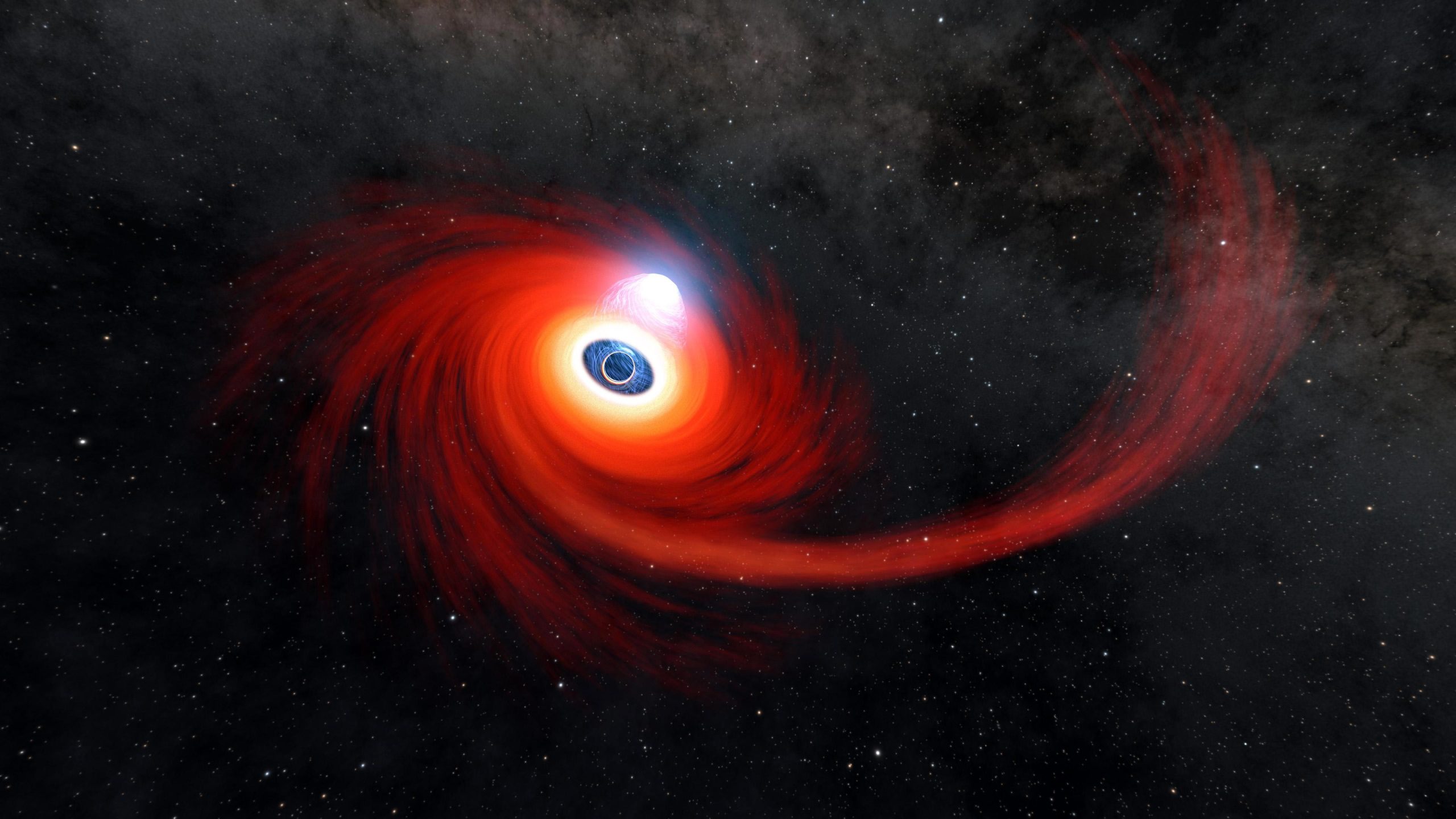
Supermassive black holes usually lurk unseen, but when an unlucky star drifts too close they ignite titanic outbursts brighter than 100 supernovae.
By mixing NASA, ESA, and ground-based data, astronomers caught three of these rare “extreme nuclear transients,” including the cheekily named “Barbie,” watching dormant galactic cores binge on stars three-to-ten times the Sun’s mass for months. The flares’ searing UV, X-ray, and infrared signatures expose otherwise hidden black-hole heavyweights and reshape their host galaxies, while offering a roadmap for future observatories like the Roman Space Telescope to spot similar blasts from the dawn of cosmic time.
Hidden Black Hole Feasts
Black holes are usually invisible, hiding silently in space unless something gives them away. Some constantly consume gas and dust, glowing brightly as they feed. Others stay completely quiet for years, only revealing themselves when a star wanders too close and gets torn apart.
Now, a new study combining data from NASA, the European Space Agency (ESA), and several ground-based observatories reveals three extraordinary cases where supermassive black holes devoured massive stars. Each of these dramatic events released more energy than 100 exploding stars, making them the most powerful cosmic explosions observed since the Big Bang.
These black holes, located in distant galaxies, suddenly lit up as they shredded stars that were three to ten times the mass of our Sun. The bursts of light from these star-destroying feasts lasted for months, giving scientists a rare opportunity to observe what would otherwise be hidden.
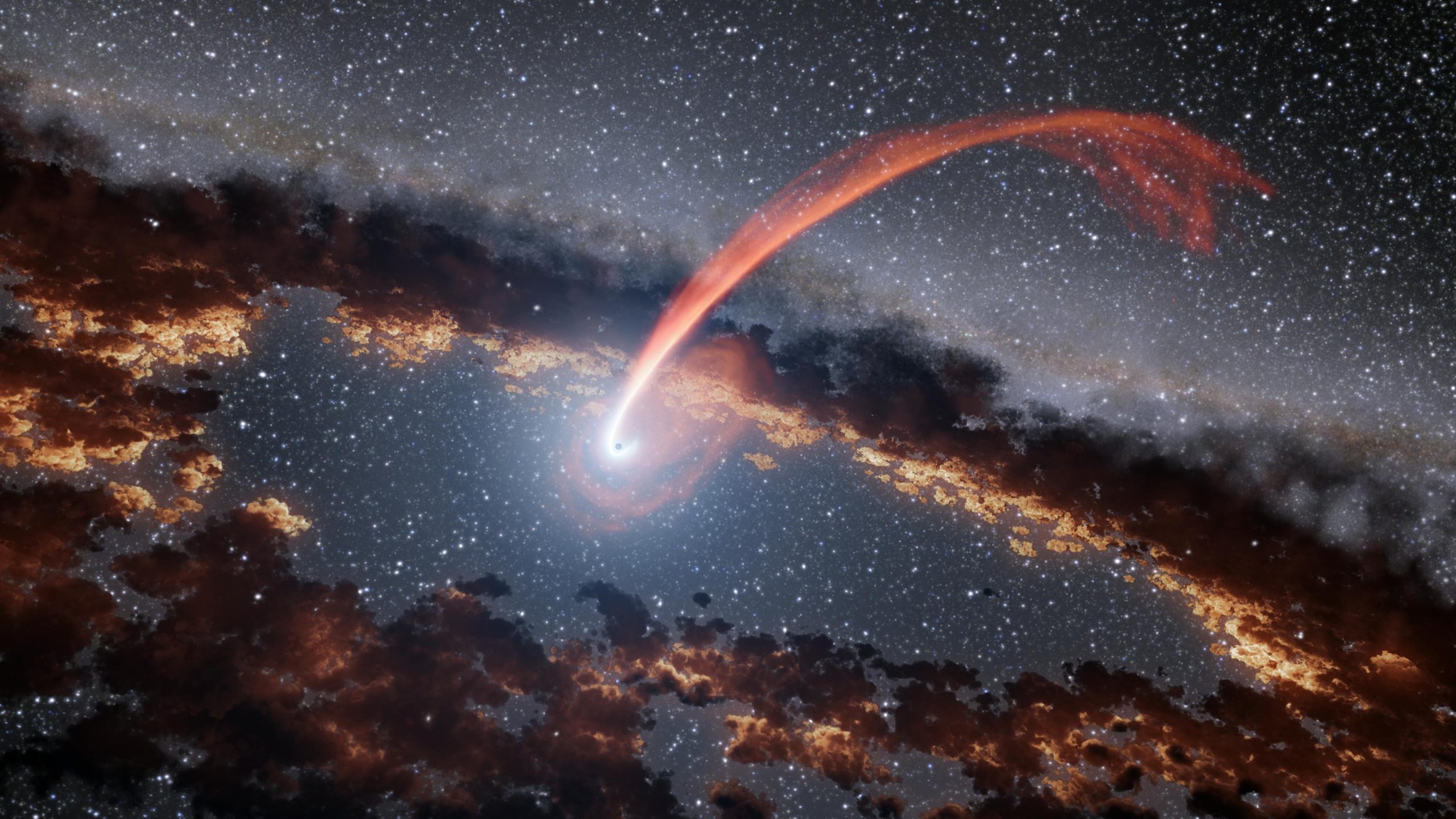
Extreme Nuclear Transients
Astronomers call these rare bursts “extreme nuclear transients.” This new category of cosmic event may help uncover some of the most massive supermassive black holes that typically stay dark and undetectable.
“These events are the only way we can have a spotlight that we can shine on otherwise inactive massive black holes,” said Jason Hinkle, graduate student at the University of Hawaii and lead author of a new study in the journal Science Advances describing this phenomenon.
These events unleash enormous amounts of high-energy radiation on the central regions of their host galaxies. “That has implications for the environments in which these events are occurring,” Hinkle said. “If galaxies have these events, they’re important for the galaxies themselves.”
The stars’ destruction produces high-energy light that takes over 100 days to reach peak brightness, then more than 150 days to dim to half of its peak. The way the high-energy radiation affects the environment results in lower-energy emissions that telescopes can also detect.
Case Studies: Barbie & Gaia Finds
One of these star-destroying events, nicknamed “Barbie” because of its catalog identifier ZTF20abrbeie, was discovered in 2020 by the Zwicky Transient Facility at Caltech’s Palomar Observatory in California, and documented in two 2023 studies. The other two black holes were detected by ESA’s Gaia mission in 2016 and 2018 and are studied in detail in the new paper.
NASA’s Neil Gehrels Swift Observatory was critical in confirming that these events must have been related to black holes, not stellar explosions or other phenomena. The way that the X-ray, ultraviolet, and optical light brightened and dimmed over time was like a fingerprint matching that of a black hole ripping a star apart.
Scientists also used data from NASA’s WISE spacecraft, which was operated from 2009 to 2011 and then was reactivated as NEOWISE and retired in 2024. Under the WISE mission the spacecraft mapped the sky at infrared wavelengths, finding many new distant objects and cosmic phenomena. In the new study, the spacecraft’s data helped researchers characterize dust in the environments of each black hole. Numerous ground-based observatories additionally contributed to this discovery, including the W. M. Keck Observatory telescopes through their NASA-funded archive and the NASA-supported Near-Earth Object surveys ATLAS, Pan-STARRS, and Catalina.
Pushing Energetic Frontiers
“What I think is so exciting about this work is that we’re pushing the upper bounds of what we understand to be the most energetic environments of the universe,” said Anna Payne, a staff scientist at the Space Telescope Science Institute and study co-author, who helped look for the chemical fingerprints of these events with the University of Hawaii 2.2-meter Telescope.
A Future Investigators in NASA Earth and Space Science and Technology (FINESST) grant from the agency helped enable Hinkle to search for these black hole events. “The FINESST grant gave Jason the freedom to track down and figure out what these events actually were,” said Ben Shappee, associate professor at the Institute for Astronomy at the University of Hawaii, a study coauthor and advisor to Hinkle.
Hinkle is set to follow up on these results as a postdoctoral fellow at the University of Illinois Urbana-Champaign through the NASA Hubble Fellowship Program. “One of the biggest questions in astronomy is how black holes grow throughout the universe,” Hinkle said.
The results complement recent observations from NASA’s James Webb Space Telescope showing how supermassive black holes feed and grow in the early universe. But since only 10% of early black holes are actively eating gas and dust, extreme nuclear transients — that is, catching a supermassive black hole in the act of eating a massive star — are a different way to find black holes in the early universe.
Future Cosmic Fireworks
Events like these are so bright that they may be visible even in the distant, early universe. Swift showed that extreme nuclear transients emit most of their light in the ultraviolet. But as the universe expands, that light is stretched to longer wavelengths and shifts into the infrared — exactly the kind of light NASA’s upcoming Nancy Grace Roman Space Telescope was designed to detect.
With its powerful infrared sensitivity and wide field of view, Roman will be able to spot these rare explosions from more than 12 billion years ago, when the universe was just a tenth of its current age. Scheduled to launch by 2027, and potentially as early as fall 2026, Roman could uncover many more of these dramatic events and offer a new way to explore how stars, galaxies, and black holes formed and evolved over time.
“We can take these three objects as a blueprint to know what to look for in the future,” Payne said.
Reference: “The most energetic transients: Tidal disruptions of high-mass stars” by Jason T. Hinkle, Benjamin J. Shappee, Katie Auchettl, Christopher S. Kochanek, Jack M. M. Neustadt, Abigail Polin, Jay Strader, Thomas W.-S. Holoien, Mark E. Huber, Michael A. Tucker, Christopher Ashall, Thomas de Jaeger, Dhvanil D. Desai, Aaron Do, Willem B. Hoogendam and Anna V. Payne, 4 June 2025, Science Advances.
DOI: 10.1126/sciadv.adt0074
Never miss a breakthrough: Join the SciTechDaily newsletter.
Follow us on Google and Google News.