
New findings reveal a star’s perilous journey around a supermassive black hole, resulting in periodic disruptions and intense light emissions, helping astronomers predict future cosmic events.
- Astronomers have correctly predicted when a giant black hole finished its last meal — and calculated the schedule for its snacks in the future.
- A star is in orbit around a supermassive black hole in a galaxy around 860 million light-years from Earth.
- Each time the star makes its closest approach, the black hole pulls pieces of the star off and consumes some of it.
- Data from NASA’s Chandra, Swift, and ESA’s XMM-Newton provide astronomers information on when these meals will take place.
Unraveling Black Hole Mysteries
By using new data from NASA’s Chandra X-ray Observatory and Neil Gehrels Swift Observatory as well as ESA’s XMM-Newton, a team of researchers have made important headway in understanding how — and when — a supermassive black hole obtains and then consumes material.
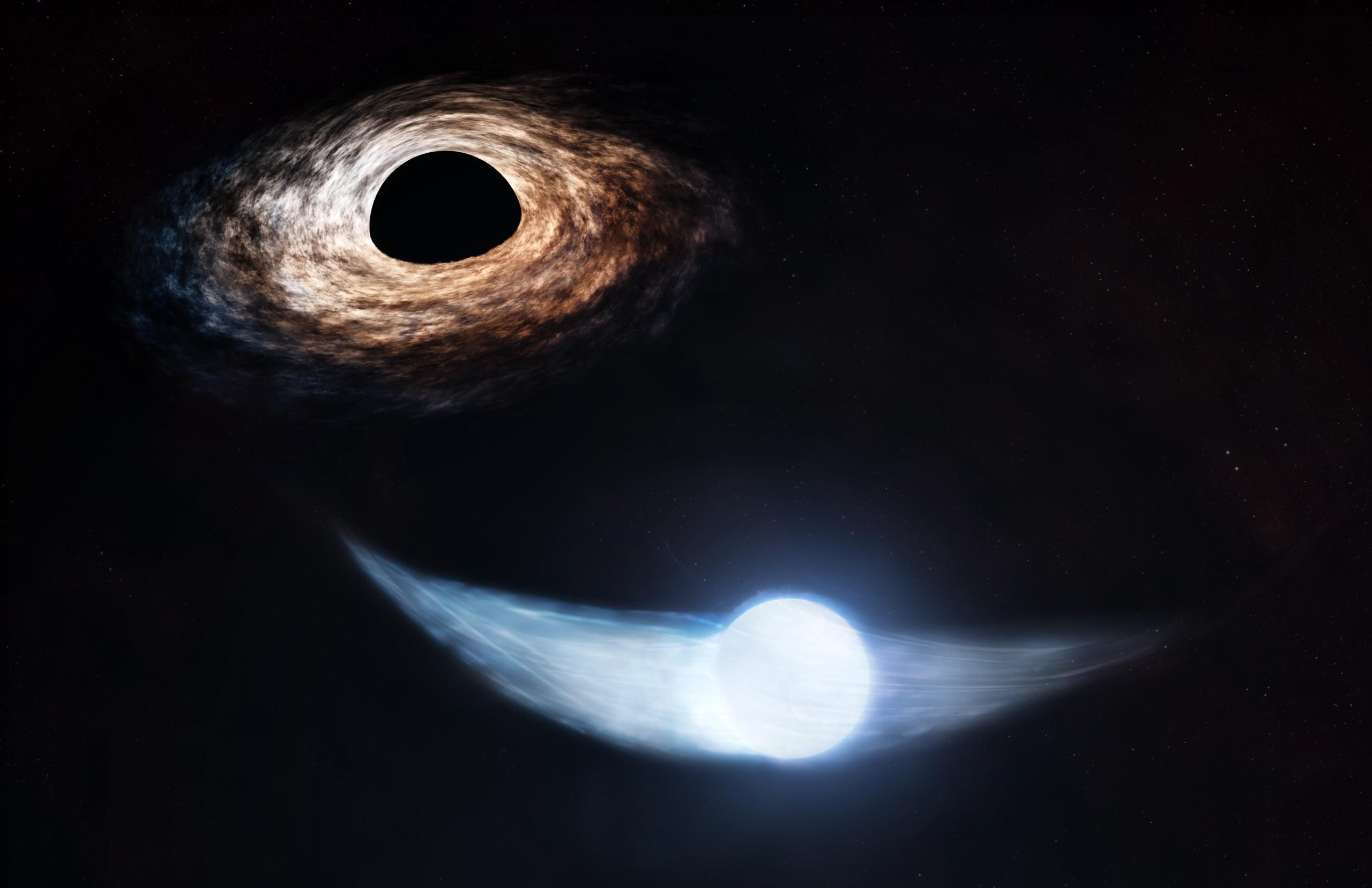
This artist’s impression shows a star that has partially been disrupted by such a black hole in the system known as AT2018fyk. The supermassive black hole in AT2018fyk — with about 50 million times more mass than the sun — is in the center of a galaxy located about 860 million light-years from Earth.
Astronomers have determined that a star is on a highly elliptical orbit around the black hole in AT2018fyk so that its point of farthest approach from the black hole is much larger than its closest. During its closest approach, tidal forces from the black hole pull some material from the star, producing two tidal tails of “stellar debris.”
Cycle of Destruction and Emission
The illustration shows a point in the orbit soon after the star is partially destroyed, when the tidal tails are still in close proximity to the star. Later in the star’s orbit, the disrupted material returns to the black hole and loses energy, leading to a large increase in X-ray brightness occurring later in the orbit (not shown here). This process repeats each time the star returns to its point of closest approach, which is approximately every 3.5 years. The illustration depicts the star during its second orbit, and the disk of X-ray emitting gas around the black hole that is produced as a byproduct of the first tidal encounter.
Tracking Astronomical Phenomena Through Brightness
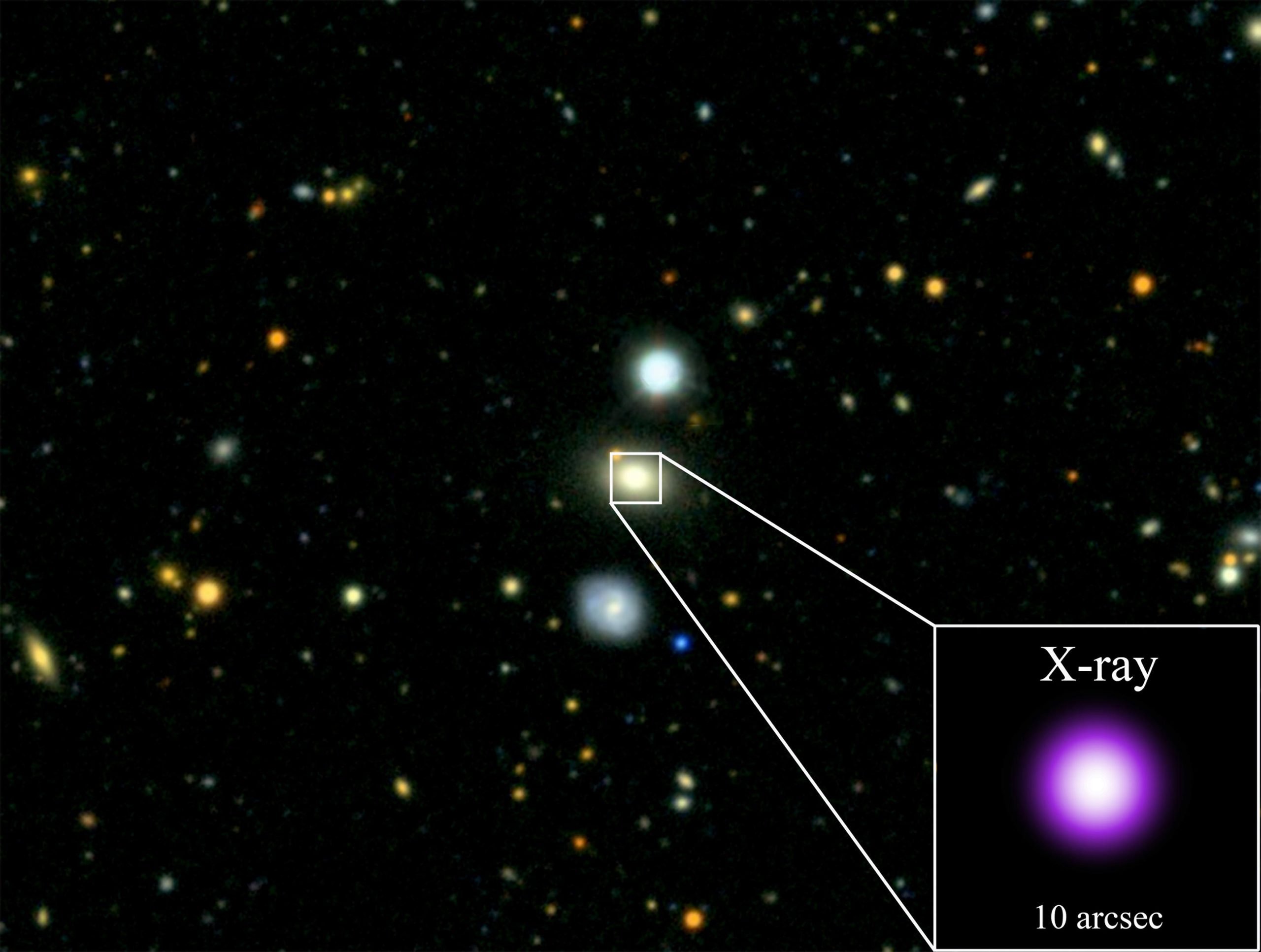
Researchers took note of AT2018fyk in 2018 when the optical ground-based survey ASAS-SN detected that the system had become much brighter. After observing it with NASA’s NICER and Chandra, and XMM-Newton, researchers determined that the surge in brightness came from a “tidal disruption event,” or TDE, which signals that a star was completely torn apart and partially ingested after flying too close to a black hole. Chandra data of AT2018fyk is shown in the inset of an optical image of a wider field of view.
Black Hole’s Continued Feast on Stellar Remnants
When material from the destroyed star approached close to the black hole, it got hotter and produced X-ray and ultraviolet (UV) light. These signals then faded, agreeing with the idea that nothing was left of the star for the black hole to digest.
However, about two years later, the X-ray and UV light from the galaxy got much brighter again. This meant, according to astronomers, that the star likely survived the initial gravitational grab by the black hole and then entered a highly elliptical orbit with the black hole. During its second close approach to the black hole, more material was pulled off and produced more X-ray and UV light.
Anticipating Celestial Events
Based on what they had learned about the star and its orbit, a team of astronomers predicted that the black hole’s second meal would end in August 2023 and applied for Chandra observing time to check. Chandra observations on August 14, 2023, indeed showed the telltale sign of the black hole feeding coming to an end with a sudden drop in X-rays. The researchers also obtained a better estimate of how long it takes the star to complete an orbit, and predicted future mealtimes for the black hole.
A paper describing these results appears in the August 14, 2024 issue of The Astrophysical Journal.
For more on this discovery, see Cosmic Clockwork Decoded in Black Hole Feeding Patterns.
Reference: “A Potential Second Shutoff from AT2018fyk: An Updated Orbital Ephemeris of the Surviving Star under the Repeating Partial Tidal Disruption Event Paradigm” by Dheeraj Pasham, E. R. Coughlin, M. Guolo, T. Wevers, C. J. Nixon, Jason T. Hinkle and A. Bandopadhyay, 14 August 2024, The Astrophysical Journal Letters.
DOI: 10.3847/2041-8213/ad57b3
The authors are Dheeraj Passam (Massachusetts Institute of Technology), Eric Coughlin (Syracuse University), Muryel Guolo (Johns Hopkins University), Thomas Wevers (Space Telescope Science Institute), Chris Nixon (University of Leeds, UK), Jason Hinkle (University of Hawaii at Manoa), and Ananaya Bandopadhyay (Syracuse).
NASA’s Marshall Space Flight Center manages the Chandra program. The Smithsonian Astrophysical Observatory’s Chandra X-ray Center controls science from Cambridge Massachusetts and flight operations from Burlington, Massachusetts.
Never miss a breakthrough: Join the SciTechDaily newsletter.
Follow us on Google and Google News.