
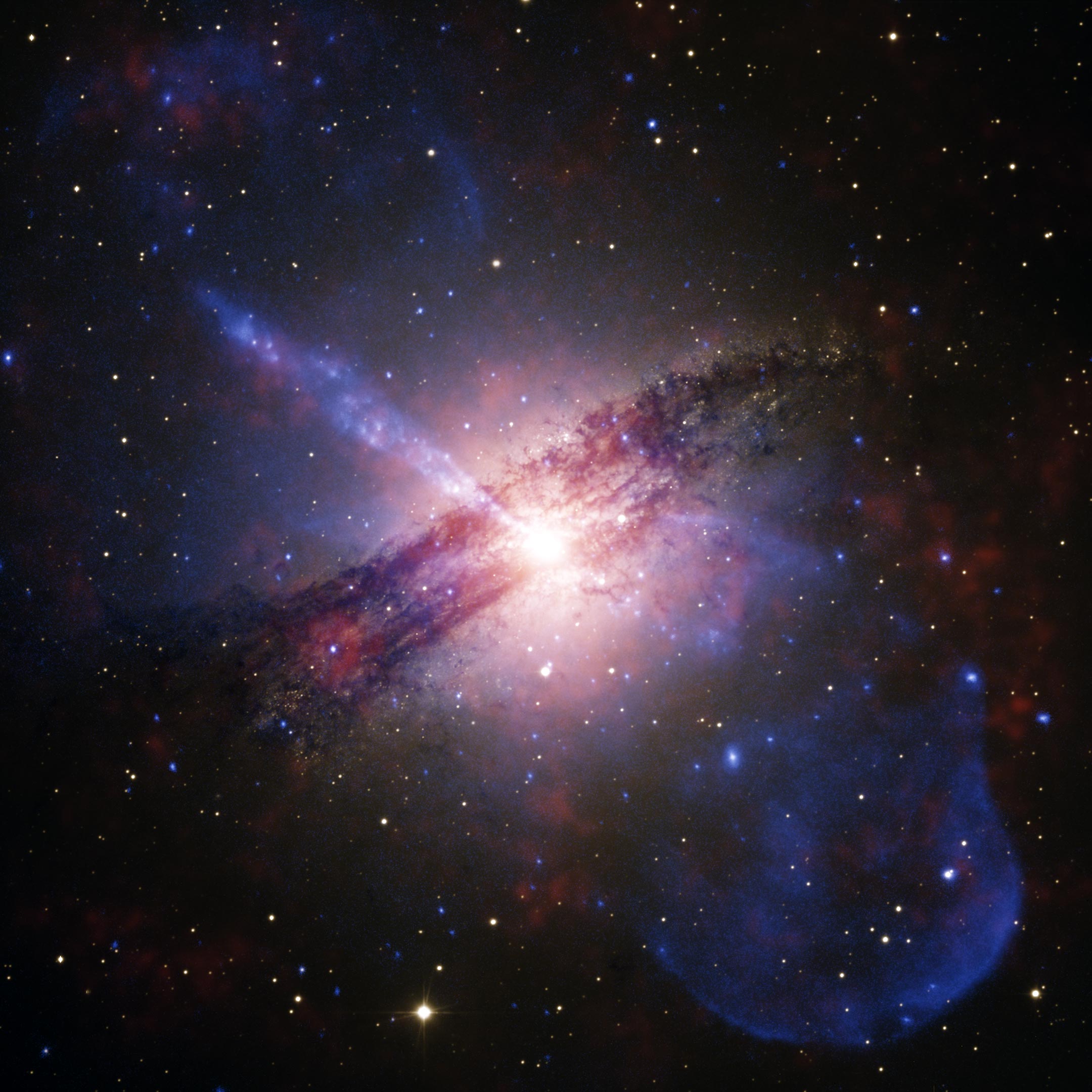
Centaurus A, located 12 million light-years away, dazzles in a composite image highlighting its supermassive black hole and the extensive jets it emits, visible in X-rays and optical light.
Recent studies leveraging data from NASA’s Chandra and IXPE satellites offer fresh perspectives on the high-energy phenomena occurring in this galaxy, which could be due to a past galactic collision.
Supermassive Black Hole and Jet Formation
The galaxy Centaurus A (Cen A) shines brilliantly in this composite image, created using data from multiple observatories. At its core lies a supermassive black hole, drawing in surrounding gas and dust, while powerful jets of high-energy particles and other matter are ejected. One of these jets, seen at the upper left of the image, stretches approximately 13,000 light-years from the black hole. A prominent dust lane is also visible, wrapping around the galaxy’s center, likely the result of a collision with a smaller galaxy millions of years ago.
The colors in the image represent different sources of data. Blue indicates X-rays captured by NASA’s Chandra X-ray Observatory, orange shows X-rays detected by NASA’s Imaging X-ray Polarimetry Explorer (IXPE), and the white and gray areas represent optical light observed by the European Southern Observatory in Chile.
New Insights From Advanced Observatories
Cen A has been studied extensively since the launch of Chandra in 1999. With IXPE, which launched in 2021, scientists can understand the mysteries of this object in a new way. IXPE is specialized to look at a property of X-ray light called polarization, which relates to the organization of electromagnetic waves. This specialized measurement is helping scientists study how particles become accelerated to high energies and speeds — nearly the speed of light — at extreme cosmic objects like this one.
At Cen A, researchers using IXPE seek to understand what causes the X-ray emission in the jets. So far, scientists have not detected X-ray polarization at Cen A, indicating that particles much heavier than electrons, such as protons, are not producing the X-rays. More insights are to come as scientists analyze the data.
Cen A is found 12 million light-years from Earth in the constellation Centaurus and represents the fifth brightest galaxy in the sky.
About the Chandra Mission
The Chandra X-ray Observatory, managed by NASA’s Marshall Space Flight Center, is one of NASA’s flagship space telescopes, specializing in observing X-rays from high-energy regions of the universe, such as black holes, supernovae, and galaxy clusters. Launched in 1999, Chandra provides astronomers with detailed images of cosmic X-ray sources, offering insights into the universe’s most energetic phenomena. The Smithsonian Astrophysical Observatory’s Chandra X-ray Center oversees science operations from Cambridge, Massachusetts, while flight operations are managed from Burlington, Massachusetts. This mission continues to be vital in expanding our understanding of the high-energy universe.
About the IXPE Mission
The Imaging X-ray Polarimetry Explorer (IXPE) is part of NASA’s Small Explorer mission series, launched in December 2021 aboard a Falcon 9 rocket from NASA’s Kennedy Space Center. Orbiting about 370 miles (595 kilometers) above Earth’s equator, IXPE is designed to study the polarization of X-rays from cosmic sources like black holes and neutron stars, revealing new insights into their environments. The mission is a collaboration between NASA and the Italian Space Agency, with scientific partners from 13 countries. Ball Aerospace manages the spacecraft’s operations from its headquarters in Broomfield, Colorado.
Never miss a breakthrough: Join the SciTechDaily newsletter.
Follow us on Google and Google News.