

New research suggests Mars may have been better suited than Earth to receive life’s chemical ingredients from comets, although the chances remain surprisingly slim.
Comets have long been considered possible sources of the chemical ingredients that helped life emerge on Earth. But new research suggests these icy visitors were extremely unlikely to deliver those molecules in sufficient quantities, challenging a theory that has shaped scientific thinking for nearly a century.
Using advanced computer simulations, researchers led by the University of Cambridge found that comet impacts would almost always destroy fragile organic compounds before they could contribute to the chemistry of early life. Even under favorable conditions, successful delivery would have been extraordinarily rare. The findings, published in Scientific Reports, also suggest that Mars may have offered slightly better conditions for receiving these molecules.
Why Comets May Have Been Poor Carriers of Life’s Ingredients
Comets contain carbon and nitrogen-bearing compounds, including hydrogen cyanide (HCN), a molecule involved in chemical reactions that can produce some of life’s essential building blocks. Their ability to transport these substances across the Solar System has made them central to theories about how prebiotic chemistry began on Earth.
“Historically, scientists thought that comets were important for the origin of life on Earth, because they carried carbon and nitrogen-bearing molecules, so these giant space snowballs were almost like a ‘get out of jail free card’ that brought all the molecules a planet would need to seed life,” said lead author Dr. Richard Anslow from Cambridge’s Institute of Astronomy. “It’s kind of a romantic idea, but our results suggest it’s highly unlikely.”
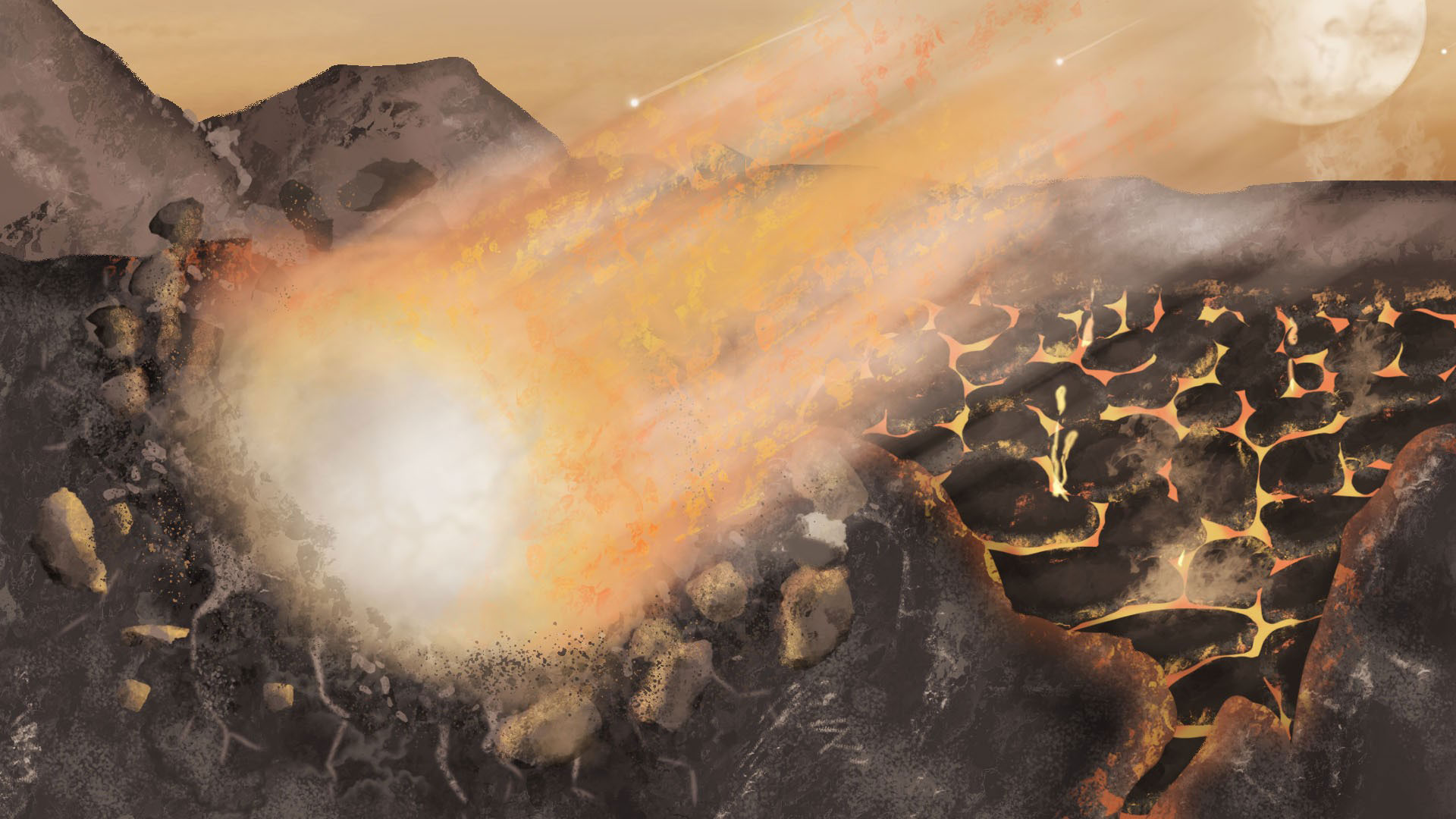
The problem lies in the violence of comet impacts. According to the simulations, comets generally approach Earth at speeds and angles that make the survival of their organic cargo extremely unlikely. Most of these molecules would vaporize during impact rather than reach the surface intact. The researchers reached this conclusion by combining models of comet trajectories, atmospheric interactions, impact physics, and the formation and evolution of comet populations.
Even a Successful Impact Might Not Be Enough
To investigate the likelihood of successful delivery, the team concentrated on HCN, which is regularly detected in Solar System comets. Their calculations showed that impacts capable of preserving the molecule and depositing it at useful concentrations would have been exceptionally uncommon.
The number of comets striking Earth also fell sharply during the planet’s first 500 million years, leaving at most a handful of opportunities for meaningful HCN delivery. Even if some molecules survived, they would likely disperse before the chemical reactions needed for life’s emergence could advance far enough.
“It would really have to be a one-in-a-million occurrence, because not only would you need an impact at just the right speed and just the right angle, you would also need everything to happen after that point, in terms of the concentration and the speed at which the chemical origins of life got going,” said Anslow. “We can’t rule out for certain that it happened that way. But it seems to be a really rare occurrence – at best, a one-off fluke.”
Testing a Theory That Dates Back Nearly a Century
The investigation builds on earlier research published in 2023, when Anslow and several colleagues proposed that closely spaced planets could help comets deliver organic molecules. In such systems, gravitational encounters might allow comets to move between planets while gradually slowing down, increasing the chances that their chemical cargo could survive an eventual impact.
The new study examined whether similar conditions could have existed in our Solar System, using recent advances in simulations of comet impacts and planetary dynamics.
“We’re learning more and more all the time about how our Solar System and the Earth formed, and pulling this together with lots of different advances in modeling, which allowed us to investigate this idea that has been around for close to a century,” Anslow said.
If comets were not a major source of Earth’s prebiotic molecules, other explanations remain possible. Asteroids struck the early Earth much more frequently, and their impacts could have triggered chemical reactions that produced organic compounds. Alternatively, the necessary ingredients may have formed through chemical processes occurring on Earth itself, without requiring delivery from space.
Mars May Have Had Better Chances
Although the results cast doubt on cometary delivery to Earth, the researchers identified Mars as a somewhat more favorable destination. Mars is smaller than Earth and currently has a much thinner atmosphere, conditions that could allow more cometary material to reach its surface. This may have increased the chances of organic molecules surviving impacts during the Solar System’s early history, when comet collisions were more common.
However, the simulations do not establish that comets successfully delivered prebiotic molecules to Mars. They indicate only that the process may have been more feasible there than on Earth.
“This is not to say it definitely happened on Mars, of course, but suggests it would be unlikely if it happened on Earth and didn’t happen on Mars,” said Anslow. “Or the other, perhaps more likely, alternative, is that it didn’t happen on either planet.”
Implications for the Search for Life Beyond Earth
The findings could also help astronomers assess the chemical environments of planets orbiting other stars. In planetary systems where several worlds orbit close together, gravitational interactions might slow incoming comets enough to improve the prospects for delivering organic molecules.
Future observatories, including proposed successors to the James Webb Space Telescope (JWST), such as the Habitable Worlds Observatory, could help investigate these planetary systems. Identifying environments where “bouncing” comets might survive long enough to deliver their chemical cargo could provide one way to narrow the search for potentially habitable worlds.
Reference: “Cometary impacts an unlikely pathway towards the origins of life on Earth” by Richard J. Anslow, Catriona H. McDonald, Amy Bonsor, Paul B. Rimmer and Auriol S. P. Rae, 28 October 2026, Scientific Reports.
DOI: 10.1038/s41598-026-74214-y
The research was supported in part by the Royal Society, the Leverhulme Centre for Life in the Universe, and the Science and Technology Facilities Council (STFC), part of UK Research and Innovation (UKRI).
Never miss a breakthrough: Join the SciTechDaily newsletter.
Follow us on Google and Google News.