
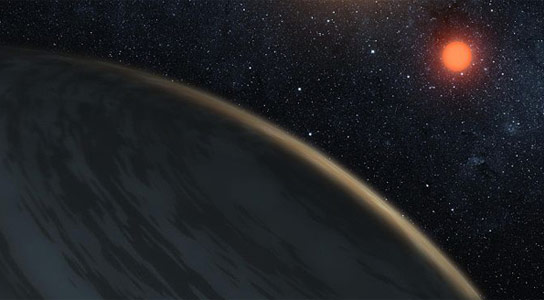
New climate model research from astronomers at the University of Washington suggests that planets orbiting cooler stars may be more likely to remain ice-free than planets around hotter star due to the interaction of a star’s light with ice and snow on the planet’s surface.
Stars emit different types of light. Hotter stars emit high-energy visible and ultraviolet light, and cooler stars give off infrared and near-infrared light, which has a much lower energy.
It seems logical that the warmth of terrestrial or rocky planets should depend on the amount of light they get from their stars, all other things being equal. But new climate model research led by Aomawa Shields, a doctoral student in the University of Washington astronomy department, has added a surprising new twist to the story: Planets orbiting cool stars actually may be much warmer and less icy than their counterparts orbiting much hotter stars, even though they receive the same amount of light.
That’s because the ice absorbs much of the longer wavelength, near-infrared light predominantly emitted by these cooler stars. This is counter to what we experience on Earth, where ice and snow strongly reflect the visible light emitted by the Sun.
Around a cooler (M-dwarf) star, the more light the ice absorbs, the warmer the planet gets. The planet’s atmospheric greenhouse gases also absorb this near-infrared light, compounding the warming effect.
The researchers found that planets orbiting cooler stars, given similar amounts of light as those orbiting hotter stars, are therefore less likely to experience so-called “snowball states,” icing over from pole to equator.
However, around a hotter star such as an F-dwarf, the star’s visible and ultraviolet light is reflected by planetary ice and snow in a process called ice-albedo feedback. The more light the ice reflects, the cooler the planet gets.
This feedback can be so effective at cooling that terrestrial planets around hotter stars appear to be more susceptible than other planets to entering snowball states. That’s not necessarily a bad thing, in the scheme of time — Earth itself is believed to have experienced several snowball states during the course of its 4.6 billion-year history.
Shields and co-authors found that this interaction of starlight with a planet’s surface ice is less pronounced near the outer edge of the habitable zone, where carbon dioxide is expected to build up as temperatures decrease. The habitable zone is the swath of space around a star that’s just right to allow an orbiting planet’s surface water to be in liquid form, thus giving life a chance.
That is the case because planets at that zone’s outer edge would likely have a thick atmosphere of carbon dioxide or other greenhouse gases, which blocks the absorption of radiation at the surface, causing the planet to lose any additional warming advantage due to the ice.
The researchers’ findings are documented in a paper published in the August issue of the journal Astrobiology, and published online ahead of print on July 15.
Shields said that astronomers hunting for possible life will prioritize planets less vulnerable to that snowball state — that is, planets other than those orbiting hotter stars. But that doesn’t mean they will rule out the cooler planets.
“The last snowball episode on Earth has been linked to the explosion of multicellular life on our planet,” Shields said. “If someone observed our Earth then, they might not have thought there was life here — but there certainly was.
“So though we’d look for the non-snowball planets first, we shouldn’t entirely write off planets that may be ice-covered, or headed for total ice cover. There could be life there too, though it may be much harder to detect.”
Shields’ UW co-authors are Victoria Meadows, associate professor of astronomy; Cecilia Bitz, associate professor of atmospheric sciences; and Tyler Robinson, an astronomy research associate. Other co-authors are Raymond T. Pierrehumbert of the University of Chicago and Manoj Joshi of the University of East Anglia.
The work was funded by a National Science Foundation Graduate Research Fellowship and performed as part of the NASA Astrobiology Institute’s Virtual Planetary Laboratory Lead Team.
Reference: “The Effect of Host Star Spectral Energy Distribution and Ice-Albedo Feedback on the Climate of Extrasolar Planets” by Aomawa L. Shields, Victoria S. Meadows, Cecilia M. Bitz, Raymond T. Pierrehumbert, Manoj M. Joshi and Tyler D. Robinson, 14 Aug 2013, Astrobiology.
DOI: 10.1089/ast.2012.0961
Never miss a breakthrough: Join the SciTechDaily newsletter.
Follow us on Google and Google News.