
Close Menu
    Facebook X (Twitter) Instagram
    SciTechDaily
    • Biology
    • Chemistry
    • Earth
    • Health
    • Physics
    • Science
    • Space
    • Technology
    Facebook X (Twitter) Pinterest YouTube RSS
    SciTechDaily
    Home»Space»Comet 2013 A1 to Make a Very Close Flyby of Mars
    Space

    Comet 2013 A1 to Make a Very Close Flyby of Mars

    By DC Agle, Jet Propulsion LaboratoryMarch 6, 20131 Comment3 Mins Read
    Facebook Twitter Pinterest Telegram LinkedIn WhatsApp Email Reddit
    Share
    Facebook Twitter LinkedIn Pinterest Telegram Email Reddit
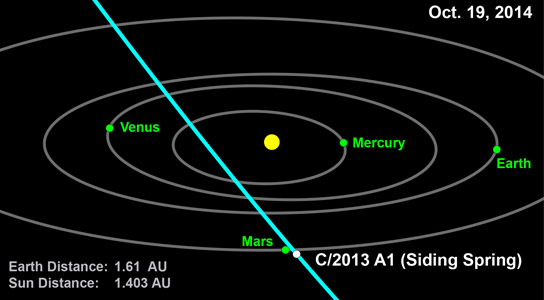
    Comet 2013 A1 Will Make a Very Close Approach to Mars
    This computer graphic depicts the orbit of comet 2013 A1 (Siding Spring) through the inner solar system. On October 19, 2014, it is expected to pass within 186,000 miles (300,000 kilometers) of Mars. Credit: NASA/JPL-Caltech

    Scientists have projected that comet 2013 A1 will make a very close approach to Mars in October 2014, possibly passing as close as 31,000 miles (50,000 kilometers) from the Red Planet’s surface.

    The latest trajectory of comet 2013 A1 (Siding Spring) generated by the Near-Earth Object Program Office at NASA’s Jet Propulsion Laboratory in Pasadena, California, indicates the comet will pass within 186,000 miles (300,000 kilometers) of Mars and there is a strong possibility that it might pass much closer. The NEO Program Office’s current estimate based on observations through March 1, 2013, has it passing about 31,000 miles (50,000 kilometers) from the Red Planet’s surface. That distance is about two-and-a-half times that of the orbit of the outermost moon, Deimos.

    Scientists generated the trajectory for comet Siding Spring based on the data obtained by observations since October 2012. Further refinement to its orbit is expected as more observational data is obtained. At present, Mars lies within the range of possible paths for the comet and the possibility of an impact cannot be excluded. However, since the impact probability is currently less than one in 600, future observations are expected to provide data that will completely rule out a Mars impact.

    During the close Mars approach the comet will likely achieve a total visual magnitude of zero or brighter, as seen from Mars-based assets. From Earth, the comet is not expected to reach naked eye brightness, but it may become bright enough (about magnitude 8) that it could be viewed from the southern hemisphere in mid-September 2014, using binoculars, or small telescopes.

    Scientists at the Near-Earth Object Program Office estimate that comet Siding Spring has been on a more than a million-year journey, arriving from our solar system’s distant Oort cloud. The comet could be complete with the volatile gases that short-period comets often lack due to their frequent returns to the sun’s neighborhood.

    Rob McNaught discovered comet 2013 A1 Siding Spring on January 3, 2013, at Siding Spring Observatory in Australia. A study of germane archival observations has unearthed more images of the comet, extending the observation interval back to October 4, 2012.

    NASA detects, tracks, and characterizes asteroids and comets passing close to Earth using both ground- and space-based telescopes. The Near-Earth Object Observations Program, commonly called “Spaceguard,” discovers these objects, characterizes a subset of them, and plots their orbits to determine if any could be potentially hazardous to our planet.

    JPL manages the Near-Earth Object Program Office for NASA’s Science Mission Directorate in Washington. JPL is a division of the California Institute of Technology in Pasadena.

    Never miss a breakthrough: Join the SciTechDaily newsletter.
    Follow us on Google and Google News.

    Astronomy Comet JPL Mars NASA Planetary Science Popular
    Share. Facebook Twitter Pinterest LinkedIn Email Reddit

    Related Articles

    NASA Completes Computer Swap for Curiosity Rover

    NASA’s Curiosity Rover Drills and Collects First Martian Bedrock Sample

    Mineralogy of Martian Soil Is Similar to Soils of Volcanic Origin in Hawaii

    Curiosity Prepares to Take Its First Scoop of Soil for Analysis

    Curiosity Finds Ancient Streambed on Mars

    NASA’s Opportunity Discovers Geological Mystery on Mars

    NASA Data Suggests “Dry Ice” Snowfall on Mars

    NASA’s Curiosity Readies for First Drive on Mars

    Color HiRISE Image of Curiosity Rover on Mars

    1 Comment

    1. photo oportunity on September 12, 2014 6:27 am

      This could be a chance to have the NASA’s Curiosity Rover try to snap a picture of the ESA’s Rosetta orbiter and Comet 67P as they both pass by Mars surface. Maybe Rosetta could also snap a picture of the Curiosity too?

      Marketing with pictures is a good thing as it inspires hope during this historical moment.

      Reply
    Leave A Reply Cancel Reply

    • Facebook
    • Twitter
    • Pinterest
    • YouTube

    Don't Miss a Discovery

    Subscribe for the Latest in Science & Tech!

    Trending News

    Largest-Ever Study Finds Medicinal Cannabis Ineffective for Anxiety, Depression, PTSD

    250-Million-Year-Old Egg Solves One of Evolution’s Biggest Mysteries

    Living With Roommates Might Be Changing Your Gut Microbiome Without You Knowing

    Century-Old Cleaning Chemical Linked to 500% Increased Risk of Parkinson’s Disease

    What if Your Memories Never Happened? Physicists Take a New Look at the Boltzmann Brain Paradox

    One of the Universe’s Largest Stars May Be Getting Ready To Explode

    Scientists Discover Enzyme That Could Supercharge Ozempic-Like Weight Loss Drugs

    Popular Sweetener Linked to DNA Damage – “It’s Something You Should Not Be Eating”

    Follow SciTechDaily
    • Facebook
    • Twitter
    • YouTube
    • Pinterest
    • Newsletter
    • RSS
    SciTech News
    • Biology News
    • Chemistry News
    • Earth News
    • Health News
    • Physics News
    • Science News
    • Space News
    • Technology News
    Recent Posts
    • Scientists Reveal Eating Fruits and Vegetables May Increase Your Risk of Lung Cancer
    • AI Reveals Explosive Growth of Floating Algae Across the World’s Oceans
    • 5.5 Million Bees Discovered Living Beneath a New York Cemetery
    • Scientists Reverse Brain Aging With Simple Nasal Spray
    • The Surprising Diet Rule That Makes “Good” Parasites Work
    Copyright © 1998 - 2026 SciTechDaily. All Rights Reserved.
    • Science News
    • About
    • Contact
    • Editorial Board
    • Privacy Policy
    • Terms of Use

    Type above and press Enter to search. Press Esc to cancel.