
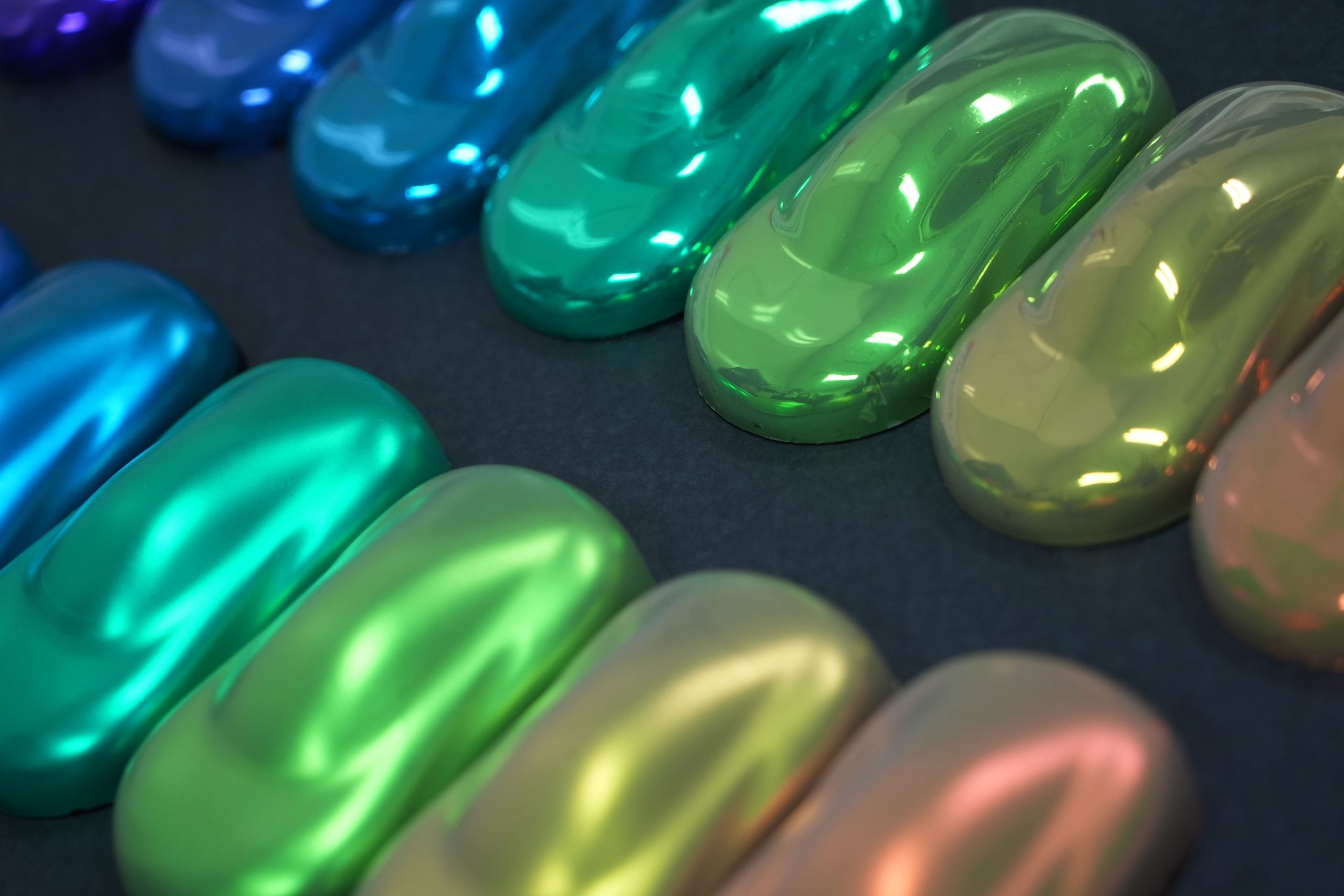
A new silicon-based coating could dramatically reduce the weight and environmental impact of conventional paints.
A glossy, car-quality finish no longer has to depend on pigments. Researchers at Kobe University have developed a coating made from silicon nanoparticles that produces vivid, lasting color without the fading or angle-dependent shifts associated with many conventional coloring technologies.
Reported in the journal Small Structures, the advance combines several properties that have been difficult to achieve together: adjustable gloss, consistent color across viewing angles, compatibility with protective coatings, and application to large, three-dimensional surfaces. The technology could also dramatically reduce the weight of painted objects, including aircraft.
How Color Can Exist Without Pigments
Traditional paints rely on pigments to absorb certain wavelengths of light and reflect others. These coatings often require relatively thick layers that add weight, while some pigments gradually degrade with exposure to sunlight. Structural color works differently. It arises from interactions between light and microscopic structures, as seen in the brilliant feathers of peacocks. However, reproducing these effects in manufactured coatings has generally required precisely arranged structures that can change appearance with viewing angle.
“Color coatings are expected to provide vivid color, brightness, gloss, and long-term durability, yet no existing technology satisfies all of these requirements simultaneously,” says Kobe University materials engineer Hiroshi Sugimoto. His earlier research established that silicon nanospheres could produce structural colors without unwanted viewing-angle shifts. His team subsequently developed an inkjet printing method for the material, but the resulting surfaces scattered light too diffusely to achieve a polished, glossy appearance.
The Nanoparticle Design Behind the Gloss
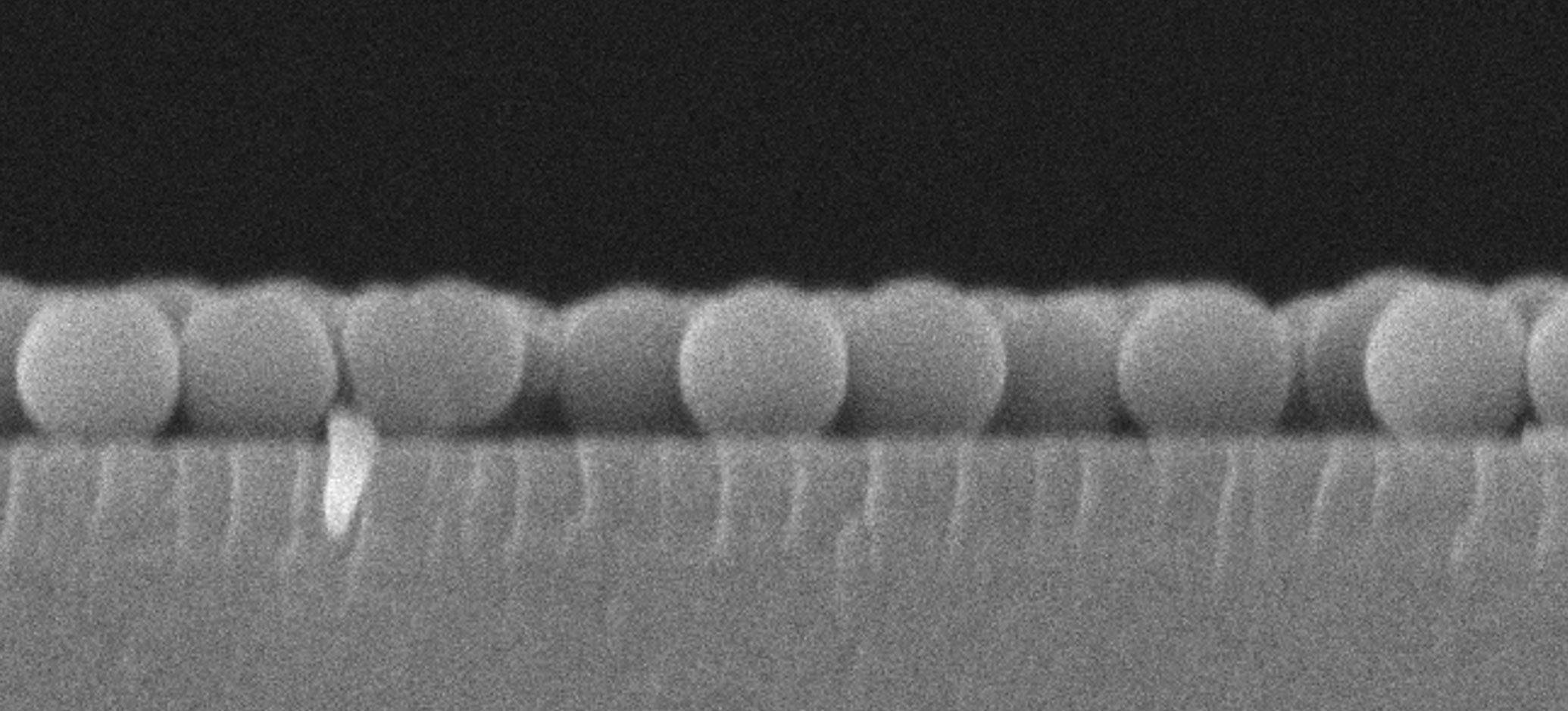
The researchers addressed this limitation by surrounding silicon nanospheres with thin silica shells. These shells protect the particles and control the distance between them, encouraging more orderly arrangements that reduce diffuse light scattering. The improved organization makes it possible to produce a glossy finish while controlling its intensity.
“Packing the nano spheres in silica shells not only protects the particles but also controls their spacing and should improve self-assembly into neat arrays,” Sugimoto explains.
The team demonstrated the coating on large, complex three-dimensional surfaces and showed that an additional protective layer did not significantly alter the resulting color. This overcomes a major limitation of previous structural color systems, whose optical properties can be disrupted by protective coatings.
“The most exciting aspect of this work is that it demonstrates glossy, non-iridescent and protection-coated structural color coatings for 3D objects in a single platform, making the technology useful for real-world applications,” Sugimoto says.
A Paint Layer That Could Weigh Just Ounces
The coating achieves high opacity and brightness using only a single layer of silicon nanospheres. This extremely thin structure offers a potentially enormous weight advantage over conventional paints. Coatings on wide-body passenger aircraft can add several hundred kilograms (about 660 pounds for 300 kilograms), whereas the researchers estimate that an equivalent structural color layer could theoretically weigh just several hundred grams (about 11 ounces for 300 grams). That comparison remains hypothetical rather than a demonstrated aircraft application.
The materials also offer potential environmental advantages. Silicon can be sourced from the semiconductor industry, while silica is among the most abundant materials in Earth’s crust. Because structural color does not depend on organic pigments that can break down under light exposure, the coatings could reduce fading and the need for replacement. Their actual environmental benefits at industrial scale have yet to be established.
From Industrial Coatings to New Optical Technologies
Sugimoto is helping establish a company to bring the technology toward industrial production. The fabrication process can accommodate several established manufacturing techniques, potentially allowing the coatings to be applied over much larger areas.
“The process is compatible with scalable coating methods such as spray coating, slot-die coating, and roll-to-roll processing,” Sugimoto explains.
The research group’s longer-term ambitions extend beyond decorative and protective finishes. By engineering the optical behavior of silicon nanoparticles, the scientists hope to create coatings that perform additional functions, including detecting environmental changes, driving light-activated chemical reactions, and managing energy.
“We want to expand the possibility of applications for the science behind our technology beyond coloration. Looking ahead, we aim to develop multifunctional silicon nanoparticle coatings that combine structural coloration with additional optical functions such as sensing, photocatalysis, and energy management.”
Reference: “Glossy yet Noniridescent Conformal Structural Color Coating of Three-Dimensional Objects With All-Dielectric Nanoparticle Monolayers” by Jialu Song, Keisuke Moriasa, Yosuke Ito, Mojtaba Karimi Habil, Patrick T. Probst, Hiroshi Sugimoto and Minoru Fujii, 3 September 2026, Small Structures.
DOI: 10.1002/sstr.70600
This research was funded by the Japan Agency for Medical Research and Development (grants JPMJPF2503, JPMJSF2405) and the Japan Society for the Promotion of Science (grants 24KF0158, 24K01287, 25K22206, 25K01608).
Never miss a breakthrough: Join the SciTechDaily newsletter.
Follow us on Google and Google News.
1 Comment
How many people would be perfectly happy with a car that has durable paint and looks like a rainbow? The part about not having any color change as tge angle changes is probably not that important. Possibly difficult for the police to use car color when looking for criminals, of course.