
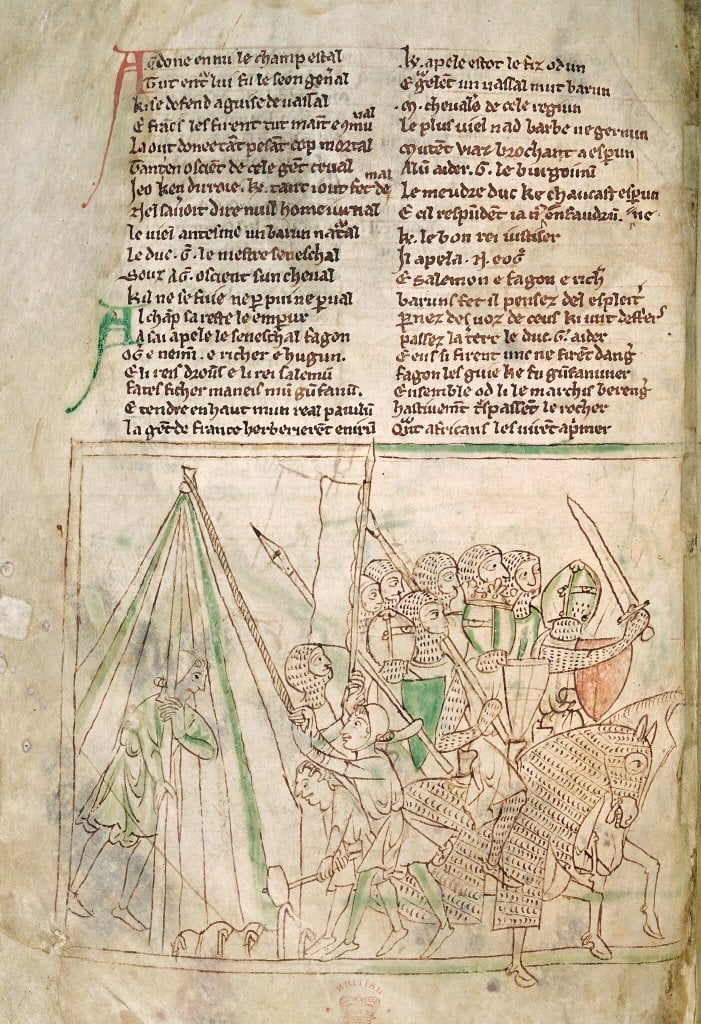
New simulations reveal how a medieval story’s earliest years may have determined its survival.
The medieval world may have produced far more stories of knights, legendary heroes, and epic adventures than historians will ever recover. A new study suggests that up to 60% of medieval chivalric works and more than 95% of their handwritten copies may have disappeared over the centuries.
Jean-Baptiste Camps and colleagues reached these estimates by combining computer simulations with historical evidence from approximately 2,000 medieval manuscripts spanning four centuries. Their research examines how stories survived through repeated copying, why others vanished entirely, and how much of a surviving work’s original history may be missing.
Why a Story’s First Years Could Determine Its Survival
Before the printing press, preserving a literary work depended on scribes making copies by hand. Each new manuscript could introduce accidental errors, deliberate revisions, or adaptations for different audiences. These changes accumulated across generations, producing branching family trees resembling those used to trace evolutionary relationships in biology. Scholars call these textual genealogies stemmata.
The simulations suggest that a work’s earliest years were especially critical. When only a few copies existed, the loss of those manuscripts could cause the entire text to disappear. The authors describe this vulnerable early period as a “danger zone.” Producing numerous copies soon after a work’s creation could substantially improve its chances of surviving for centuries.
The researchers tested several scenarios, including steady copying rates, declining popularity, and sudden destruction of manuscripts during a major crisis. Depending on the scenario, their models estimated that just 1.4% to 4.4% of individual manuscripts survived, illustrating how extensive the losses could have been.
Even Surviving Stories May Have Lost Their Original Versions
The disappearance of manuscripts did more than eliminate entire works. It also erased branches of the textual family trees that connect surviving copies to their origins.
The simulations indicate that surviving manuscripts often descend from later versions rather than directly preserving an author’s original text. The Song of Roland, one of the most famous medieval epics, may be an example. Its earliest form is probably lost, leaving scholars with later versions and rewritings that cannot fully establish what the original contained.
Historical events may have further influenced which stories endured. The Black Death, the Hundred Years’ War, and changing literary tastes could have disrupted manuscript production or contributed to the destruction of existing copies. Although the simulations demonstrate the substantial role chance can play, they do not establish which individual works disappeared because of particular historical events.
“Our results expose the fragility of cultural heritage and offer new tools to understand how randomness, historical contingencies, and human choices have shaped the legacy we inherit today,” the authors write.
Reference: “On the transmission of texts: Written cultures as complex systems” by Jean-Baptiste Camps, Julien Randon-Furling and Ulysse Godreau, 7 July 2026, PNAS Nexus.
DOI: 10.1093/pnasnexus/pgag207
Never miss a breakthrough: Join the SciTechDaily newsletter.
Follow us on Google and Google News.