
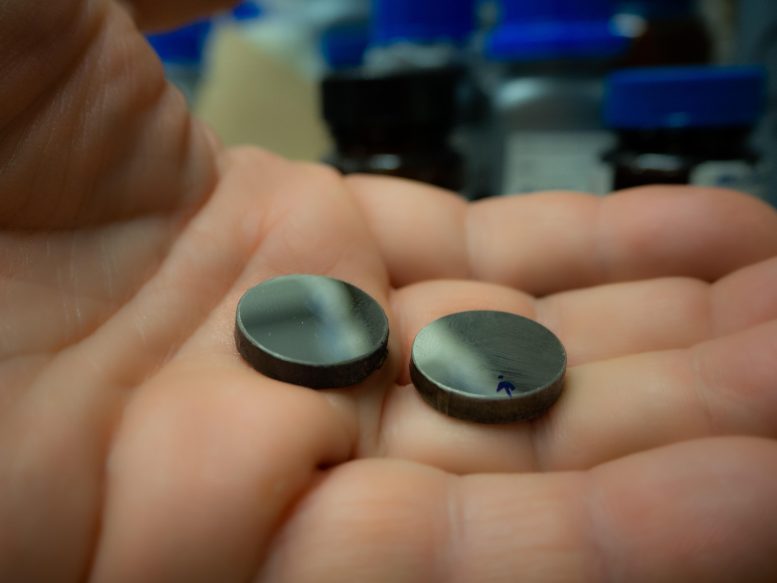
Scientists have uncovered a method to make ceramics tougher and more resistant to cracking. By building these materials with a mix of metal atoms that have a higher number of electrons in their external shell, a group spearheaded by engineers from the University of California San Diego has unlocked the potential to enable ceramics to handle higher levels of force and stress than before.
Characteristics and Limitations of Ceramics
Ceramics offer many advantages due to their remarkable properties, including their ability to withstand extremely high temperatures, resist corrosion and surface wear, and maintain lightweight profiles. These properties make them suitable for a variety of applications such as aerospace components and protective coatings for engines and cutting tools. However, their weakness has always been their brittleness. They break easily under stress.
But now, researchers have found a solution that could make ceramics harder to break. They published their work recently in Science Advances.
Unlocking Enhanced Toughness
The study, led by UC San Diego nanoengineering professor Kenneth Vecchio, centers on a class of ceramics known as high-entropy carbides. These materials have highly disordered atomic structures, composed of carbon atoms bonded with multiple metal elements from the fourth, fifth, and sixth columns of the periodic table. These metals include titanium, niobium and tungsten, for example. The researchers found that the key to enhancing ceramic toughness lay in the use of metals from the fifth and sixth columns of the periodic table, due to their higher number of valence electrons.
Valence electrons—those residing in an atom’s outermost shell and engaging in bonding with other atoms—proved to be a pivotal factor. By using metals with a higher valence electron count, the researchers successfully improved the material’s resistance to cracking when subjected to mechanical load and stress.
“Those extra electrons are important because they effectively make the ceramic material more ductile, meaning it can undergo more deformation before breaking, similar to a metal,” said Vecchio.
Simulations comparing the responses under applied stress of ceramics with different valence electron concentrations. Credit: UC San Diego Jacobs School of Engineering
To better understand this effect, Vecchio’s group collaborated with Davide Sangiovanni, a professor of theoretical physics at Linköping University, Sweden. Sangiovanni performed the computational simulations, and Vecchio’s team experimentally fabricated and tested the materials.
The team investigated high-entropy carbides featuring various combinations of five metal elements. Each combination yielded a different concentration of valence electrons within the material.
Identifying the Strongest Combinations
They identified two high-entropy carbides that exhibited exceptional resistance to cracking under load or stress, thanks to their high valence electron concentrations. One was composed of the metals vanadium, niobium, tantalum, molybdenum, and tungsten. The other variant substituted niobium with chromium in the mix.
Under mechanical load or stress, these materials were able to deform or stretch, respectively, resembling the behavior of metals rather than the typical brittle response of ceramics. As these materials were punctured or pulled apart, bonds began to break, forming atom-sized openings. The additional valence electrons around the metal atoms then reorganized to bridge these openings, forming new bonds between neighboring metal atoms. This mechanism preserved the material’s structure around the openings, effectively inhibiting them from growing bigger and forming cracks.
“We discovered that there’s this underlying transformation happening at the nanoscale where the bonds are being rearranged to hold the material together,” said study co-author Kevin Kaufmann, a UC San Diego nanoengineering Ph.D. alumnus from Vecchio’s lab. “Instead of just cleaving right across the fracture surface, the material slowly frays like a rope would when it is being pulled. In this way, the material can accommodate this deformation that’s occurring and not fail in a brittle manner.”
Applications and Future Prospects
The challenge now lies in scaling up the production of these tough ceramics for commercial applications. That could help transform technologies that rely on high-performance ceramic materials, from aerospace components to biomedical implants.
The newfound toughness of these ceramics also paves the way for their use in extreme applications, such as leading edges for hypersonic vehicles. Tougher ceramics could serve as frontline defense for these vehicles, shielding vital components from getting impacted by debris and enabling the vehicles to better survive supersonic flights, explained Vecchio.
“By addressing a longstanding limitation of ceramics, we can greatly expand their use and create next-generation materials that hold the potential to revolutionize our society,” said Vecchio.
Reference: “Valence electron concentration as key parameter to control the fracture resistance of refractory high-entropy carbides” by Davide G. Sangiovanni, Kevin Kaufmann and Kenneth Vecchio, 13 September 2023, Science Advances.
DOI: 10.1126/sciadv.adi2960
This work was supported by Swedish Research Council (grants VR-2018-05973 and VR-2021-04426), Competence Center Functional Nanoscale Materials (grant 2022-03071), Olle Engkvist Foundation, UC San Diego Department of NanoEngineering’s Materials Research Center, National Defense Science and Engineering Graduate Fellowship Program, ARCS Foundation (San Diego Chapter) and The Oerlikon Group.
Never miss a breakthrough: Join the SciTechDaily newsletter.
Follow us on Google and Google News.
1 Comment
Wow, metal in ceramics to create carbides! This breakthrough could mean significant industrial changes for the 19th and 20th centuries.
Allow me to attempt a translation of an article that was dumbed too far down. Materials scientists evaluated physical properties of common and unusual carbide ceramics at the nano-scale, and found the electron valence configuration of the metallic element used predicts durability. This isn’t my field, so the study itself is beyond me, and a dumbed-up article would have helped me.