
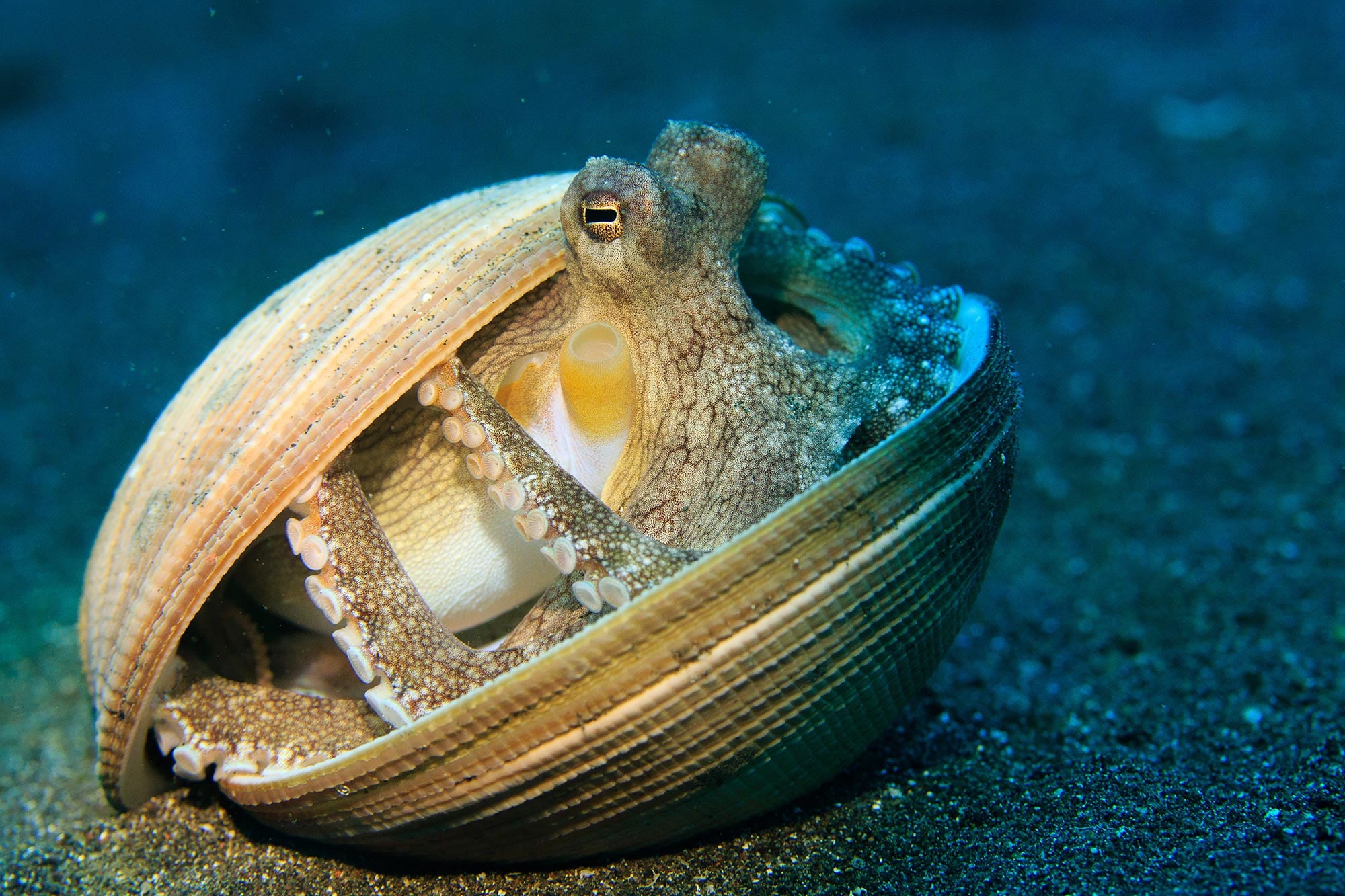
The extraordinary intelligence of octopuses, squid, and cuttlefish may be linked to more than just their genes.
Octopuses can solve problems, squid can rapidly change their appearance, and cuttlefish display remarkably sophisticated behaviors. These abilities rely on unusually complex nervous systems, but how such biological complexity evolved remains an open question. A new study suggests that part of the answer may lie in the three-dimensional structure of DNA rather than in genes alone.
Scientists at the University of Vienna discovered evidence that extensive genome rearrangements hundreds of millions of years ago changed how different regions of DNA interact in cephalopods. Published in Nature Communications, the study suggests that these ancient changes may have helped establish new patterns of gene regulation, potentially contributing to the evolution of their elaborate nervous systems.
How Ancient Genome Changes Reshaped Gene Regulation
DNA is not arranged as a straight strand inside the cell nucleus. Instead, it folds into a complex three-dimensional structure that brings distant genetic regions close together. This positioning influences which regulatory elements can interact with genes and control their activity.
“The genome isn’t just a sequence of genes. It’s folded into a complex three-dimensional structure,” said lead author Dr. Thea Rogers. “Understanding how that structure evolves is becoming increasingly important for understanding how new forms of biological complexity arise.”
By examining genome architecture alongside gene activity in octopuses, squid, and cuttlefish, the researchers identified the lasting effects of a major evolutionary restructuring. DNA regions that were previously separated became neighbors, creating opportunities for new regulatory interactions. Over time, some of these connections may have developed into increasingly interconnected networks, a process the researchers describe as “regulatory entanglement.”
Why Some Parts of the Genome Change More Than Others
The study also found that different levels of genome organization have evolved at strikingly different rates. Large structural regions called chromatin domains remained relatively stable over evolutionary time, even as other features of the genome changed substantially.
Smaller structures known as chromatin loops showed much greater variation across species, tissues, and developmental stages. These loops bring distant sections of DNA into physical proximity, allowing regulatory elements to influence genes that may be far away along the DNA sequence. Many occurred near genes associated with distinctive cephalopod characteristics, including those linked to the nervous system.
The researchers propose that regulatory entanglement may allow genomes to develop new patterns of gene expression while preserving essential biological functions. Stable chromatin domains could help maintain existing regulatory organization, while more flexible loops provide opportunities for evolutionary changes.
The findings suggest that the physical arrangement of DNA may actively influence evolutionary processes rather than simply reflect changes that have already occurred.
Reference: “Genome reorganisation and expansion shape 3D genome architecture and define a distinct regulatory landscape in coleoid cephalopods” by Thea F. Rogers, Jessica Stock, Natalie Grace Schulz, Gözde Yalçin, Simone Rencken, Anton Weissenbacher, Tereza Clarence, Darrin T. Schultz, Clifton W. Ragsdale, Caroline B. Albertin and Oleg Simakov, 9 October 2026, Nature Communications.
DOI: 10.1038/s41467-026-77625-7
Never miss a breakthrough: Join the SciTechDaily newsletter.
Follow us on Google and Google News.
1 Comment
Here’s the deal. Anything that accidentally happens to DNA will have one of 3 effects. It will either kill the cell, improve one or another function, or have no discernible effect. Sometimes, that effect only shows up if 2 matching bits both get either the same mutation or both have changes that don’t allow for either to compensate for the other. When the organism reproduces, sometimes there will be 2 different mutations that both are helpful. Such things have to happen many times before large numbers of a particular species actually have the new ability. One must presume that these invertebrates are the ones whose parents survived. Being able to remember what they did to survive must have been a big help. DNA folds in many animals, not just invertebrates.