
Close Menu
    Facebook X (Twitter) Instagram
    SciTechDaily
    • Biology
    • Chemistry
    • Earth
    • Health
    • Physics
    • Science
    • Space
    • Technology
    Facebook X (Twitter) Pinterest YouTube RSS
    SciTechDaily
    Home»Space»Astronomers Use G1 and G2 to Probe the Accretion Flow Feeding Sgr A*
    Space

    Astronomers Use G1 and G2 to Probe the Accretion Flow Feeding Sgr A*

    By Harvard-Smithsonian Center for AstrophysicsJanuary 4, 2016No Comments4 Mins Read
    Facebook Twitter Pinterest Telegram LinkedIn WhatsApp Email Reddit
    Share
    Facebook Twitter LinkedIn Pinterest Telegram Email Reddit
    Using Gas Clouds to Probe the Accretion Flow Feeding Sgr A
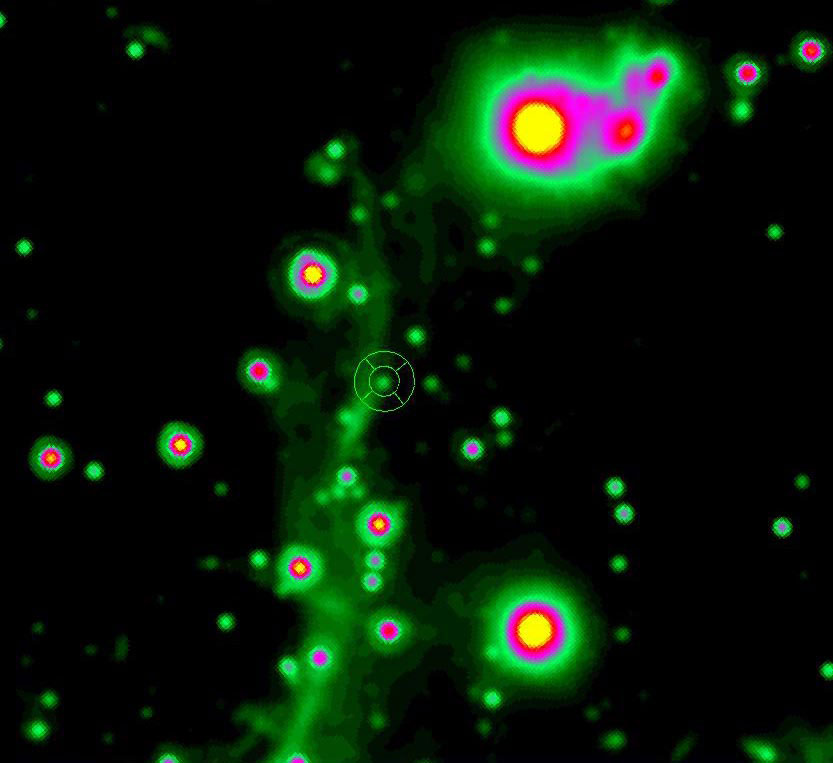
    A false-color infrared image of the region around the nucleus of our Milky Way, the supermassive black hole SagA*. The marker shows the location of the black hole, which glows faintly due to the accretion of material; the other objects are stars or dense clouds either orbiting the black hole or in its general vicinity. The size scale of the image end is about one light-year.

    New research uses the G1 and G2 gas clouds to probe the accretion flow feeding Sgr A∗.

    The center of our Milky Way galaxy, about twenty-five thousand light-years from Earth, is invisible to us in optical light because of the extensive amounts of absorbing, intervening dust. Radiation at many other wavelengths, however, including the infrared, radio, and energetic X-rays, can penetrate the veiling material. At the heart of the galactic center is a supermassive black hole, SagA*, with about four million solar masses of material. It is a relatively dim object, and shows some slight flickering that is thought to be the result of small blobs of material randomly accreting onto a disk around it. Its general passivity distinguishes SagA* from many other supermassive black holes in other galactic centers that actively accrete and heat large amounts of material, and then eject powerful bipolar jets of fast-moving charged particles.

    A few years ago astronomers spotted a large cloud of gas (estimated to be three Earth masses in size) moving relatively quickly towards SagA*. Some models projected that the cloud (known as G2) would be disrupted by the black hole during 2015, an event that might be accompanied by detectable radiation that could in turn shed light on a black hole’s feeding mechanisms. That did not happen; the year passed without any fireworks, possibly because G2 was too dense to break up.

    CfA astronomer Michael McCourt and his colleague have been able to make the most out of this recent non-event. They recognized that the ongoing X-ray emission from SgrA* implied an inflow rate of about a few Earth-masses per year from ambient material, but that this rate was inconsistent with almost every other measurement, including among other things the total luminosity of SgrA*. Sorting out the possible solutions required knowing the distribution of the gas very near the black hole – distances less than the distance of the Earth from the Sun. The scientists realized that they could use the changes in the orbit of G2 as it passed through this medium to probe the innermost gas. Even though the object was not devoured as expected, its path would be altered. They also took advantage of a second small cloud in the system, G1, to pin down some parameters as the two traveled during the year along highly eccentric, nearly co-planar orbits around SgrA*.

    The scientists modeled slight changes in the orbital parameters of G1 and G2 as they moved, assuming the changes were due to encounters with the local material. Their analysis provides the first determination of the rotation axis of the accretion flow, and points to the source of the accretion as being from the large torus of molecular gas that is about 4 light-years from the black hole, rather than from the winds of stars that are present in the intervening volume. The result is an important clue to the nature of the black hole’s environment, and moreover it has some observational consequences that might be tested in the next decade, including the future paths of G2 and G2 and the geometry of the emission close to the black hole’s boundary.

    Reference: “Going with the flow: using gas clouds to probe the accretion flow feeding Sgr A∗” Michael McCourt and Ann-Marie Madigan, 19 November 2015, MNRAS.
    DOI: 10.1093/mnras/stv2232

    Never miss a breakthrough: Join the SciTechDaily newsletter.
    Follow us on Google and Google News.

    Astronomy Astrophysics Black Hole Cosmology Harvard-Smithsonian Center for Astrophysics Milky Way
    Share. Facebook Twitter Pinterest LinkedIn Email Reddit

    Related Articles

    Astrophysicists Show Milky Way Had a Blowout Bash 6 Million Years Ago

    Astronomers Discover Evidence of a ‘Direct-Collapse Black Hole’

    Astronomers Take A Closer Look at the Milky Way’s Central Molecular Zone

    New Research Shows LIGO’s Twin Black Holes Might Have Been Born Inside a Single Star

    Astronomers Detect Signs of an Invisible Black Hole at the Center of the Milky Way

    Astronomers Reveal the “Skeletal Structure” of the Milky Way

    XMM-Newton Views Turbulent Events at the Center of the Milky Way

    A Significant Step Towards Explaining the Cosmic Origins of the Seeds of Galaxies

    Astrophysicists Closer to Figuring Out the Mysteries of the Milky Way

    Leave A Reply Cancel Reply

    • Facebook
    • Twitter
    • Pinterest
    • YouTube

    Don't Miss a Discovery

    Subscribe for the Latest in Science & Tech!

    Trending News

    Largest-Ever Study Finds Medicinal Cannabis Ineffective for Anxiety, Depression, PTSD

    250-Million-Year-Old Egg Solves One of Evolution’s Biggest Mysteries

    Living With Roommates Might Be Changing Your Gut Microbiome Without You Knowing

    Century-Old Cleaning Chemical Linked to 500% Increased Risk of Parkinson’s Disease

    What if Your Memories Never Happened? Physicists Take a New Look at the Boltzmann Brain Paradox

    One of the Universe’s Largest Stars May Be Getting Ready To Explode

    Scientists Discover Enzyme That Could Supercharge Ozempic-Like Weight Loss Drugs

    Popular Sweetener Linked to DNA Damage – “It’s Something You Should Not Be Eating”

    Follow SciTechDaily
    • Facebook
    • Twitter
    • YouTube
    • Pinterest
    • Newsletter
    • RSS
    SciTech News
    • Biology News
    • Chemistry News
    • Earth News
    • Health News
    • Physics News
    • Science News
    • Space News
    • Technology News
    Recent Posts
    • This Simple Blood Test Could Outperform “Bad Cholesterol” in Preventing Heart Disease
    • Scientists Uncover Potential Brain Risks of Popular Fish Oil Supplements
    • Scientists Prove There Are Just Six Degrees of Separation in a Social Network
    • Bee Bacteria Could Fix a Major Flaw in Plant-Based Milk
    • Scientists Discover a Surprising Way To Make Bread Healthier and More Nutritious
    Copyright © 1998 - 2026 SciTechDaily. All Rights Reserved.
    • Science News
    • About
    • Contact
    • Editorial Board
    • Privacy Policy
    • Terms of Use

    Type above and press Enter to search. Press Esc to cancel.