

Using Chandra observations, astronomers have discovered one of the nearest supermassive black holes to Earth that is currently undergoing powerful outbursts. Such outbursts are part of the “feedback” process that is important to the evolution of the black hole and its host galaxy.
Evidence for powerful blasts produced by a giant black hole has been discovered using NASA’s Chandra X-ray Observatory. This is one of the nearest supermassive black holes to Earth that is currently undergoing such violent outbursts.
Astronomers found this outburst in the supermassive black hole centered in the small galaxy NGC 5195. This companion galaxy is merging with a large spiral galaxy NGC 5194, also known as “The Whirlpool.” Both of these galaxies are in the Messier 51 galaxy system, located about 26 million light-years from Earth.
“For an analogy, astronomers often refer to black holes as ‘eating’ stars and gas. Apparently, black holes can also burp after their meal,” said Eric Schlegel of The University of Texas in San Antonio, who led the study. “Our observation is important because this behavior would likely happen very often in the early universe, altering the evolution of galaxies. It is common for big black holes to expel gas outward, but rare to have such a close, resolved view of these events.”
In the Chandra data, Schlegel and his colleagues detect two arcs of X-ray emission close to the center of NGC 5195.
“We think these arcs represent fossils from two enormous blasts when the black hole expelled material outward into the galaxy,” said co-author Christine Jones of the Harvard-Smithsonian Center for Astrophysics (CfA) in Cambridge, Mass. “This activity is likely to have had a big effect on the galactic landscape.”
Just outside the outer X-ray arc, the researchers detected a slender region of emission of relatively cool hydrogen gas in an optical image from the Kitt Peak National Observatory 0.9-meter telescope. This suggests that the hotter, X-ray emitting gas has “snow-plowed,” or swept up, the hydrogen gas from the center of the galaxy. This is a clear case where a supermassive black hole is affecting its host galaxy in a phenomenon that astronomers call “feedback.”
In NGC 5195, the properties of the gas around the X-ray-glowing arcs suggest that the outer arc has plowed up enough material to trigger the formation of new stars.
“We think that feedback keeps galaxies from becoming too large,” said co-author Marie Machacek of CfA. “But at the same time, it can be responsible for how some stars form. This shows that black holes can create, not just destroy.”
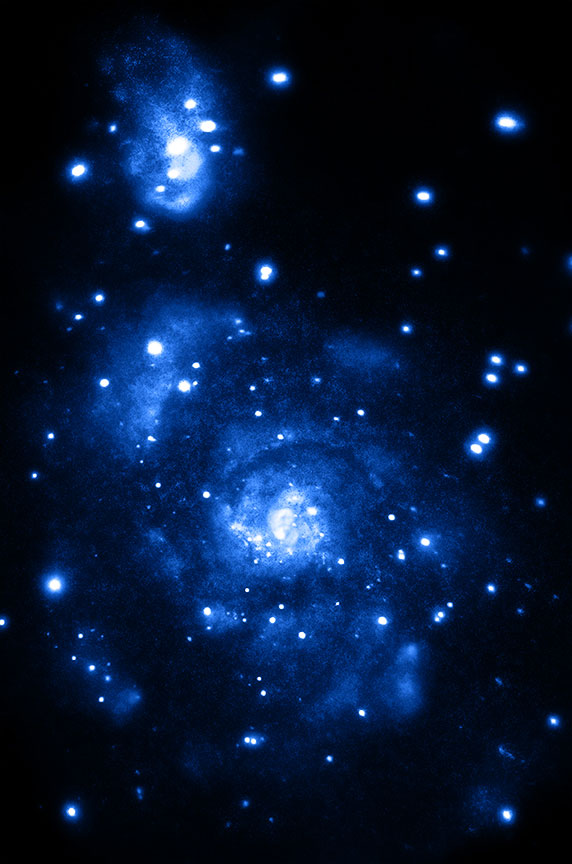
The astronomers think the outbursts of the supermassive black hole in NGC 5195 may have been triggered by the interaction of this smaller galaxy with its large spiral companion, causing gas to be funneled in towards the black hole. The energy generated by this infalling matter would produce the outbursts. The team estimates that it took about one to three million years for the inner arc to reach its current position, and three to six million years for the outer arc.
The arcs are also significant because of their location in the galaxy. They are well outside the region where rapid outflow, or winds, have been detected from active supermassive black holes in other galaxies, yet inside the much larger cavities and filaments observed in the hot gas around many massive galaxies. As such they may represent a rare view of an intermediate stage in the feedback process operating between the interstellar gas and the black hole.
These results were presented in January 2016 at the 227th meeting of the American Astronomical Society meeting in Kissimmee, FL, and have been submitted in a paper to The Astrophysical Journal. Laura Vega, of the Fisk University and Vanderbilt University Bridge Program, in Nashville, Tennessee was also a co-author of the paper. NASA’s Marshall Space Flight Center in Huntsville, Alabama, manages the Chandra program for NASA’s Science Mission Directorate in Washington. The Smithsonian Astrophysical Observatory in Cambridge, Massachusetts, controls Chandra’s science and flight operations.
More info at NASA’s Chandra X-ray Observatory.
Never miss a breakthrough: Join the SciTechDaily newsletter.
Follow us on Google and Google News.