
Close Menu
    Facebook X (Twitter) Instagram
    SciTechDaily
    • Biology
    • Chemistry
    • Earth
    • Health
    • Physics
    • Science
    • Space
    • Technology
    Facebook X (Twitter) Pinterest YouTube RSS
    SciTechDaily
    Home»Space»Calculations Show the Ideal Time to Study the Cosmos
    Space

    Calculations Show the Ideal Time to Study the Cosmos

    By Harvard-Smithsonian Center for AstrophysicsMay 23, 2012No Comments4 Mins Read
    Facebook Twitter Pinterest Telegram LinkedIn WhatsApp Email Reddit
    Share
    Facebook Twitter LinkedIn Pinterest Telegram Email Reddit
    ideal time to study the cosmos was more than 13 billion years ago
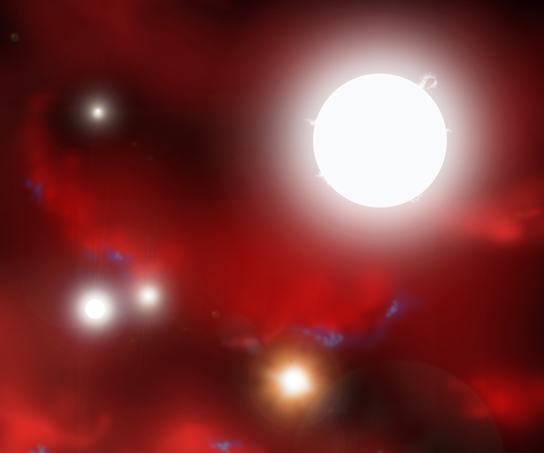
    New research finds that the ideal time to study the cosmos was more than 13 billion years ago, just about 500 million years after the Big Bang – the era (shown in this artist’s conception) when the first stars and galaxies began to form. Since information about the early universe is lost when the first galaxies are made, the best time to view cosmic perturbations is right when stars began to form. Modern observers can still access this nascent era from a distance by using surveys designed to detect 21-cm radio emission from hydrogen gas at those early times. Credit: Harvard-Smithsonian Center for Astrophysics

    The time to study the cosmos is now. New calculations show that the expansion of the cosmos is accelerating, galaxies are being pushed beyond our horizon and the scale of gravitationally unbound structures is growing larger and will eventually stretch beyond our horizon as well.

    The universe is a marvelously complex place, filled with galaxies and larger-scale structures that have evolved over its 13.7-billion-year history. Those began as small perturbations of matter that grew over time, like ripples in a pond, as the universe expanded. By observing the large-scale cosmic wrinkles now, we can learn about the initial conditions of the universe. But is now really the best time to look, or would we get better information billions of years into the future — or the past?

    New calculations by Harvard theorist Avi Loeb show that the ideal time to study the cosmos was more than 13 billion years ago, just about 500 million years after the Big Bang. The farther into the future you go from that time, the more information you lose about the early universe.

    “I’m glad to be a cosmologist at a cosmic time when we can still recover some of the clues about how the universe started,” Loeb said.

    Two competing processes define the best time to observe the cosmos. In the young universe the cosmic horizon is closer to you, so you see less. As the universe ages, you can see more of it because there’s been time for light from more distant regions to travel to you. However, in the older and more evolved universe, matter has collapsed to make gravitationally bound objects. This “muddies the waters” of the cosmic pond, because you lose memory of initial conditions on small scales. The two effects counter each other – the first grows better as the second grows worse.

    Loeb asked the question: When were viewing conditions optimal? He found that the best time to study cosmic perturbations was only 500 million years after the Big Bang.

    This is also the era when the first stars and galaxies began to form. The timing is not coincidental. Since information about the early universe is lost when the first galaxies are made, the best time to view cosmic perturbations is right when stars began to form.

    But it’s not too late. Modern observers can still access this nascent era from a distance by using surveys designed to detect 21-cm radio emission from hydrogen gas at those early times. These radio waves take more than 13 billion years to reach us, so we can still see how the universe looked early on.

    “21-centimeter surveys are our best hope,” said Loeb. “By observing hydrogen at large distances, we can map how matter was distributed at the early times of interest.”

    The accelerating universe makes the picture bleak for future cosmologists. Because the expansion of the cosmos is accelerating, galaxies are being pushed beyond our horizon. Light that leaves those distant galaxies will never reach Earth in the far future. In addition, the scale of gravitationally unbound structures is growing larger and larger. Eventually they, too, will stretch beyond our horizon. Some time between 10 and 100 times the universe’s current age, cosmologists will no longer be able to observe them.

    “If we want to learn about the very early universe, we’d better look now before it is too late!” Loeb said.

    Reference: “The optimal cosmic epoch for precision cosmology” by Abraham Loeb, 22 May 2012,  Journal of Cosmology and Astroparticle Physics (JCAP).
    DOI: 10.1088/1475-7516/2012/05/028

    Never miss a breakthrough: Join the SciTechDaily newsletter.
    Follow us on Google and Google News.

    Astronomy Astrophysics Cosmology Galaxy Harvard-Smithsonian Center for Astrophysics Universe
    Share. Facebook Twitter Pinterest LinkedIn Email Reddit

    Related Articles

    Mysterious Radio Signals Reveal What’s Hiding Between Galaxies

    Cosmic Mystery Solved: Astronomers Have Discovered the Universe’s “Missing” Matter

    GASS 3505: A Hydrogen Rich, Passive Galaxy

    Examining the Dust Absorption of Active Galactic Nuclei

    Dark Matter Filament in Galaxy Supercluster Directly Measured

    Using Infrared Images from Hubble & Spitzer, Scientists Discover 25 Distant Galaxies

    Earth in Motion and the Galaxies Around it

    Origins of Type Ia Supernovae

    The Bolshoi Simulation: Boxing the Universe

    Leave A Reply Cancel Reply

    • Facebook
    • Twitter
    • Pinterest
    • YouTube

    Don't Miss a Discovery

    Subscribe for the Latest in Science & Tech!

    Trending News

    Artificial Sweeteners May Harm Future Generations, Study Suggests

    Splashdown! NASA Artemis II Returns From Record-Breaking Moon Mission

    What If Consciousness Exists Beyond Your Brain

    Scientists Finally Crack the 100-Million-Year Evolutionary Mystery of Squid and Cuttlefish

    Beyond “Safe Levels”: Study Challenges What We Know About Pesticides and Cancer

    Researchers Have Found a Dietary Compound That Increases Longevity

    Scientists Baffled by Bizarre “Living Fossil” From 275 Million Years Ago

    Your IQ at 23 Could Predict Your Wealth at 27, Study Finds

    Follow SciTechDaily
    • Facebook
    • Twitter
    • YouTube
    • Pinterest
    • Newsletter
    • RSS
    SciTech News
    • Biology News
    • Chemistry News
    • Earth News
    • Health News
    • Physics News
    • Science News
    • Space News
    • Technology News
    Recent Posts
    • What if Dark Matter Has Two Forms? Bold New Hypothesis Could Explain a Cosmic Mystery
    • Researchers Expose Hidden Chemistry of “Ore-Forming” Elements in Biology
    • Geologists Reveal the Americas Collided Earlier Than We Thought
    • 20x Difference: Study Reveals True Source of Airborne Microplastics
    • Scientists Uncover Hidden Force Powering Yellowstone’s Supervolcano
    Copyright © 1998 - 2026 SciTechDaily. All Rights Reserved.
    • Science News
    • About
    • Contact
    • Editorial Board
    • Privacy Policy
    • Terms of Use

    Type above and press Enter to search. Press Esc to cancel.