

A filament of dark matter, which works like the Universe’s backbone, and dictates where galaxies can form, was observed for the first time by astronomers using a technique that could help astrophysicists understand the structure of the Universe.
Jörg Dietrich, a cosmologist at the University Observatory Munich in Germany, and his team, published their findings in the journal Nature. The researchers directly detected a slim bridge of dark matter joining two clusters of galaxies.
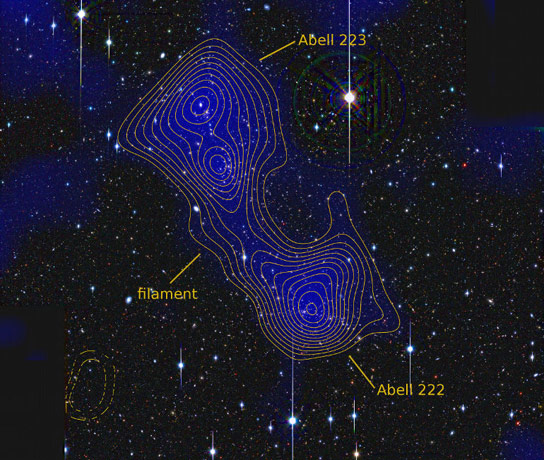
Visible stars and galaxies are supposed to trace a pattern across the sky, which is known as the cosmic web, according to the standard model of cosmology. This web was originally etched out by dark matter, which is hypothesized to account for almost 80% of the Universe’s matter. After the Big Bang, some regions were slightly denser than others, and pulled in dark matter that clumped together into flatter surfaces. When these surfaces intersect, they result in long strands of dark matter, or filaments. Clusters of galaxies are formed at the nodes of this cosmic web, where the filaments cross.
Dark matter is usually inferred by gravitational lensing, when its strong gravity bends light traveling from distant galaxies. The gravitational lensing of these dark matter filaments is hard to see because they contain little mass. Dietrich and his colleagues solved this problem by studying a massive filament, 18 megaparsecs long, that bridges the galaxy cluster Abell 222 and Abell 223. This particular filament is oriented so that much of its mass lies in the direct line of sight to Earth, which has the effect of enhancing the lensing effect.

The scientists examined the distortion of more than 40,000 background galaxies, and were able to calculate the mass of the filament as 6.5 × 10¹³ and 9.8 × 10¹³ times the mass of Sol. X-rays of the plasma in the filament were observed by the XMM-Newton spacecraft, which allowed the team to calculate that no more than 9% of the filament’s mass could be made up of hot gas. Another 10% of the mass could be due to visible stars and galaxies, something that computer simulations suggested. The bulk of it is dark matter.
It’s not yet known why baryonic matter follows the paths laid out by dark matter. This unusual system might let scientists map out how dark matter and normal matter interact, connect, and evolve along the filament. Japan’s Astro-H X-ray space telescope, which will be launched in 2014, might be able to characterize the ionization state and temperature of the plasma in the filament, which will help discriminate between different models of how the structure formed.
Reference: “A filament of dark matter between two clusters of galaxies” by Jörg P. Dietrich, Norbert Werner, Douglas Clowe, Alexis Finoguenov, Tom Kitching, Lance Miller and Aurora Simionescu, 4 July 2012, Nature.
DOI: 10.1038/nature11224
Never miss a breakthrough: Join the SciTechDaily newsletter.
Follow us on Google and Google News.
2 Comments
I believe that part of the problem with current theories is that the speed of light is considered to be a constant… Which it is if you are attached to the reference frame from which the light originates. However, when you look at things on a galactic scale each light source has its own reference frame with its own Universal velocity and direction which are different from the observer’s velocity and direction. Thus the speed of light is not constant from the observer’s point of view. This would at least partially explain why we have been unable to make the theories match the observations.
http://en.wikipedia.org/wiki/Electromagnetic_field_tensor
http://en.wikipedia.org/wiki/Einstein%E2%80%93Cartan_theory
http://en.wikipedia.org/wiki/Baryon
http://en.wikipedia.org/wiki/MOND#Publication_of_the_MOND_theory
http://en.wikipedia.org/wiki/Dark_Matter
http://science.nasa.gov/astrophysics/focus-areas/what-is-dark-energy/
Astronomers tells us that to study the largest object (universe) we must study the smallest objects (atomic particles). As a microbiologist, I see a great similarity between the universal filaments and bacterial cultures. Consider: When a mass of bacteria is added to warm agar and stirred, then poured into Petri plates, it cools. Soon bacterial colonies form that are associated with invisible pressure filaments. Those that form within the filament are flat, being pressured equally on both sides. Those that form at the “surface” of a filament are egg shaped, those that form between filaments are globular. And, the new colonies grow in singles, groups, clusters and superclusters. Perhaps we can learn more about the universe by studying the formation of bacterial colonies. Dr. Mark Sneller