
Close Menu
    Facebook X (Twitter) Instagram
    SciTechDaily
    • Biology
    • Chemistry
    • Earth
    • Health
    • Physics
    • Science
    • Space
    • Technology
    Facebook X (Twitter) Pinterest YouTube RSS
    SciTechDaily
    Home»Space»Examining the Dust Absorption of Active Galactic Nuclei
    Space

    Examining the Dust Absorption of Active Galactic Nuclei

    By Harvard-Smithsonian Center for AstrophysicsAugust 13, 2012No Comments3 Mins Read
    Facebook Twitter Pinterest Telegram LinkedIn WhatsApp Email Reddit
    Share
    Facebook Twitter LinkedIn Pinterest Telegram Email Reddit
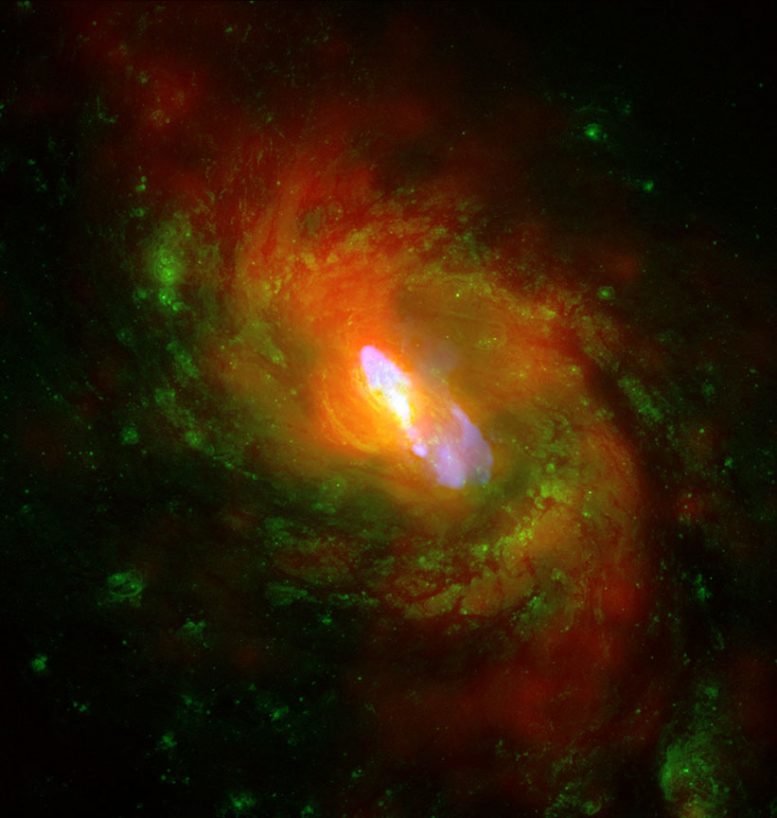
    composite image of NGC 1068
    This composite image (X-rays from Chandra in red, optical data in green, and radio emission in blue) shows NGC 1068, one of the nearest and brightest spiral galaxies containing a rapidly growing supermassive black hole. The X-ray images and spectra obtained using Chandra’s High Energy Transmission Grating Spectrometer show that a strong wind is being driven away from the center of NGC 1068 at a rate of about a million miles per hour. These results help explain how an “average”-sized supermassive black hole can alter the evolution of its host galaxy. Scale: Image is 1.0 arcmin across (about 15,000 light-years across). Credit: X-ray (NASA/CXC/MIT/C.Canizares, D.Evans et al), Optical (NASA/STScI), Radio (NSF/NRAO/VLA)

    Using the infrared spectrometer on the Spitzer Space Telescope to examine the dust absorption of active galactic nuclei, astronomers at Smithsonian Astrophysical Observatory found that in a significant amount of cases the absorbing dust is spread over a region larger than a torus.

    At the core of most galaxies including our own Milky Way is a massive black hole. Material falling into the environment of the black hole heats up, and can radiate dramatically, sometimes also powering the ejection of bipolar jets of rapidly moving charged particles. These so-called active galactic nuclei (AGN) are observed to have roughly two types of characteristics: bright, rapidly moving hot gas with dust emission features, or dust absorption with modest (or no) fast gas.

    According to the “unified” model of AGN, these and most other variations in appearance are primarily due to the angle at which a galaxy and its central engine are seen. In the first case the galaxy is seen face-on, and fast-moving gas close to the black hole is clearly visible. In the latter, the whole galaxy as well as a torus of obscuring dust around the black hole are seen edge-on; the torus blocks our view of the fast-moving gas and absorbs infrared in characteristic dust features.

    But is this simple model correct in all cases? Harvard-Smithsonian Center for Astrophysics (CfA) astronomers Andy Goulding, Bill Forman, Christine Jones, and Markos Trichas have undertaken a study of the origin of this infrared dust absorption feature. They specifically study the nature of the presumed torus: is it a small, uniform ring of dense material, a large extended structure of more diffuse material, or is it perhaps composed of many small dense clumps? The observed strength the infrared dust absorption is key to sorting out these differences.

    The astronomers used the infrared spectrometer on the Spitzer Space Telescope to examine the dust feature in all twenty nearby AGN having extremely large columns of neutral gas (Compton-thick AGN). The spectra provide quantitative measures of star formation as well as dust absorption. Writing in the Astrophysical Journal, the scientists reach several important conclusions. They find that in a significant minority of cases the absorbing dust is spread over a region larger than a torus, in support of one variant of the unified model. They also caution that these kinds of AGN have unusually high levels of star-formation; searches for other extreme AGN that neglect star-formation signatures are likely to miss a significant population of the most heavily obscured AGN.

    Reference: “Deep Silicate Absorption Features in Compton-Thick Active Galactic Nuclei Predominantly Arise Due to Dust in the Host Galaxy” by A. D. Goulding, D. M. Alexander, F. E. Bauer, W. R. Forman, R. C. Hickox, C. Jones, J. R. Mullaney and M. Trichas, 19 July 2012, Astrophysical Journal.
    DOI: 10.1088/0004-637X/755/1/5

    Never miss a breakthrough: Join the SciTechDaily newsletter.
    Follow us on Google and Google News.

    Astronomy Astrophysics Galaxy Harvard-Smithsonian Center for Astrophysics Popular
    Share. Facebook Twitter Pinterest LinkedIn Email Reddit

    Related Articles

    Centaurus a Hides a Gaseous Spiral at Its Core

    Pr0201b and Pr0211b Orbiting Sun-Like Stars in the Beehive Cluster

    Cloud of Hydrogen and Helium Plunging Toward the Galactic Center

    Rapid Star Formation Observed in the Phoenix Cluster

    Astronomers Detect X-rays From the Remains of Supernova SN 1957D

    Calculations Show the Ideal Time to Study the Cosmos

    Using Infrared Images from Hubble & Spitzer, Scientists Discover 25 Distant Galaxies

    Origins of Type Ia Supernovae

    Ancient Galactic Collision Created Stellar Swirls of NGC 5907

    Leave A Reply Cancel Reply

    • Facebook
    • Twitter
    • Pinterest
    • YouTube

    Don't Miss a Discovery

    Subscribe for the Latest in Science & Tech!

    Trending News

    Breakthrough Bowel Cancer Trial Leaves Patients Cancer-Free for Nearly 3 Years

    Natural Compound Shows Powerful Potential Against Rheumatoid Arthritis

    100,000-Year-Old Neanderthal Fossils in Poland Reveal Unexpected Genetic Connections

    Simple “Gut Reset” May Prevent Weight Gain After Ozempic or Wegovy

    2.8 Days to Disaster: Scientists Warn Low Earth Orbit Could Suddenly Collapse

    Common Food Compound Shows Surprising Power Against Superbugs

    5 Simple Ways To Remember More and Forget Less

    The Atomic Gap That Could Cost the Semiconductor Industry Billions

    Follow SciTechDaily
    • Facebook
    • Twitter
    • YouTube
    • Pinterest
    • Newsletter
    • RSS
    SciTech News
    • Biology News
    • Chemistry News
    • Earth News
    • Health News
    • Physics News
    • Science News
    • Space News
    • Technology News
    Recent Posts
    • Powerful Antioxidant Found To Play a Key Role in Proper Protein Folding
    • MIT Laser Breakthrough Lets Scientists Watch Drugs Enter the Brain in Real Time
    • Study Reveals Malaria’s Hidden Role in Human Evolution
    • Scientists Print Artificial Neurons That Can Talk to the Brain
    • Bowel and Ovarian Cancers Are Dramatically Rising in Young Adults and Scientists Aren’t Sure Why
    Copyright © 1998 - 2026 SciTechDaily. All Rights Reserved.
    • Science News
    • About
    • Contact
    • Editorial Board
    • Privacy Policy
    • Terms of Use

    Type above and press Enter to search. Press Esc to cancel.