
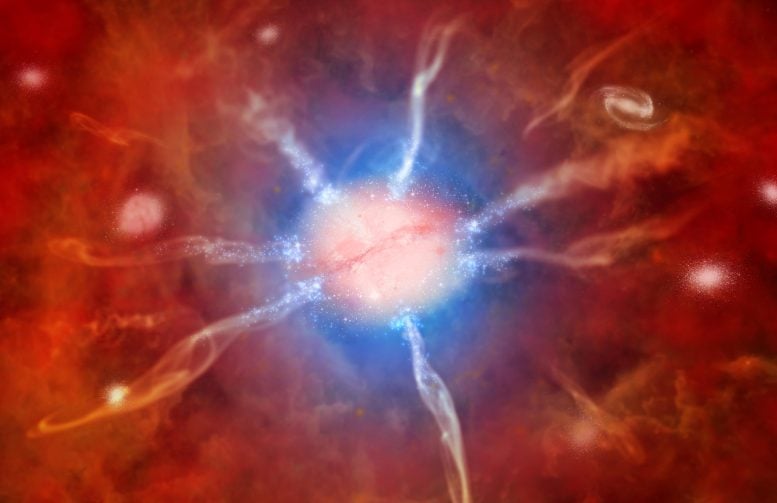
Using the Chandra X-Ray Observatory, the Magellan telescopes in Chile, the South Pole Telescope in Antarctica, and other facilities, a team of astronomers discovered the Phoenix Cluster, which is located 5.7 billion light-years away and is undergoing a massive burst of star formation with about 740 solar-masses worth of new stars being created every year.
Most galaxies lie in clusters, groupings of several to many thousands of galaxies. Our Milky Way galaxy itself is a member of the “Local Group,” a band of about fifty galaxies whose other large member is the Andromeda Galaxy about 2.3 million light-years away. The closest large cluster of galaxies to us is the Virgo Cluster, with about 2000 members, whose center is about 50 million light-years away. The space between all these galaxies is not empty, but is filled with hot gas whose temperature is of order ten million kelvin, or even higher.
The development of clusters is a key feature of galaxy evolution, as hundreds or often thousands of galaxies are bound together by their mutual gravitational attractions. Clustering influences how a particular member galaxy will evolve, and reflects the larger cosmic structures and physical processes. Astronomers use observations of faint, distant galaxies to check for consistency in their models of galaxy evolution, and to refine the parameters. The task of deciphering clustering in the early universe is difficult, however, because distant galaxies are faint and only the brightest ones can be seen. Still, research to date has been very productive. Observations of galaxy clusters have recently shed important new light on everything from dark matter in the universe to early cosmological phases following the Big Bang.
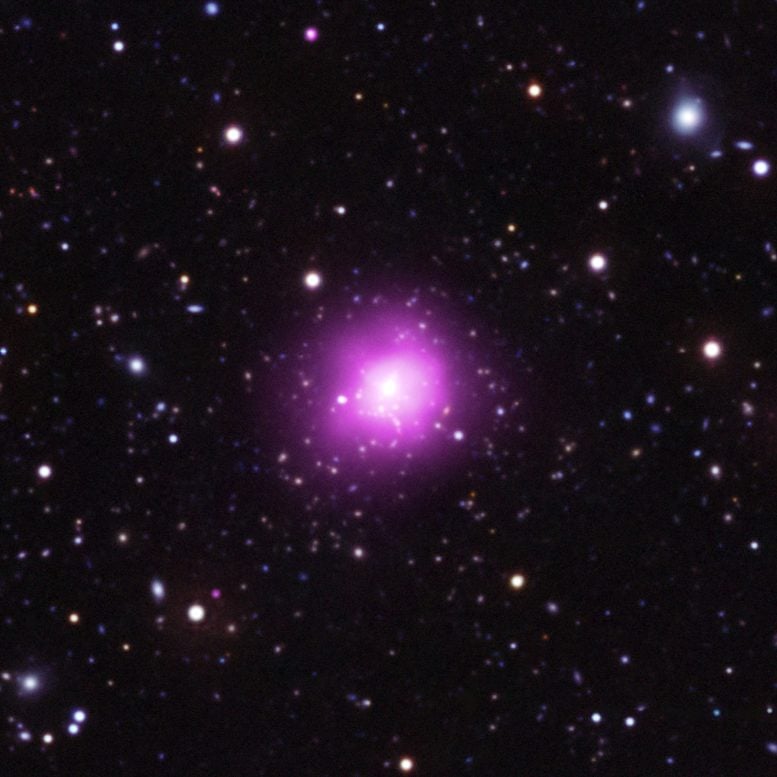
Despite many successes, current models of galaxy clustering suffer from several glaring omissions. One relates to the fate of its hot, X-ray emitting gas. In the cores of clusters the gas is heated to extreme temperatures by supernovae (the explosive deaths of stars) and other processes. The mystery is why this hot gas does not cool more efficiently and sink towards the center of the cluster. The common surmise has been that outflowing jets from supermassive black holes, or other kinds of feedback, inhibit the formation of such “cooling flows,” but establishing the details of this mechanism has been elusive.
Harvard-Smithsonian Center for Astrophysics (CfA) astronomers Ryan Foley, Matt Ashby, Bill Forman, Steve Murray, Brian Stalder, Tony Stark, Chris Stubbs, and Alex Vikhlinin are part of a team of astronomers who have discovered one of the largest and most luminous galaxy clusters in the universe, the so-called Phoenix Cluster, about 5.7 billion light-years away. Using the Chandra X-Ray Observatory, the Magellan telescopes in Chile, the South Pole Telescope in Antarctica, and a suite of other space and ground-based facilities, the team finds that the cluster (at least currently) is undergoing a massive burst of star formation with about 740 solar-masses worth of new stars being created every year (for reference, the Milky Way forms about one star per year).
This was unexpected: most clusters support only modest star formation. At the same time, the team finds that the dominant black hole in the cluster does not show especially powerful jet activity. Writing in last week’s issue of the journal Nature, the team concludes that this massive starburst is powered by the infalling material. They speculate that in this cluster the dominant black hole, although steadily growing in mass, has jets that are unable to halt the “cooling flow.”The implication is that either this cluster is of a very rare kind, or that with subsequent evolution it will develop more effective and customary ways to inhibit the infalling material.
Reference: “A massive, cooling-flow-induced starburst in the core of a luminous cluster of galaxies” by M. McDonald, M. Bayliss, B. A. Benson, R. J. Foley, J. Ruel, P. Sullivan, S. Veilleux, K. A. Aird, M. L. N. Ashby, M. Bautz, G. Bazin, L. E. Bleem, M. Brodwin, J. E. Carlstrom, C. L. Chang, H. M. Cho, A. Clocchiatti, T. M. Crawford, A. T. Crites, T. de Haan, S. Desai, M. A. Dobbs, J. P. Dudley, E. Egami, W. R. Forman, G. P. Garmire, E. M. George, M. D. Gladders, A. H. Gonzalez, N. W. Halverson, N. L. Harrington, F. W. High, G. P. Holder, W. L. Holzapfel, S. Hoover, J. D. Hrubes, C. Jones, M. Joy, R. Keisler, L. Knox, A. T. Lee, E. M. Leitch, J. Liu, M. Lueker, D. Luong-Van, A. Mantz, D. P. Marrone, J. J. McMahon, J. Mehl, S. S. Meyer, E. D. Miller, L. Mocanu, J. J. Mohr, T. E. Montroy, S. S. Murray, T. Natoli, S. Padin, T. Plagge, C. Pryke, T. D. Rawle, C. L. Reichardt, A. Rest, M. Rex, J. E. Ruhl, B. R. Saliwanchik, A. Saro, J. T. Sayre, K. K. Schaffer, L. Shaw, E. Shirokoff, R. Simcoe, J. Song, H. G. Spieler, B. Stalder, Z. Staniszewski, A. A. Stark, K. Story, C. W. Stubbs, R. Šuhada, A. van Engelen, K. Vanderlinde, J. D. Vieira, A. Vikhlinin, R. Williamson, O. Zahn and A. Zenteno, 15 August 2012, Nature.
DOI: 10.1038/nature11379
Never miss a breakthrough: Join the SciTechDaily newsletter.
Follow us on Google and Google News.
1 Comment
To the author of this story:
This article makes the claim that the Milky Way Galaxy creates a new star about once a year. We have had pretty good astronomy equipment for the past 100 years, and certainly in the last 50 years. Can you please provide the names and locations of the 50 stars to have been formed in the Milky Way Galaxy during the last 50 years?
Thank you.