
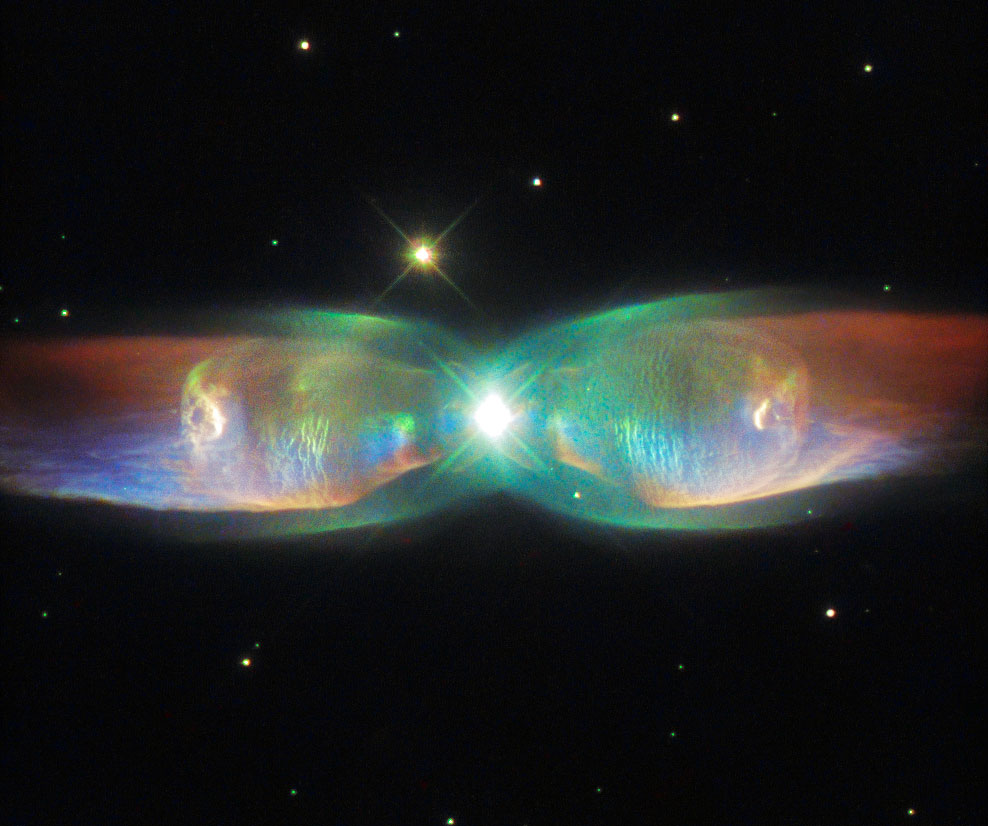
This newly released Hubble image shows the Twin Jet Nebula, which is a striking example of a bipolar planetary nebula. Astronomers have shown that the nebula’s size increases with time, and measurements of this rate of increase suggest that the stellar outburst that formed the lobes occurred just 1200 years ago.
The shimmering colors visible in this NASA/ESA Hubble Space Telescope image show off the remarkable complexity of the Twin Jet Nebula, or PN M2-9. The new image highlights the nebula’s shells and its knots of expanding gas in striking detail. Two iridescent lobes of material stretch outwards from a central star system. Within these lobes two huge jets of gas are streaming from the star system at speeds in excess of one million kilometers per hour.
The cosmic butterfly pictured in this NASA/ESA Hubble Space Telescope image goes by many names. It is called the Twin Jet Nebula as well as answering to the slightly less poetic name of PN M2-9.
The M in this name refers to Rudolph Minkowski, a German-American astronomer who discovered the nebula in 1947. The PN, meanwhile, refers to the fact that M2-9 is a planetary nebula. The glowing and expanding shells of gas clearly visible in this image represent the final stages of life for an old star of low to intermediate mass. The star has not only ejected its outer layers, but the exposed remnant core is now illuminating these layers — resulting in a spectacular light show like the one seen here. However, the Twin Jet Nebula is not just any planetary nebula, it is a bipolar nebula.
Ordinary planetary nebulae have one star at their center, bipolar nebulae have two, in a binary star system. Astronomers have found that the two stars in this pair each have around the same mass as the Sun, ranging from 0.6 to 1.0 solar masses for the smaller star, and from 1.0 to 1.4 solar masses for its larger companion. The larger star is approaching the end of its days and has already ejected its outer layers of gas into space, whereas its partner is further evolved, and is a small white dwarf.
This Hubblecast explores the wings of Twin Jet Nebula which were observed and studied by the NASA/ESA Hubble Space Telescope.
The characteristic shape of the wings of the Twin Jet Nebula is most likely caused by the motion of the two central stars around each other. It is believed that a white dwarf orbits its partner star and thus the ejected gas from the dying star is pulled into two lobes rather than expanding as a uniform sphere. However, astronomers are still debating whether all bipolar nebulae are created by binary stars. Meanwhile, the nebula’s wings are still growing and, by measuring their expansion, astronomers have calculated that the nebula was created only 1200 years ago.
Within the wings, starting from the star system and extending horizontally outwards like veins are two faint blue patches. Although these may seem subtle in comparison to the nebula’s rainbow colors, these are actually violent twin jets streaming out into space, at speeds in excess of one million kilometers per hour. This is a phenomenon that is another consequence of the binary system at the heart of the nebula. These jets slowly change their orientation, precessing across the lobes as they are pulled by the wayward gravity of the binary system.
The two stars at the heart of the nebula circle one another roughly every 100 years. This rotation not only creates the wings of the butterfly and the two jets, it also allows the white dwarf to strip gas from its larger companion, which then forms a large disc of material around the stars, extending out as far as 15 times the orbit of Pluto! Even though this disc is of incredible size, it is much too small to be seen on the image taken by Hubble.
An earlier image of the Twin Jet Nebula using data gathered by Hubble’s Wide Field Planetary Camera 2 was released in 1997. This newer version incorporates more recent observations from the telescope’s Space Telescope Imaging Spectrograph (STIS).
Never miss a breakthrough: Join the SciTechDaily newsletter.
Follow us on Google and Google News.
2 Comments
These images have been thoroughly explained by Dr. Donald Scott at NASA’s Goddard Colloquim on Engineering in 2009.
The photos represent intergalactic Birkeland currents. The presence of the Z pinch is classic and easily identified by any electrical engineer.
This is a classic example of data that puzzles astrophysicists but is routine to electrical engineers.
Anyone interested in the interpretation of the newest radio telescope data from deep space would benefit from Scott’s presentation. It is available on you tube.
The latest findings of massive magnetic fields surrounding “black holes” and even galaxies clearly show a much bigger role for electromagnetism in the understanding of cosmology. This includes the structure of stars, “black holes” and galaxies.
All the latest radio telescope data indicates that electromagnetism is a main driving force for the formation of all structures in space. Those that ignore this data will be left behind.
Outflows are ubiquitous in astrophysics. Despite different sizes, velocity and amount of transported energy, luminosity and degree of collimation, they have obvious morphological similarities. However, what is important for us, there is the picture of the outflows from everywhere and none of inflows into somewhere. That is an obvious asymmetry.