
Close Menu
    Facebook X (Twitter) Instagram
    SciTechDaily
    • Biology
    • Chemistry
    • Earth
    • Health
    • Physics
    • Science
    • Space
    • Technology
    Facebook X (Twitter) Pinterest YouTube RSS
    SciTechDaily
    Home»Space»Hubble Telescope Close-up of the Red Planet
    Space

    Hubble Telescope Close-up of the Red Planet

    By Hubble Space TeelscopeMay 23, 2016No Comments4 Mins Read
    Facebook Twitter Pinterest Telegram LinkedIn WhatsApp Email Reddit
    Share
    Facebook Twitter LinkedIn Pinterest Telegram Email Reddit
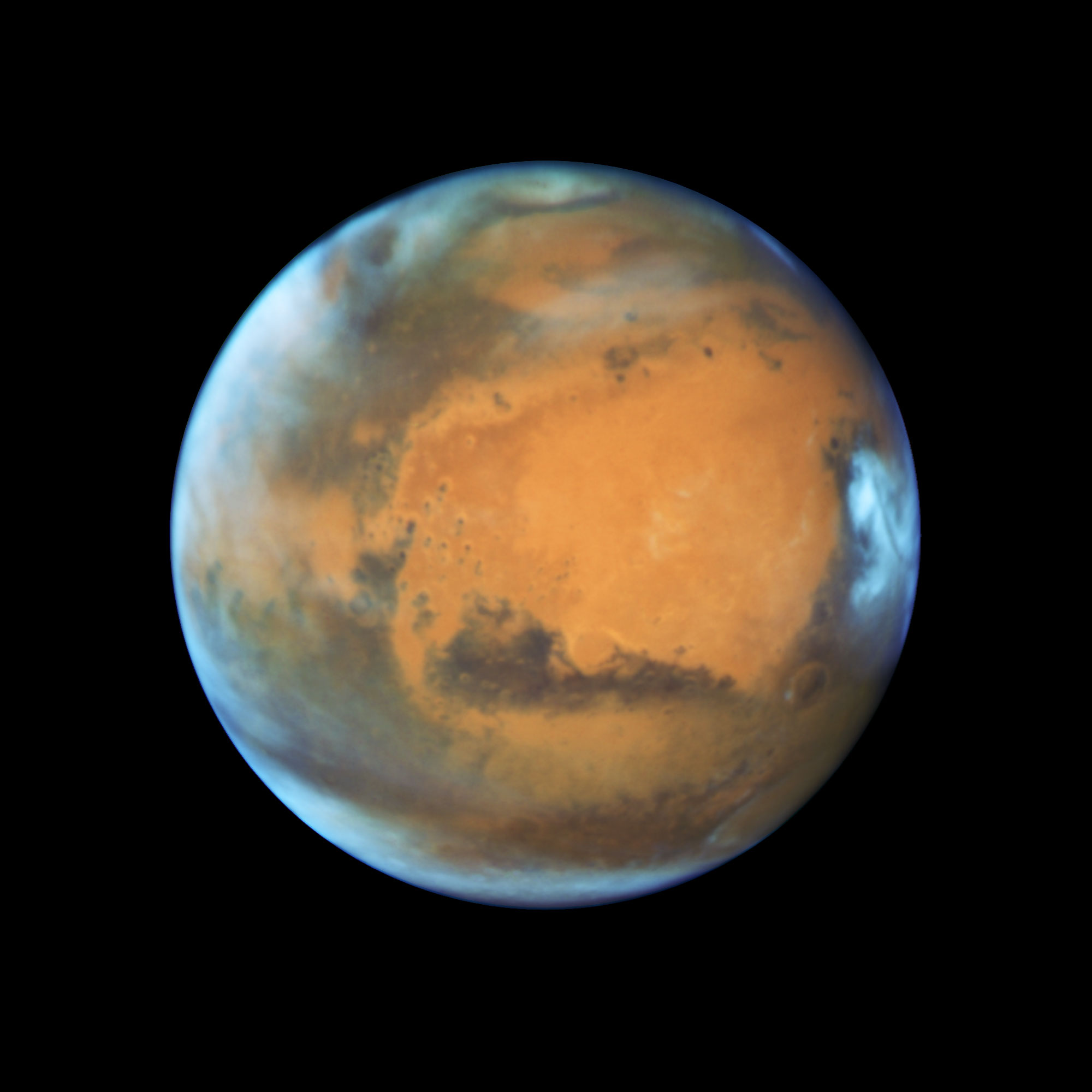
    Close-up of the Red Planet
    This image shows our neighboring planet Mars, as it was observed shortly before opposition in 2016 by the NASA/ESA Hubble Space Telescope. Some prominent features of the planet are clearly visible: the ancient and inactive shield volcano Syrtis Major; the bright and oval Hellas Planitia basin; the heavily eroded Arabia Terra in the center of the image; the dark features of Sinus Sabaeous and Sinus Meridiani along the equator; and the small southern polar cap.

    Using NASA’s Hubble Space Telescope, astronomers captured this striking image of Mars, when the planet was 50 million miles (80 million kilometers) from Earth. The photo reveals details as small as 20 miles to 30 miles (32 to 48 kilometers) across. On May 30th, Mars will be the closest it has been to Earth in 11 years, at a distance of 46.8 million miles (75 million kilometers). Mars is especially photogenic during opposition because it can be seen fully illuminated by the sun as viewed from Earth.

    During May 2016 the Earth and Mars get closer to each other than at any time in the last ten years. The NASA/ESA Hubble Space Telescope has exploited this special configuration to catch a new image of our red neighbor, showing some of its famous surface features. This image supplements previous Hubble observations of Mars and allows astronomers to study large-scale changes on its surface.

    On May 22nd Mars came into opposition, the point at which the planet is located directly opposite the Sun in the sky. This means that the Sun, Earth, and Mars line up, with Earth sitting in between the Sun and the red planet.

    Opposition also marks the planet’s closest approach to Earth, so that Mars appears bigger and brighter in the sky than usual. This event allows astronomers using telescopes in space and on the ground to see more details on the Martian surface. For observers using ground-based instruments, the opposing planet is visible throughout the night and is also fully illuminated, making it a great opportunity for detailed studies.

    On May 12th Hubble took advantage of this favorable alignment and turned its gaze towards Mars to take an image of our rusty-hued neighbor, adding it to the collection of previous images. From this distance, the telescope could see Martian features as small as 30 kilometers (19 miles) across.

    Hubble observed Mars using its Wide Field Camera 3 (WFC3). The final image shows a sharp, natural-color view of Mars and reveals several prominent geological features, from smaller mountains and erosion channels to immense canyons and volcanoes.
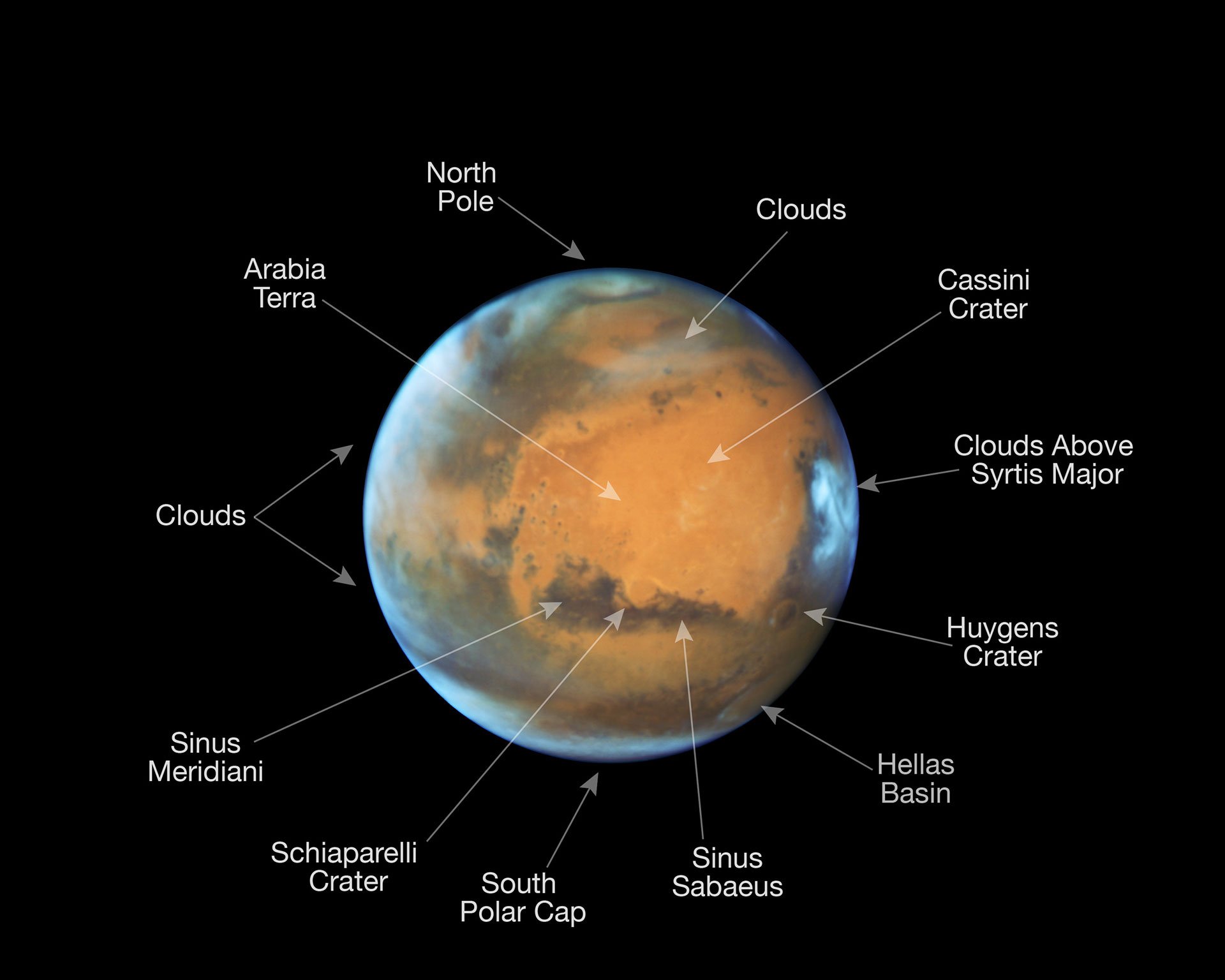
    Mars in Opposition 2016 Image Annotated
    This image shows our neighboring planet Mars, as it was observed shortly before opposition in 2016 by the NASA/ESA Hubble Space Telescope. Some prominent features on the surface of the planet have been annotated.

    The large, dark region to the far right is Syrtis Major Planitia, one of the first features identified on the surface of the planet by seventeenth-century observers. Syrtis Major is an ancient, inactive shield volcano. Late-afternoon clouds surround its summit in this view. The oval feature south of Syrtis Major is the bright Hellas Planitia basin, the largest crater on Mars. About 1,800 kilometers (1,100 miles) across and eight kilometers (5 miles) deep, it was formed about 3.5 billion years ago by an asteroid impact.

    The orange area in the center of the image is Arabia Terra, a vast upland region. The landscape is densely cratered and heavily eroded, indicating that it could be among the oldest features on the planet.

    South of Arabia Terra, running east to west along the equator, are the long dark features known as Sinus Sabaeous (to the east) and Sinus Meridiani (to the west). These darker regions are covered by bedrock from ancient lava flows and other volcanic features.

    An extended blanket of clouds can be seen over the southern polar cap. The icy northern polar cap has receded to a comparatively small size because it is now late summer in the northern hemisphere.

    For Mars, the average time between successive oppositions — known as the planet’s synodic period — is 780 days — so the previous time that the planet was in opposition was April 2014. Hubble has observed Mars at (or near) opposition many times, including in 1995, 1999 (twice), 2001, 2003 (twice), 2005, and 2007.

    Never miss a breakthrough: Join the SciTechDaily newsletter.
    Follow us on Google and Google News.

    Astronomy Cosmology Hubble Space Telescope Mars NASA Planetary Science Popular
    Share. Facebook Twitter Pinterest LinkedIn Email Reddit

    Related Articles

    Hubble Finds a Planet Orbiting Pair of Stars in System OGLE-2007-BLG-349

    Mineralogy of Martian Soil Is Similar to Soils of Volcanic Origin in Hawaii

    New Study Revives Doubted Exoplanet Fomalhaut b

    Curiosity Prepares to Take Its First Scoop of Soil for Analysis

    Curiosity Finds Ancient Streambed on Mars

    NASA’s Opportunity Discovers Geological Mystery on Mars

    NASA Data Suggests “Dry Ice” Snowfall on Mars

    NASA’s Curiosity Readies for First Drive on Mars

    Color HiRISE Image of Curiosity Rover on Mars

    Leave A Reply Cancel Reply

    • Facebook
    • Twitter
    • Pinterest
    • YouTube

    Don't Miss a Discovery

    Subscribe for the Latest in Science & Tech!

    Trending News

    Largest-Ever Study Finds Medicinal Cannabis Ineffective for Anxiety, Depression, PTSD

    250-Million-Year-Old Egg Solves One of Evolution’s Biggest Mysteries

    Living With Roommates Might Be Changing Your Gut Microbiome Without You Knowing

    Century-Old Cleaning Chemical Linked to 500% Increased Risk of Parkinson’s Disease

    What if Your Memories Never Happened? Physicists Take a New Look at the Boltzmann Brain Paradox

    One of the Universe’s Largest Stars May Be Getting Ready To Explode

    Scientists Discover Enzyme That Could Supercharge Ozempic-Like Weight Loss Drugs

    Popular Sweetener Linked to DNA Damage – “It’s Something You Should Not Be Eating”

    Follow SciTechDaily
    • Facebook
    • Twitter
    • YouTube
    • Pinterest
    • Newsletter
    • RSS
    SciTech News
    • Biology News
    • Chemistry News
    • Earth News
    • Health News
    • Physics News
    • Science News
    • Space News
    • Technology News
    Recent Posts
    • A Simpler Path to Super-Resolution: Scientists Reinvent Microscopy
    • Scientists Uncover Hidden Genetic Cause of Diabetes in Babies
    • Amazonian Chocolate Could Become the Next Superfood, Scientists Say
    • Challenging the Narrative: New Study Shows U.S. Life Expectancy Is Rising Across All States
    • Mystery Illness Kills 5 in Burundi As Doctors Scramble for Answers
    Copyright © 1998 - 2026 SciTechDaily. All Rights Reserved.
    • Science News
    • About
    • Contact
    • Editorial Board
    • Privacy Policy
    • Terms of Use

    Type above and press Enter to search. Press Esc to cancel.