
Close Menu
    Facebook X (Twitter) Instagram
    SciTechDaily
    • Biology
    • Chemistry
    • Earth
    • Health
    • Physics
    • Science
    • Space
    • Technology
    Facebook X (Twitter) Pinterest YouTube RSS
    SciTechDaily
    Home»Health»Yale Researchers Reveal How Antibodies Access Neurons to Fight Infection
    Health

    Yale Researchers Reveal How Antibodies Access Neurons to Fight Infection

    By Ziba Kashef, Yale UniversityMay 23, 20161 Comment2 Mins Read
    Facebook Twitter Pinterest Telegram LinkedIn WhatsApp Email Reddit
    Share
    Facebook Twitter LinkedIn Pinterest Telegram Email Reddit
    Yale Researchers Show How Antibodies Access Neurons to Fight Infection
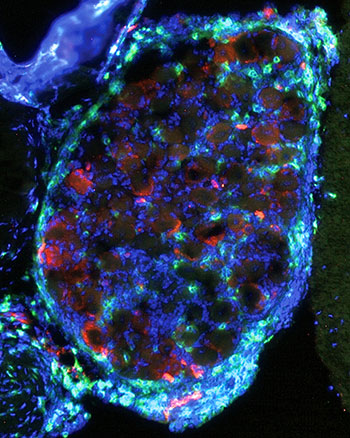
    A cross-section of mouse dorsal root ganglia stained for memory CD4 T cells (green) and the vascular cell adhesion molecule, VCAM-1 (red) after six days of genital herpes challenge. (Photo by Norifumi Iijima)

    New research from Yale University reveals how antibodies enter the nervous system to control viral infections. The findings may have implications for the prevention and treatment of a range of conditions, including herpes and Guillain-Barre syndrome, which has been linked to the Zika virus.

    Many viruses — such as West Nile, Zika, and the herpes simplex virus — enter the nervous system, where they were thought to be beyond the reach of antibodies. Yale immunobiologists Akiko Iwasaki and Norifumi Iijima used mice models to investigate how antibodies could gain access to nerve tissue in order to control infection.

    In mice infected with herpes, they observed a previously under-recognized role of CD4 T cells, a type of white blood cell that guards against infection by sending signals to activate the immune system. In response to herpes infection, CD4 T cells entered the nerve tissue, secreted signaling proteins, and allowed antibody access to infected sites. Combined, CD4 T cells and antibodies limited viral spread.

    “This is a very elegant design of the immune system to allow antibodies to go to the sites of infection,” said Iwasaki. “The CD4 T cells will only go to the site where there is a virus. It’s a targeted delivery system for antibodies.”

    The finding has multiple implications, said the researchers. Without CD4 T cells, antibody-based therapies that are being developed for conditions like herpes may not be sufficient to control infection, Iwasaki noted. Conversely, for antibody-mediated autoimmune diseases such as Guillain-Barre, “it may be beneficial to block CD4 from entering the neuronal tissues,” she said.

    The study was funded by the National Institutes of Health, and the Howard Hughes Medical Institute and was published May 18 in Nature.

    Reference: “Access of protective antiviral antibody to neuronal tissues requires CD4 T-cell help ” by Norifumi Iijima and Akiko Iwasaki, 18 May 2016, Nature.
    DOI: 10.1038/nature17979

    Never miss a breakthrough: Join the SciTechDaily newsletter.
    Follow us on Google and Google News.

    Antibodies Disease Immunobiology Yale University
    Share. Facebook Twitter Pinterest LinkedIn Email Reddit

    Related Articles

    New Antibody-Based Treatment Targets Colorectal Cancer

    New Drug Suppresses HIV & Protects Immune Cells With a Single Dose

    Yale Study Shows Surprising Link Between Constipation and Herpes Infection

    Yale Examines How Bacteria Might Trigger and Treat Autoimmune Disease

    New Strategy to Better Protect Cancer Patients from the Flu

    Researchers May Have Pinpointed a Strategy for Eliminating Latent HIV

    How the Immune System Combats Superinfection

    New Model for Vaccination Against Genital Herpes

    New Antibody Drug Boosts the Immune System’s Capacity to Fight Cancer

    1 Comment

    1. Gina Dickens on September 3, 2024 8:36 am

      This is the kind of research people need for Alpha gal Syndrome. AGS sets off a wide array of autoimmune diseases. In-depth research is needed to understand how the Allergen behaves in our bodies- every organ can be affected by AGS. Everything from MS, thyroid, liver, brain, skin, gastrointestinal, arthritis, it literally sends our immune system in hyper mode causing our bodies to attack itself. There hasn’t been enough research at the level that you all do! Top notch!! I have seen impressive testing done by your institution on multiple levels that concern me. Thank you!!

      Reply
    Leave A Reply Cancel Reply

    • Facebook
    • Twitter
    • Pinterest
    • YouTube

    Don't Miss a Discovery

    Subscribe for the Latest in Science & Tech!

    Trending News

    Why Popular Diabetes Drugs Like Ozempic Don’t Work for Everyone: The “Genetic Glitch”

    Scientists Stunned After Finding Plant Thought Extinct for 60 Years

    Scientists Discover Tiny New Spider That Hunts Prey 6x Its Size

    Natural Component From Licorice Shows Promise for Treating Inflammatory Bowel Disease

    Scientists Warn: Popular Sweetener Linked to Dangerous Metabolic Effects

    Monster Storms on Jupiter Unleash Lightning Beyond Anything on Earth

    Scientists Create “Liquid Gears” That Spin Without Touching

    The Simple Habit That Could Help Prevent Cancer

    Follow SciTechDaily
    • Facebook
    • Twitter
    • YouTube
    • Pinterest
    • Newsletter
    • RSS
    SciTech News
    • Biology News
    • Chemistry News
    • Earth News
    • Health News
    • Physics News
    • Science News
    • Space News
    • Technology News
    Recent Posts
    • This Common Habit Could Signal Serious Health Problems in Later Life
    • Common Food Preservative Linked to Rising Suicide Deaths Among Young People
    • Seeing the Invisible: Scientists Develop New Way To Track Particles in 3D
    • The Atomic Gap That Could Cost the Semiconductor Industry Billions
    • Earth’s Secret Advantage: Why Most Alien Worlds May Be Too Dry for Life
    Copyright © 1998 - 2026 SciTechDaily. All Rights Reserved.
    • Science News
    • About
    • Contact
    • Editorial Board
    • Privacy Policy
    • Terms of Use

    Type above and press Enter to search. Press Esc to cancel.