

Observations from the Penn State Habitable-zone Planet Finder revealed a stellar flare on vB 10, a cool, small star, showing signs of coronal rain similar to that seen on the Sun.
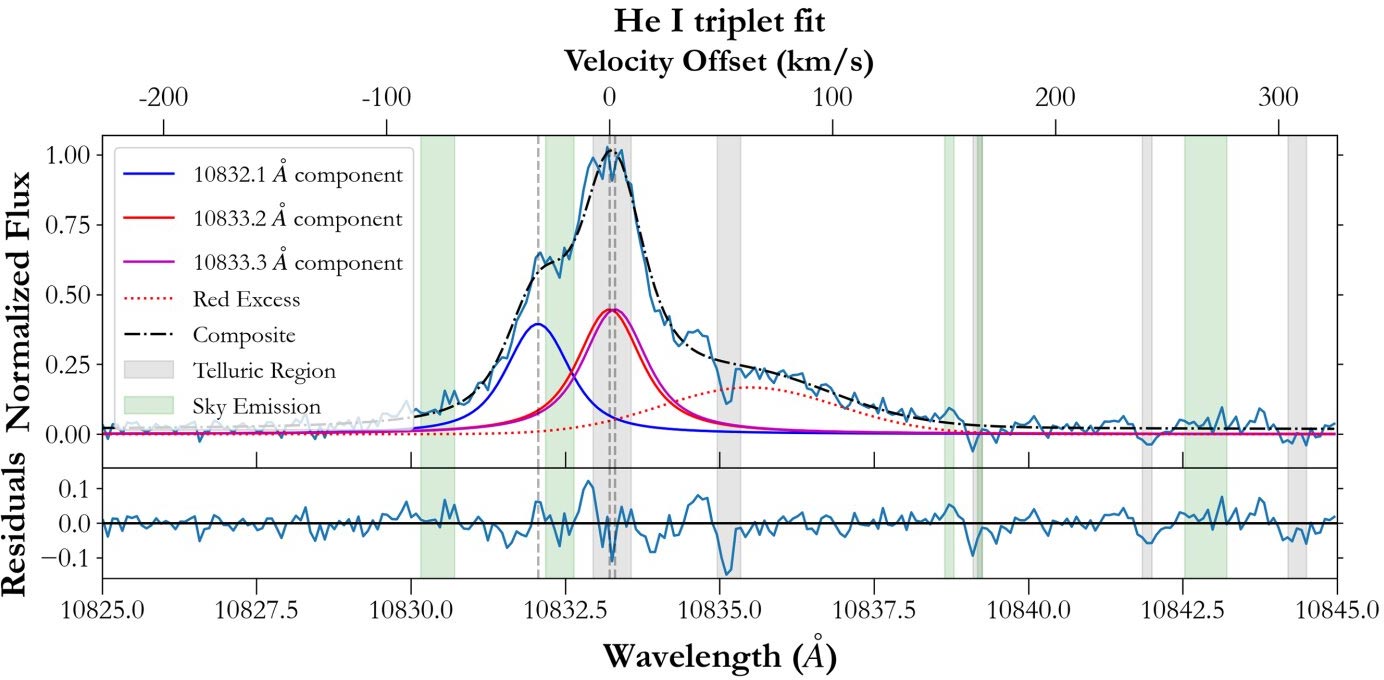
High-resolution spectroscopic observations of a stellar flare on a small, cool star indicate the possibility of coronal rain, a phenomenon that has been observed on our Sun but not yet confirmed on a star of this size. This faint star, known as vB 10, which is about a tenth the size of the Sun and produces less than 1% of the Sun’s energy, was studied using the Penn State Habitable-zone Planet Finder (HPF) at the large Hobby Eberly Telescope (with its 10 m mirror). These observations with the HPF spectrograph allowed researchers to measure a shift in the wavelength of certain atomic lines from the flare that are consistent with hot plasma raining back down on the star’s surface and are similar to observations of coronal rain from the Sun.
A paper describing the observations, by a team led by Penn State scientists, includes a time-series analysis of the flare and could help astronomers put constraints on the energy and frequency of such events. The research was published in The Astrophysical Journal.
“As the name suggests, the Habitable-zone Planet Finder was designed to detect planets by looking for shifts in the light spectra from M-dwarf stars that result from the star ‘wobbling’ under the gravitational pull of orbiting planets,” said Larry Ramsey, professor emeritus of astronomy and astrophysics at Penn State and an author of the paper. “But we knew from the start that we might learn more about stellar activity from these spectra than we do about planets.”
Characteristics of vB 10 and Its Stellar Flare
The star is classified as an “ultracool dwarf”—it is close in size to Jupiter—and is among the smallest stars that can still fuse hydrogen to helium. It was observed by HPF as part of its normal, exoplanet hunting operations but subsequent analysis revealed a huge spike in the star’s emissions consistent with a stellar flare.
Flares are short lived intense eruptions of energy on stellar surfaces. Astronomers don’t know exactly what causes them, but the current best hypothesis is that when magnetic field lines on stellar surfaces rupture and reconnect they release a lot of energy, some of which is converted to thermal energy which accelerates ions and electrons on the star to extreme speeds. Some of the gas near the event rushes back toward the star’s surface and some is shot out above the flare.
“Stellar flares are common on M-dwarf stars,” said Shubham Kanodia, a graduate student at Penn State and lead author of the paper. “But because of the high resolution of the HPF spectrograph, we were able to detect some unusual characteristics in the spectra from this flare.”
Unveiling Coronal Rain Using High-Resolution Spectroscopy
HPF detected emission from several atoms that were excited to high energy states by the flare. In particular, emission lines from the atomic transitions of helium atoms showed a slight shift toward longer wavelengths, known as a “red shift.” This shift shows that the excited atoms that emitted this light, were falling towards the star with a velocity of about 70 kilometers per second.
“This red-shift in the helium lines is indicative of a phenomenon called ‘coronal rain,’ which has been observed on the Sun for many decades,” said Kanodia. “Coronal rain occurs when some of the gas excited by the flare falls back to the star’s surface. Some previous studies have suggested the possibility of coronal rain on M-dwarf stars, but If our interpretation is correct, this would be the first quantitative observation of coronal rain on an ultracool dwarf and the first to use helium emission as an indicator.”
Observations of flares and coronal rain on M-dwarfs could help astronomers to better understand the physics of stars.
“Flares are thought to result from the disruption of magnetic fields, but we don’t currently have a model for how magnetic fields are generated on stars like vB 10,” said Ramsey. “It’s amazing to see the similarities in the details of activity between stars like this and our Sun. Additional observations like this will hopefully help constrain models that can begin to explain this phenomenon.”
HPF, which was designed and built at Penn State and is installed on the Hobby-Eberly Telescope at the McDonald Observatory in Texas, is one of the few high-resolution near-infrared astronomical spectrographs capable of detecting these types of signals from small, cool stars.
“It’s important to note that we detect the red shift in helium lines along with other emission lines which suggest that they are associated with a flare,” said Suvrath Mahadevan, professor of astronomy and astrophysics at Penn State, principal investigator of HPF, and an author of the paper. “We know that the magnetic structure of these stars can be very different to stars like our Sun, so seeing this analogous activity is exciting and will hopefully lead to a better understanding of stellar magnetism and activity.”
Reference: “High resolution near-infrared spectroscopy of a flare around the ultracool dwarf vB 10” by Shubham Kanodia, Lawrence W. Ramsey, Marissa Maney, Suvrath Mahadevan, Caleb I. Cañas, Joe P. Ninan, Andrew J. Monson, Adam F. Kowalski, Maximos C. Goumas, Gudmundur Stefansson, Chad F. Bender, William D. Cochran, Scott A. Diddams, Connor Fredrick, Samuel P. Halverson, Fred R. Hearty, Steven Janowiecki, Andrew J. Metcalf, Stephen C. Odewahn, Paul Robertson, Arpita Roy, Christian Schwab, Ryan C. Terrien, 2 February 2022, The Astrophysical Journal.
DOI: 10.3847/1538-4357/ac3e61
arXiv:2111.14647
In addition to Ramsey, Kanodia, and Mahadevan the research team includes Marissa Maney, Caleb Cañas, Joe P. Ninan, Andrew Monson, Adam F. Kowalski, Maximos C. Goumas, Gudmundur Stefansson, Chad F. Bender, William D. Cochran, Scott A. Diddams, Connor Fredrick, Samuel Halverson, Fred Hearty, Steven Janowiecki, Andrew J. Metcalf, Stephen C. Odewahn, Paul Robertson, Arpita Roy, Christian Schwab, and Ryan C. Terrien.
Computations for this research were performed on the Penn State Institute for Computational and Data Sciences Advanced CyberInfrastructure (ICDS-ACI), including the CyberLAMP cluster supported by the U.S. National Science Foundation. The Center for Exoplanets and Habitable Worlds is supported by Penn State, the Eberly College of Science, and the Pennsylvania Space Grant Consortium.
Never miss a breakthrough: Join the SciTechDaily newsletter.
Follow us on Google and Google News.