
Close Menu
    Facebook X (Twitter) Instagram
    SciTechDaily
    • Biology
    • Chemistry
    • Earth
    • Health
    • Physics
    • Science
    • Space
    • Technology
    Facebook X (Twitter) Pinterest YouTube RSS
    SciTechDaily
    Home»Technology»Physicists Use Cloud of Rubidium Atoms as Optical Memory Device
    Technology

    Physicists Use Cloud of Rubidium Atoms as Optical Memory Device

    By National Institute of Standards and Technology (NIST)April 4, 2013No Comments3 Mins Read
    Facebook Twitter Pinterest Telegram LinkedIn WhatsApp Email Reddit
    Share
    Facebook Twitter LinkedIn Pinterest Telegram Email Reddit
    NIST Vapor Animation
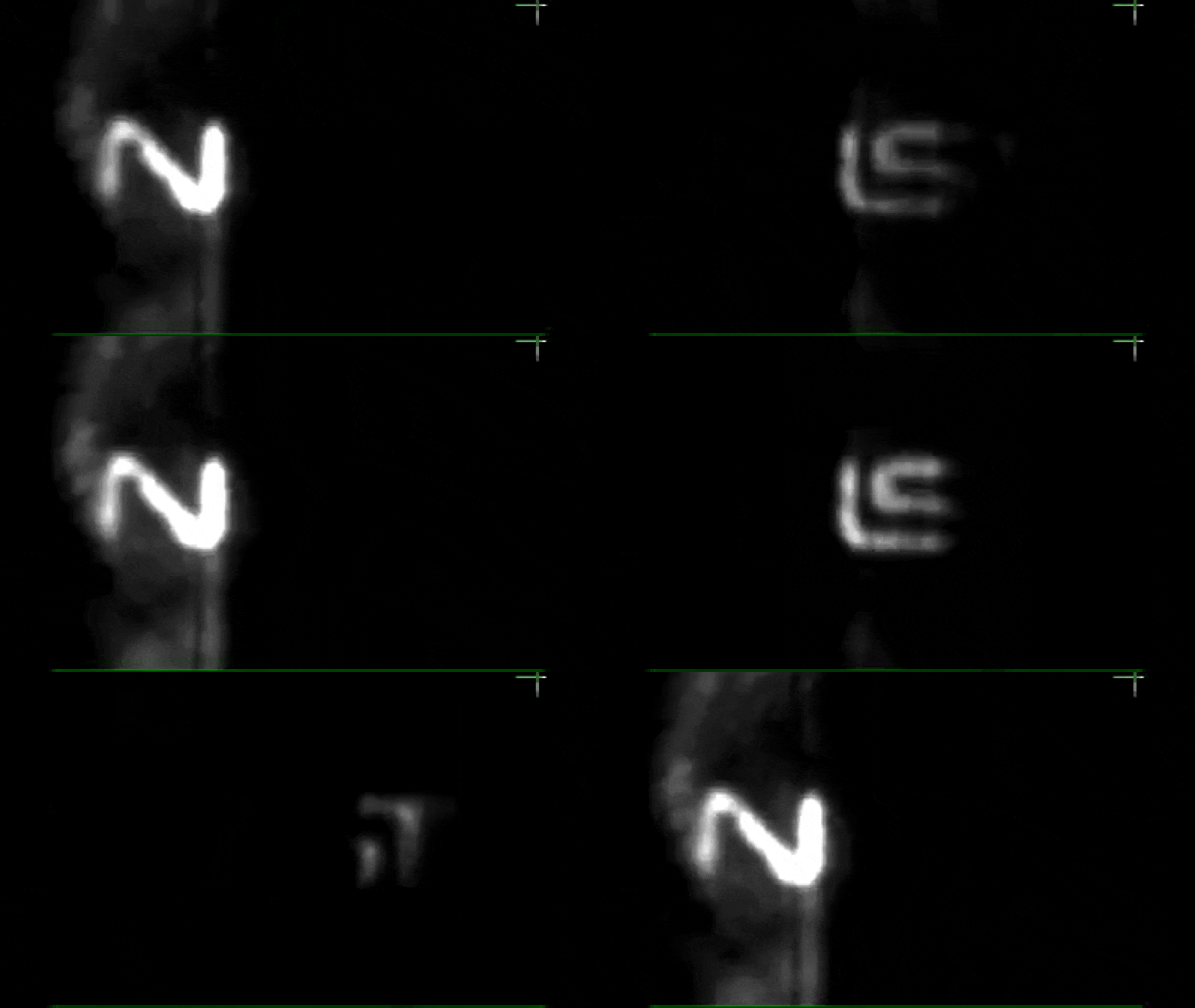
    Scientists have shown they can store visual images in a thin vapor of rubidium atoms, potentially aiding memory development for quantum computers. Credit: National Institute of Standards and Technology (NIST)

    In a newly published study, researchers detail how they used a cloud of rubidium atoms as an optical memory device, showing that portions of an image written into a gradient echo memory can be individually retrieved or erased on demand, an important step toward processing a spatially multiplexed quantum signal.

    Talk about storing data in the cloud. Scientists at the Joint Quantum Institute (JQI) of the National Institute of Standards and Technology (NIST) and the University of Maryland have taken this to a whole new level by demonstrating that they can store visual images within quite an ethereal memory device—a thin vapor of rubidium atoms. The effort may prove helpful in creating memory for quantum computers.

    Their work builds on an approach developed at the Australian National University, where scientists showed that a rubidium vapor could be manipulated in interesting ways using magnetic fields and lasers. The vapor is contained in a small tube and magnetized, and a laser pulse made up of multiple light frequencies is fired through the tube. The energy level of each rubidium atom changes depending on which frequency strikes it, and these changes within the vapor become a sort of fingerprint of the pulse’s characteristics. If the field’s orientation is flipped, a second pulse fired through the vapor takes on the exact characteristics of the first pulse—in essence, a readout of the fingerprint.

    “With our paper, we’ve taken this same idea and applied it to storing an image—basically moving up from storing a single ‘pixel’ of light information to about a hundred,” says Paul Lett, a physicist with JQI and NIST’s Quantum Measurement Division. “By modifying their technique, we have been able to store a simple image in the vapor and extract pieces of it at different times.”

    It’s a dramatic increase in the amount of information that can be stored and manipulated with this approach. But because atoms in a vapor are always in motion, the image can only be stored for about 10 milliseconds, and in any case the modifications the team made to the original technique introduce too much noise into the laser signal to make the improvements practically useful. So, should the term vaporware be applied here after all? Not quite, says Lett—because the whole point of the effort was not to build a device for market, but to learn more about how to create memory for next-generation quantum computers.

    “What we’ve done here is store an image using classical physics. However, the ultimate goal is to store quantum information, which a quantum computer will need,” he says. “Measuring what the rubidium atoms do as we manipulate them is teaching us how we might use them as quantum bits and what problems those bits might present. This way, when someone builds a solid-state system for a finished computer, we’ll know how to handle them more effectively.”

    Reference: “Spatially addressable readout and erasure of an image in a gradient echo memory” by Jeremy B Clark, Quentin Glorieux and Paul D Lett, 6 March 2013, New Journal of Physics.
    DOI: 10.1088/1367-2630/15/3/035005

    Never miss a breakthrough: Join the SciTechDaily newsletter.
    Follow us on Google and Google News.

    NIST Quantum Computing Quantum Physics
    Share. Facebook Twitter Pinterest LinkedIn Email Reddit

    Related Articles

    New Technique Allows Particles to Switch the Quantum State of Each Other

    USC Study Validates Large-Scale Quantum Chip

    A New Model of a Quantum Computer

    Quantum Computing Continues to Move Forward

    New Spin Technique Moves Quantum Computers a Step Closer

    Yale Physicists Observe Quantum Information While Preserving Its Integrity

    Photon Devices Could Outperform Traditional Computers

    Samarium Hexoboride Behaves Like a Topological Insulator

    Electronic Read-Out of the Quantum State of an Atom

    Leave A Reply Cancel Reply

    • Facebook
    • Twitter
    • Pinterest
    • YouTube

    Don't Miss a Discovery

    Subscribe for the Latest in Science & Tech!

    Trending News

    Just a Few Breathless Minutes a Day Could Slash Your Risk of 8 Major Diseases

    This Simple Habit Could Cut Your Risk of Dementia by 30%

    Scientists Debunk Rattlesnake Myth That Fooled Hikers and Doctors for Decades

    Scientists Discover Plants Can “Count” – and May Be Smarter Than We Thought

    New Research Reveals Ancient Mars May Have Been Warm, Wet – and Possibly Alive

    This Surprising Daily Habit Could Cut Dementia Risk by 35%

    Just 10 Minutes a Day: Scientists Say This Ancient Chinese Practice Shows Powerful Blood Pressure Benefits

    Scientists Say This Popular Food Could Help Your Body Get Rid of Microplastics

    Follow SciTechDaily
    • Facebook
    • Twitter
    • YouTube
    • Pinterest
    • Newsletter
    • RSS
    SciTech News
    • Biology News
    • Chemistry News
    • Earth News
    • Health News
    • Physics News
    • Science News
    • Space News
    • Technology News
    Recent Posts
    • Scientists Just Rewrote the Timeline of Complex Life on Earth
    • 160,000 Years Ago, Hominins in China Were Far More Advanced Than We Thought
    • Teenager’s Fossil Find Leads to Discovery of Shark Teeth in 5 Million-Year-Old Whale Skull
    • Weight-Loss Drugs Like Ozempic Are Creating a Hidden Environmental Disaster
    • Even Occasional Binge Drinking May Triple Liver Damage Risk
    Copyright © 1998 - 2026 SciTechDaily. All Rights Reserved.
    • Science News
    • About
    • Contact
    • Editorial Board
    • Privacy Policy
    • Terms of Use

    Type above and press Enter to search. Press Esc to cancel.