
Close Menu
    Facebook X (Twitter) Instagram
    SciTechDaily
    • Biology
    • Chemistry
    • Earth
    • Health
    • Physics
    • Science
    • Space
    • Technology
    Facebook X (Twitter) Pinterest YouTube RSS
    SciTechDaily
    Home»Space»Dawn Spacecraft Reveals New Maps and Insights about Ceres
    Space

    Dawn Spacecraft Reveals New Maps and Insights about Ceres

    By Elizabeth Landau, Jet Propulsion LaboratorySeptember 30, 20154 Comments3 Mins Read
    Facebook Twitter Pinterest Telegram LinkedIn WhatsApp Email Reddit
    Share
    Facebook Twitter LinkedIn Pinterest Telegram Email Reddit
    Dawn Team Shares New Maps and Insights about Ceres
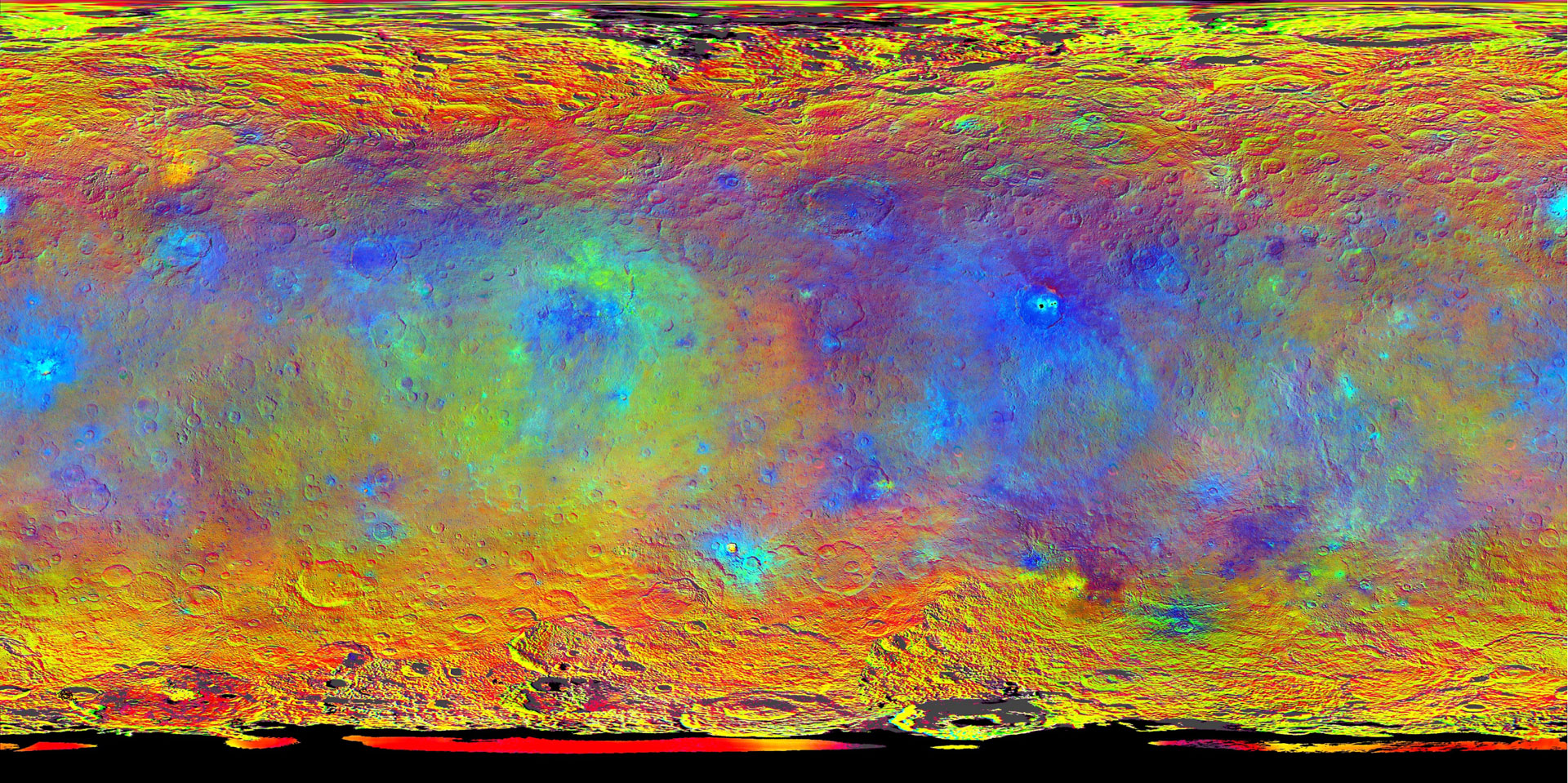
    This map-projected view of Ceres was created from images taken by NASA’s Dawn spacecraft during its high-altitude mapping orbit, in August and September, 2015. Credit: NASA/JPL-Caltech/UCLA/MPS/DLR/IDA

    NASA’s Dawn spacecraft continues to provide scientists with new data on Ceres and scientists are still trying to identify the “bright spots” and the processes that could produce these and other unique Cerean phenomena.

    Mysteries and insights about Ceres are being discussed this week at the European Planetary Science Conference in Nantes, France. NASA’s Dawn spacecraft is providing scientists with tantalizing views and other data about the intriguing dwarf planet that they continue to analyze.

    “Ceres continues to amaze, yet puzzle us, as we examine our multitude of images, spectra, and now energetic particle bursts,” said Chris Russell, Dawn principal investigator at the University of California, Los Angeles.

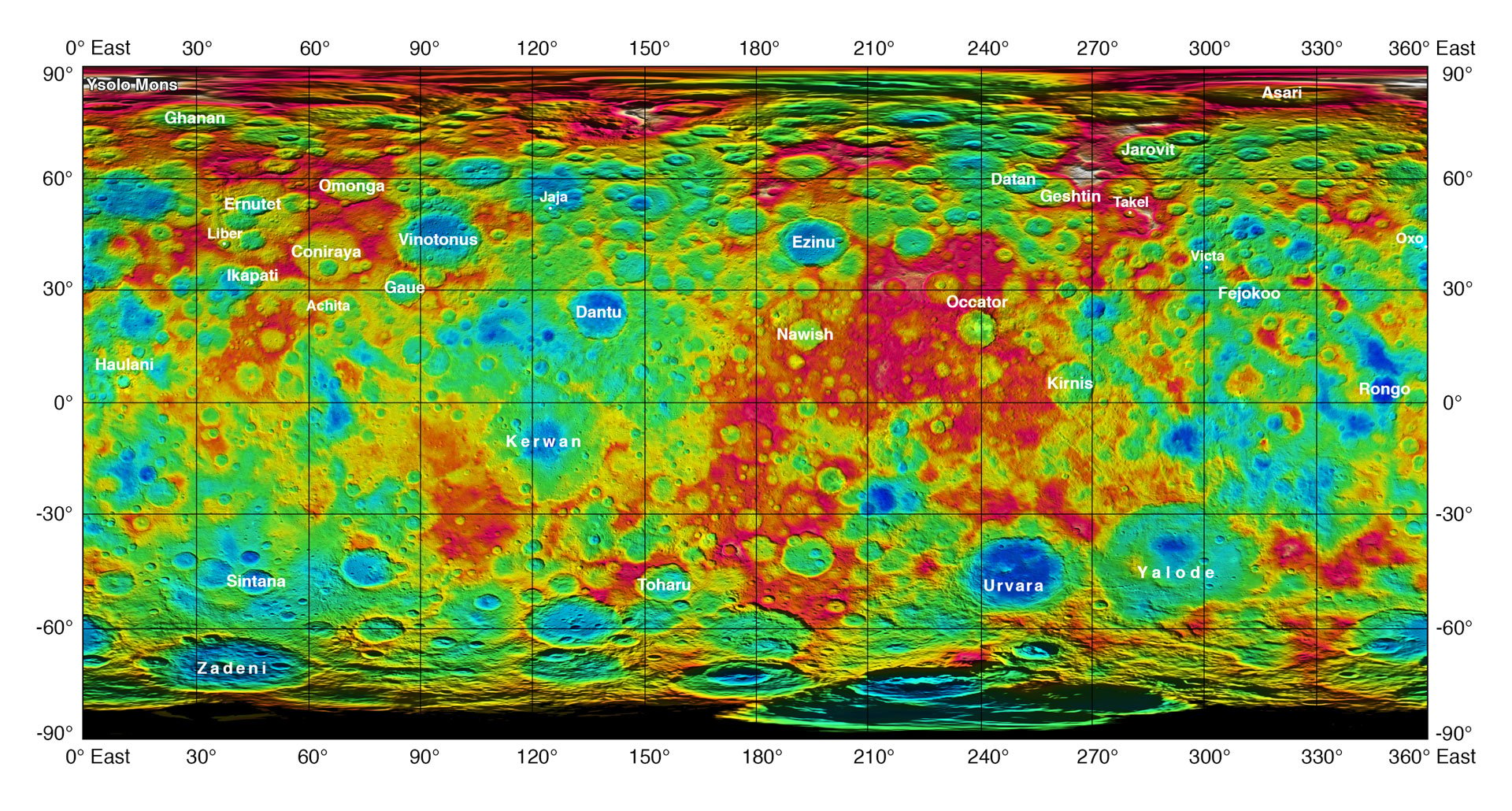
    A new color-coded topographic map shows more than a dozen recently approved names for features on Ceres, all eponymous for agricultural spirits, deities, and festivals from cultures around the world. These include Jaja, after the Abkhazian harvest goddess, and Ernutet, after the cobra-headed Egyptian harvest goddess. A 12-mile (20-kilometer) diameter mountain near Ceres’ north pole is now called Ysolo Mons, for an Albanian festival that marks the first day of the eggplant harvest.

    Color-Coded Topographic Map of the Occator Crater on Ceres
    This view, made using images taken by NASA’s Dawn spacecraft, is a color-coded topographic map of Occator crater on Ceres. Credit: NASA/JPL-Caltech/UCLA/MPS/DLR/IDA

    Another new Ceres map, in false color, enhances compositional differences present on the surface. The variations are more subtle than on Vesta, Dawn’s previous port of call. Color-coded topographic images of Occator (oh-KAH-tor) crater, home of Ceres’ brightest spots, and a puzzling, cone-shaped 4-mile-high (6-kilometer-high) mountain, are also available. Scientists are still trying to identify processes that could produce these and other unique Cerean phenomena.

    “The irregular shapes of craters on Ceres are especially interesting, resembling craters we see on Saturn’s icy moon Rhea,” said Carol Raymond, Dawn’s deputy principal investigator based at NASA’s Jet Propulsion Laboratory, Pasadena, California. “They are very different from the bowl-shaped craters on Vesta.”

    A surprising bonus observation came from Dawn’s gamma ray and neutron spectrometer. The instrument detected three bursts of energetic electrons that may result from the interaction between Ceres and radiation from the sun. The observation isn’t yet fully understood, but may be important in forming a complete picture of Ceres.
    Topography on the Surface of Dwarf Planet Ceres
    This color-coded map from NASA’s Dawn mission shows the highs and lows of topography on the surface of dwarf planet Ceres. It is labeled with names of features approved by the International Astronomical Union. Credit: NASA/JPL-Caltech/UCLA/MPS/DLR/IDA

    “This is a very unexpected observation for which we are now testing hypotheses,” Russell said.

    Dawn is currently orbiting Ceres at an altitude of 915 miles (1,470 kilometers), and the spacecraft will image the entire surface of the dwarf planet up to six times in this phase of the mission. Each imaging cycle takes 11 days.

    Starting in October and continuing into December, Dawn will descend to its lowest and final orbit, an altitude of 230 miles (375 kilometers). The spacecraft will continue imaging Ceres and taking other data at higher resolutions than ever before at this last orbit. It will remain operational at least through mid-2016.

    Dawn made history as the first mission to reach a dwarf planet, and the first to orbit two distinct extraterrestrial targets, when it arrived at Ceres on March 6, 2015. It conducted extensive observations of Vesta in 2011 and 2012.

    Never miss a breakthrough: Join the SciTechDaily newsletter.
    Follow us on Google and Google News.

    Astronomy Ceres Dawn Spacecraft JPL NASA Planetary Science Popular
    Share. Facebook Twitter Pinterest LinkedIn Email Reddit

    Related Articles

    NASA’s Dawn Spacecraft Maps Ceres Craters Where Ice Can Accumulate

    New Images Reveal More Details on Ceres’ Craters

    What’s Creating Those Unusual Bright Spots on Ceres? Dawn Heads Toward Low-Altitude Mapping Orbit

    New Up-Close View of the Bright Spots on Ceres

    NASA’s Dawn Reveals Topography of Dwarf Planet Ceres

    Ceres Spots Remain a Mystery in Latest Dawn Images

    NASA’s Dawn Mission Reveals Hydrated Minerals on Vesta

    NASA’s Curiosity Readies for First Drive on Mars

    Color HiRISE Image of Curiosity Rover on Mars

    4 Comments

    1. Loren Avey on September 30, 2015 10:37 am

      Ceres is my favorite non planet. this is some great material for commoners to try and digest. Keep up the great work and the flow of information

      Reply
    2. HornyPanda on September 30, 2015 1:10 pm

      Dafuq is up with these names?? Are you scientists or sorcerers?!

      Reply
    3. Jerry Oliver on September 30, 2015 7:51 pm

      The variations are more subtle than on Vesta, Dawn’s previous port of call. Color-coded topographic images of Occator (oh-KAH-tor) crater, home of Ceres’ brightest spots, and a puzzling, cone-shaped 6-mile-high (4-kilometer-high) mountain, are also available.

      I hate to tell you “sciency” writers this… but miles are longer then kilometers. Might wanna check your data. lol

      Reply
      • Staff on October 1, 2015 8:14 am

        Nice catch…The 4 and 6 were reversed and have since been corrected. Thanks-

        Reply
    Leave A Reply Cancel Reply

    • Facebook
    • Twitter
    • Pinterest
    • YouTube

    Don't Miss a Discovery

    Subscribe for the Latest in Science & Tech!

    Trending News

    Just a Few Breathless Minutes a Day Could Slash Your Risk of 8 Major Diseases

    This Simple Habit Could Cut Your Risk of Dementia by 30%

    Scientists Debunk Rattlesnake Myth That Fooled Hikers and Doctors for Decades

    Scientists Discover Plants Can “Count” – and May Be Smarter Than We Thought

    New Research Reveals Ancient Mars May Have Been Warm, Wet – and Possibly Alive

    This Surprising Daily Habit Could Cut Dementia Risk by 35%

    Just 10 Minutes a Day: Scientists Say This Ancient Chinese Practice Shows Powerful Blood Pressure Benefits

    Scientists Say This Popular Food Could Help Your Body Get Rid of Microplastics

    Follow SciTechDaily
    • Facebook
    • Twitter
    • YouTube
    • Pinterest
    • Newsletter
    • RSS
    SciTech News
    • Biology News
    • Chemistry News
    • Earth News
    • Health News
    • Physics News
    • Science News
    • Space News
    • Technology News
    Recent Posts
    • Scientists Just Rewrote the Timeline of Complex Life on Earth
    • 160,000 Years Ago, Hominins in China Were Far More Advanced Than We Thought
    • Teenager’s Fossil Find Leads to Discovery of Shark Teeth in 5 Million-Year-Old Whale Skull
    • Weight-Loss Drugs Like Ozempic Are Creating a Hidden Environmental Disaster
    • Even Occasional Binge Drinking May Triple Liver Damage Risk
    Copyright © 1998 - 2026 SciTechDaily. All Rights Reserved.
    • Science News
    • About
    • Contact
    • Editorial Board
    • Privacy Policy
    • Terms of Use

    Type above and press Enter to search. Press Esc to cancel.