
Close Menu
    Facebook X (Twitter) Instagram
    SciTechDaily
    • Biology
    • Chemistry
    • Earth
    • Health
    • Physics
    • Science
    • Space
    • Technology
    Facebook X (Twitter) Pinterest YouTube RSS
    SciTechDaily
    Home»Space»New Up-Close View of the Bright Spots on Ceres
    Space

    New Up-Close View of the Bright Spots on Ceres

    By NASA/JPL-Caltech/UCLA/MPS/DLR/IDA/PSISeptember 9, 20154 Comments3 Mins Read
    Facebook Twitter Pinterest Telegram LinkedIn WhatsApp Email Reddit
    Share
    Facebook Twitter LinkedIn Pinterest Telegram Email Reddit
    New Image of Ceres Bright Spots
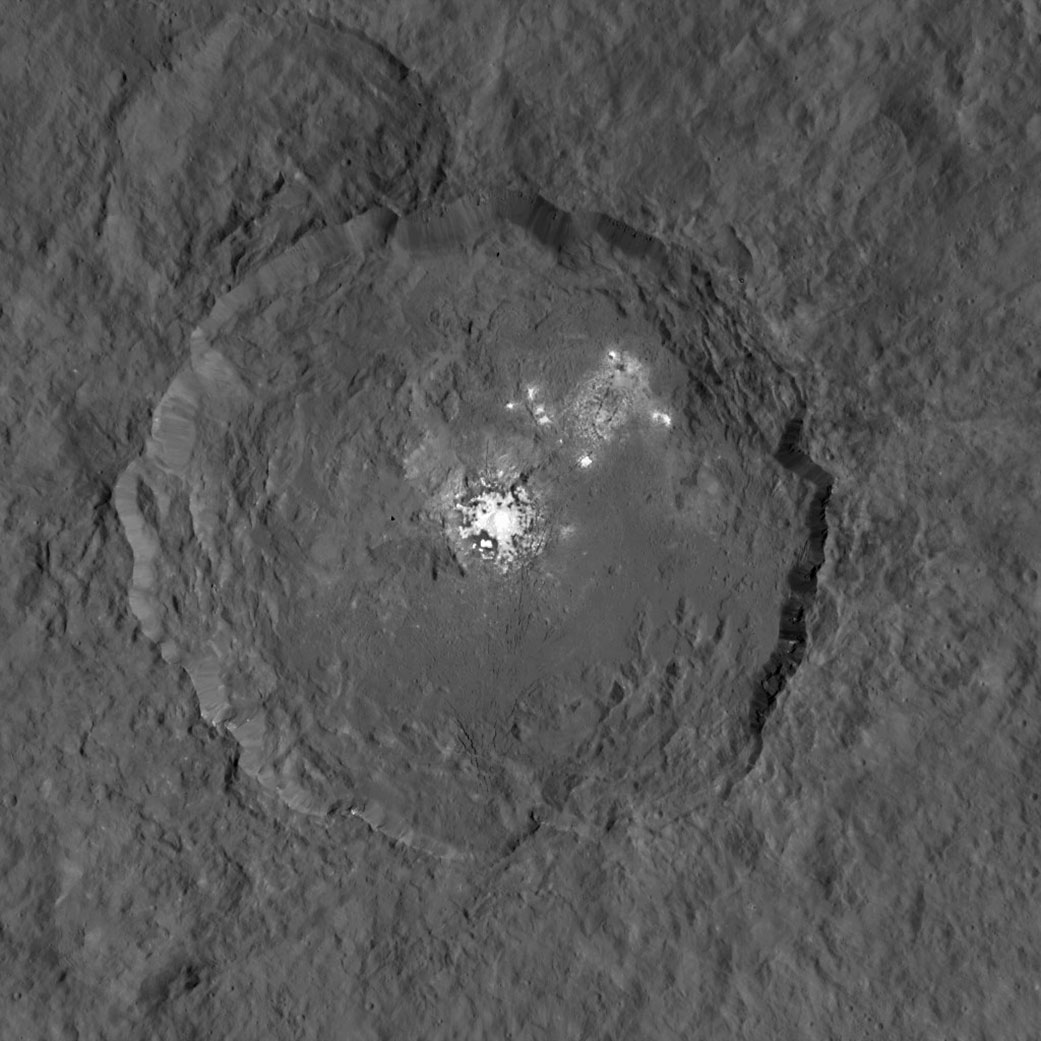
    This image, made using images taken by NASA’s Dawn spacecraft, shows Occator crater on Ceres, home to a collection of intriguing bright spots. Credit: NASA/JPL-Caltech/UCLA/MPS/DLR/IDA

    NASA’s Dawn Spacecraft provides new-up-close images of the bright spots on Ceres, revealing better-defined shapes of the central spot and features on the crater floor.

    The brightest spots on the dwarf planet Ceres gleam with mystery in new views delivered by NASA’s Dawn spacecraft. These closest-yet views of Occator crater, with a resolution of 450 feet (140 meters) per pixel, give scientists a deeper perspective on these very unusual features.

    The new up-close view of Occator crater from Dawn’s current vantage point reveals better-defined shapes of the brightest, central spot and features on the crater floor. Because these spots are so much brighter than the rest of Ceres’ surface, the Dawn team combined two different images into a single composite view — one properly exposed for the bright spots, and one for the surrounding surface.


    Black and white and color animations made with new data from NASA’s Dawn spacecraft highlight the topography of Occator crater on Ceres.

    Scientists also have produced animations that provide a virtual fly-around of the crater, including a colorful topographic map.

    Dawn scientists note the rim of Occator crater is almost vertical in some places, where it rises steeply for 1 mile (nearly 2 kilometers).

    Views from Dawn’s current orbit, taken at an altitude of 915 miles (1,470 kilometers), have about three times better resolution than the images the spacecraft delivered from its previous orbit in June, and nearly 10 times better than in the spacecraft’s first orbit at Ceres in April and May.

    “Dawn has transformed what was so recently a few bright dots into a complex and beautiful, gleaming landscape,” said Marc Rayman, Dawn’s chief engineer and mission director based at NASA’s Jet Propulsion Laboratory, Pasadena, California. “Soon, the scientific analysis will reveal the geological and chemical nature of this mysterious and mesmerizing extraterrestrial scenery.”

    The spacecraft has already completed two 11-day cycles of mapping the surface of Ceres from its current altitude, and began the third on September 9. Dawn will map all of Ceres six times over the next two months. Each cycle consists of 14 orbits. By imaging Ceres at a slightly different angle in each mapping cycle, Dawn scientists will be able to assemble stereo views and construct 3-D maps.

    Dawn is the first mission to visit a dwarf planet, and the first to orbit two distinct solar system targets. It orbited protoplanet Vesta for 14 months in 2011 and 2012, and arrived at Ceres on March 6, 2015.

    Never miss a breakthrough: Join the SciTechDaily newsletter.
    Follow us on Google and Google News.

    Astronomy Ceres Dawn Spacecraft NASA Planetary Science Popular
    Share. Facebook Twitter Pinterest LinkedIn Email Reddit

    Related Articles

    NASA’s Dawn Spacecraft Maps Ceres Craters Where Ice Can Accumulate

    New Images Reveal More Details on Ceres’ Craters

    What’s Creating Those Unusual Bright Spots on Ceres? Dawn Heads Toward Low-Altitude Mapping Orbit

    Dawn Spacecraft Reveals New Maps and Insights about Ceres

    NASA’s Dawn Reveals Topography of Dwarf Planet Ceres

    Ceres Spots Remain a Mystery in Latest Dawn Images

    Dawn Spacecraft Shows Crater Shapes on Ceres’ Surface

    NASA’s Dawn Captures Sharper Images of Ceres

    NASA’s Dawn Mission Reveals Hydrated Minerals on Vesta

    4 Comments

    1. Jim Oss on September 9, 2015 8:25 am

      What’s the speculation on what cause the high reflectivity?

      Reply
    2. MIKE MILLER on September 9, 2015 4:24 pm

      .

      Possibly wreckage of grav-trapped Apollo hardware? Russian, maybe?

      .

      Reply
    3. bobbymac1947 on October 27, 2015 11:11 am

      mining operation?

      Reply
    4. Jeffrey on October 27, 2015 11:52 am

      Really the shadows are inaccurate

      Reply
    Leave A Reply Cancel Reply

    • Facebook
    • Twitter
    • Pinterest
    • YouTube

    Don't Miss a Discovery

    Subscribe for the Latest in Science & Tech!

    Trending News

    Scientists May Have Solved a Long-Standing Melanoma Treatment Mystery

    This Flesh-Eating Fly Is Back in the U.S. – Scientists Are Tracking Where It Could Strike Next

    Scientists Have Uncovered a Troubling New Pattern Hidden in America’s Rivers

    “Entirely Surprising” – Scientists Have Found a Martian Meteorite Unlike Any Known Before

    “Find of the Year” – Archaeologists Discover the Smallest Ice Age Figurines Ever Found

    New Research Challenges Common Exercise Advice for Bone Health

    Avoiding These 3 Health Risks in Midlife Linked to 13 More Years Without Dementia

    Where Were All the Tiny Dinosaurs? Scientists May Finally Have an Answer

    Follow SciTechDaily
    • Facebook
    • Twitter
    • YouTube
    • Pinterest
    • Newsletter
    • RSS
    SciTech News
    • Biology News
    • Chemistry News
    • Earth News
    • Health News
    • Physics News
    • Science News
    • Space News
    • Technology News
    Recent Posts
    • Scientists Discover a Hidden Hormone Pathway That Protects the Liver From Damage
    • Quitting Alcohol Can Change the Brain in Surprising Ways, Mouse Study Finds
    • FDA-Approved Drug Shows Promise for Reversing Osteoarthritis Damage
    • A 2-Billion-Year-Old Clue Challenges a Popular Earth Science Theory
    • Paleontologists Reconstruct 56-Million-Year-Old Forests – and Find a Chilling Warning for Today
    Copyright © 1998 - 2026 SciTechDaily. All Rights Reserved.
    • Science News
    • About
    • Contact
    • Editorial Board
    • Privacy Policy
    • Terms of Use

    Type above and press Enter to search. Press Esc to cancel.