
Close Menu
    Facebook X (Twitter) Instagram
    SciTechDaily
    • Biology
    • Chemistry
    • Earth
    • Health
    • Physics
    • Science
    • Space
    • Technology
    Facebook X (Twitter) Pinterest YouTube RSS
    SciTechDaily
    Home»Space»Ceres Spots Remain a Mystery in Latest Dawn Images
    Space

    Ceres Spots Remain a Mystery in Latest Dawn Images

    By Elizabeth Landau, Jet Propulsion LaboratoryJune 22, 20151 Comment4 Mins Read
    Facebook Twitter Pinterest Telegram LinkedIn WhatsApp Email Reddit
    Share
    Facebook Twitter LinkedIn Pinterest Telegram Email Reddit
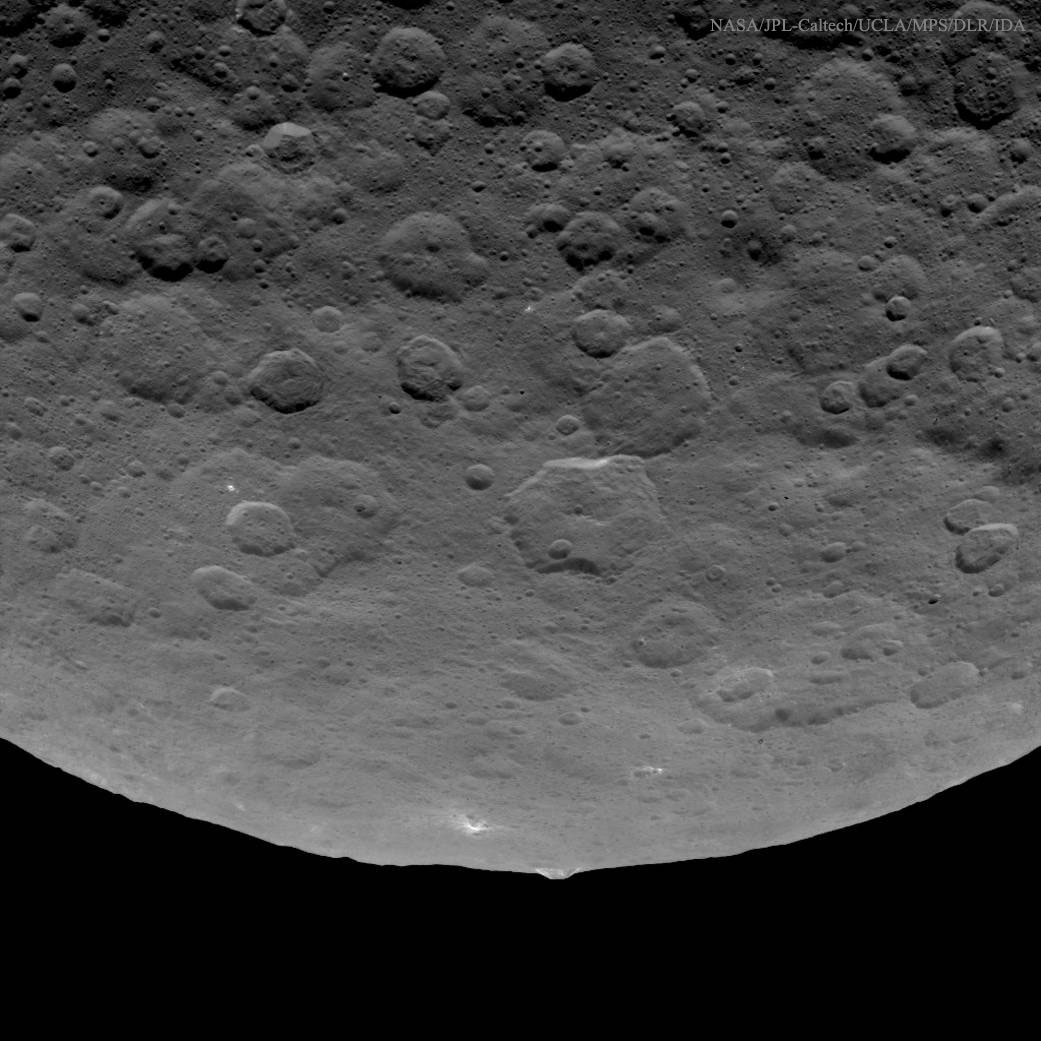
    Intriguing Mountain on Dwarf Planet Ceres
    This image, taken by NASA’s Dawn spacecraft, shows an intriguing mountain on dwarf planet Ceres protruding from a relatively smooth area. Scientists estimate that this structure rises about 3 miles (5 kilometers) above the surface. Dawn captured this image from an altitude of 2,700 miles (4,400 kilometers). The image was taken on June 14, 2015. Credit: NASA/JPL-Caltech/UCLA/MPS/DLR/IDA

    Although new images from the Dawn spacecraft provide more clues, the unusual bright spots on Ceres continue to mystify.

    The closer we get to Ceres, the more intriguing the distant dwarf planet becomes. New images of Ceres from NASA’s Dawn spacecraft provide more clues about its mysterious bright spots, and also reveal a pyramid-shaped peak towering over a relatively flat landscape.

    “The surface of Ceres has revealed many interesting and unique features. For example, icy moons in the outer solar system have craters with central pits, but on Ceres central pits in large craters are much more common. These and other features will allow us to understand the inner structure of Ceres that we cannot sense directly,” said Carol Raymond, deputy principal investigator for the Dawn mission, based at NASA’s Jet Propulsion Laboratory in Pasadena, California.
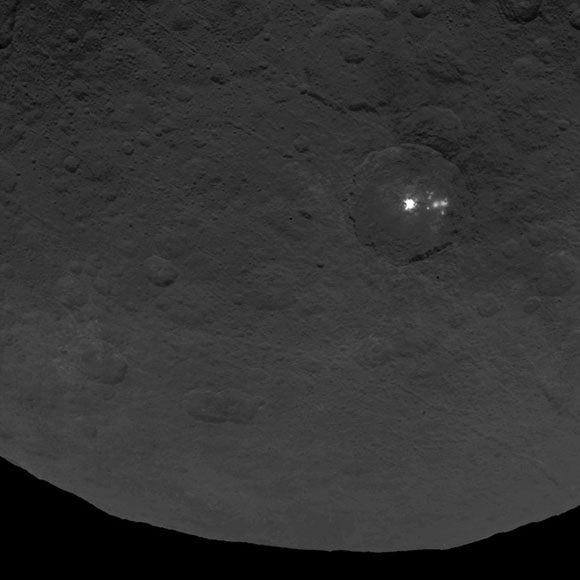
    A cluster of mysterious bright spots on dwarf planet Ceres can be seen in this image, taken by NASA's Dawn spacecraft from an altitude of 2,700 miles (4,400 kilometers). The image was taken on June 9, 2015.
    A cluster of mysterious bright spots on dwarf planet Ceres can be seen in this image, taken by NASA’s Dawn spacecraft from an altitude of 2,700 miles (4,400 kilometers). The image was taken on June 9, 2015. Credit: NASA/JPL-Caltech/UCLA/MPS/DLR/IDA

    Dawn has been studying the dwarf planet in detail from its second mapping orbit, which is 2,700 miles (4,400 kilometers) above Ceres. A new view of its intriguing bright spots, located in a crater about 55 miles (90 kilometers) across, shows even more small spots in the crater than were previously visible.

    At least eight spots can be seen next to the largest bright area, which scientists think is approximately 6 miles (9 kilometers) wide. A highly reflective material is responsible for these spots — ice and salt are leading possibilities, but scientists are considering other options, too.
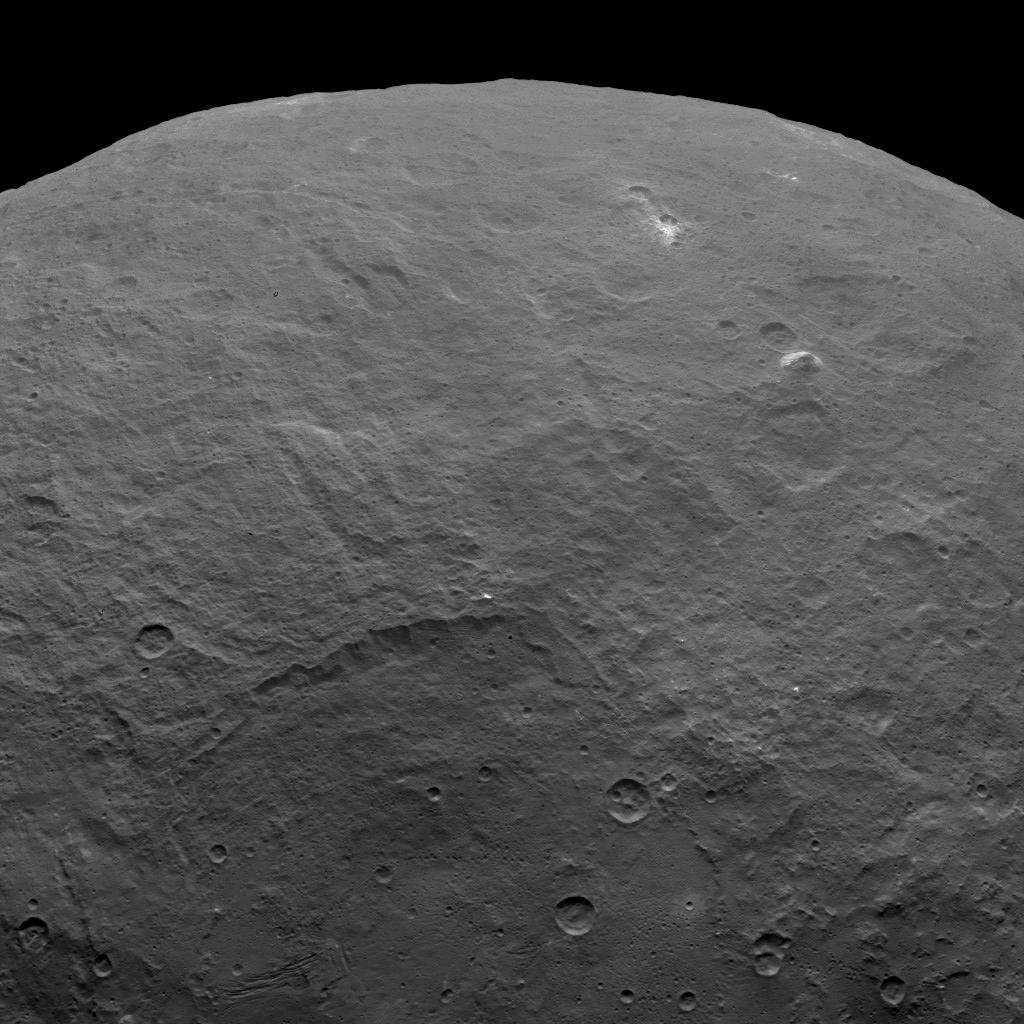
    Pyramid Shaped Mountain On Dwarf Planet Ceres
    Among the fascinating features on dwarf planet Ceres is an intriguing pyramid-shaped mountain protruding from a relatively smooth area. Scientists estimate that this structure rises about 3 miles (5 kilometers) above the surface. NASA’s Dawn spacecraft took this image from an altitude of 2,700 miles (4,400 kilometers). The image was taken on June 6, 2015. Credit: NASA/JPL-Caltech/UCLA/MPS/DLR/IDA

    Dawn’s visible and infrared mapping spectrometer allows scientists to identify specific minerals present on Ceres by looking at how light is reflected. Each mineral reflects the range of visible and infrared-light wavelengths in a unique way, and this signature helps scientists determine the components of Ceres. So, as the spacecraft continues to send back more images and data, scientists will learn more about the mystery bright spots.

    In addition to the bright spots, the latest images also show a mountain with steep slopes protruding from a relatively smooth area of the dwarf planet’s surface. The structure rises about 3 miles (5 kilometers) above the surface.

    Ceres also has numerous craters of varying sizes, many of which have central peaks. There is ample evidence of past activity on the surface, including flows, landslides, and collapsed structures. It seems that Ceres shows more remnants of activity than the protoplanet Vesta, which Dawn studied intensively for 14 months in 2011 and 2012.
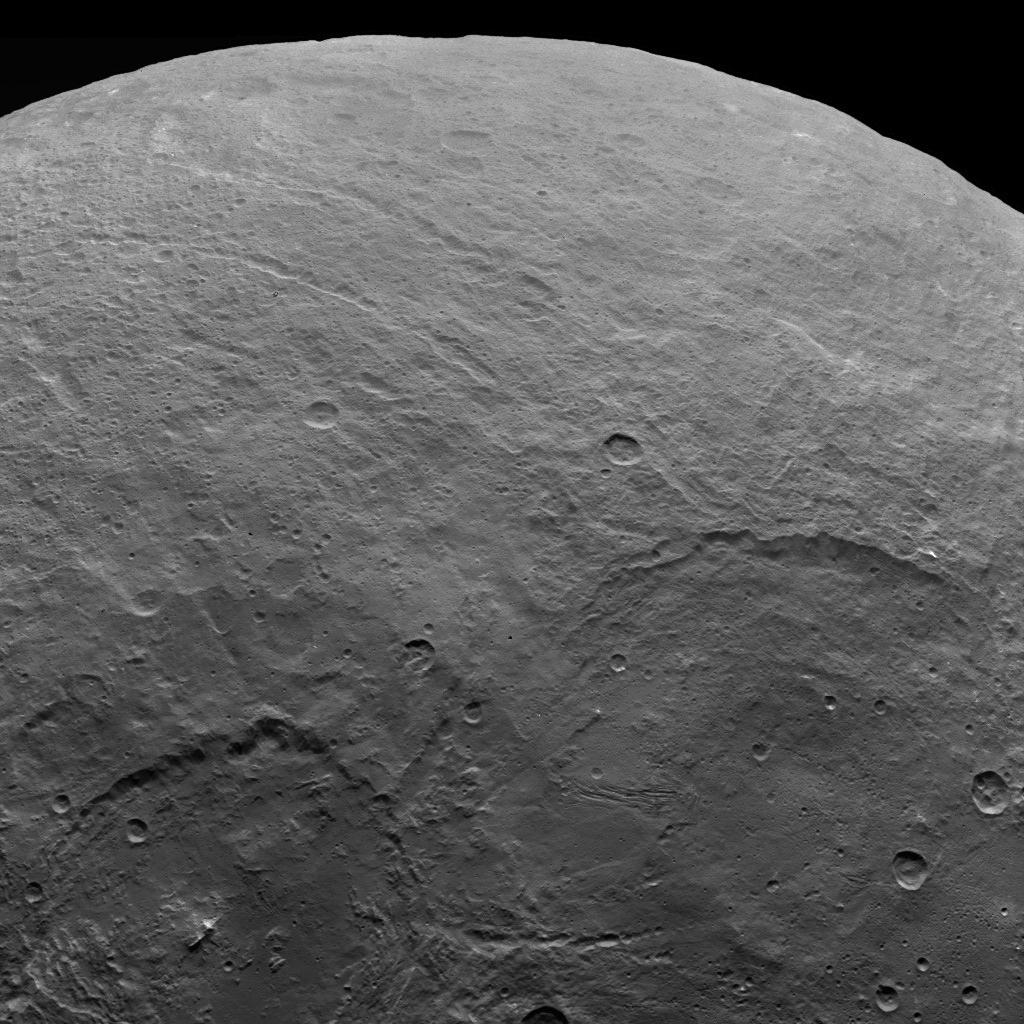
    A Variety Of Craters And Other Geological Features On Dwarf Planet Ceres
    A variety of craters and other geological features can be found on dwarf planet Ceres. NASA’s Dawn spacecraft took this image of Ceres from an altitude of 2,700 miles (4,400 kilometers). The image was taken on June 5, 2015. Credit: NASA/JPL-Caltech/UCLA/MPS/DLR/IDA

    Dawn is the first mission to visit a dwarf planet, and the first to orbit two distinct targets in our solar system. It arrived at Ceres, the largest object in the main asteroid belt between Mars and Jupiter, on March 6, 2015.

    Dawn will remain in its current altitude until June 30, continuing to take images and spectra of Ceres in orbits of about three days each. It then will move into its next orbit at an altitude of 900 miles (1,450 kilometers), arriving in early August.

    Dawn’s mission is managed by JPL for NASA’s Science Mission Directorate in Washington. Dawn is a project of the directorate’s Discovery Program, managed by NASA’s Marshall Space Flight Center in Huntsville, Alabama. UCLA is responsible for overall Dawn mission science. Orbital ATK Inc., in Dulles, Virginia, designed and built the spacecraft. The German Aerospace Center, Max Planck Institute for Solar System Research, Italian Space Agency and Italian National Astrophysical Institute are international partners on the mission team.

    Never miss a breakthrough: Join the SciTechDaily newsletter.
    Follow us on Google and Google News.

    Astronomy Ceres Dawn Spacecraft NASA Planetary Science Popular
    Share. Facebook Twitter Pinterest LinkedIn Email Reddit

    Related Articles

    NASA’s Dawn Spacecraft Maps Ceres Craters Where Ice Can Accumulate

    New Images Reveal More Details on Ceres’ Craters

    What’s Creating Those Unusual Bright Spots on Ceres? Dawn Heads Toward Low-Altitude Mapping Orbit

    Dawn Spacecraft Reveals New Maps and Insights about Ceres

    New Up-Close View of the Bright Spots on Ceres

    NASA’s Dawn Reveals Topography of Dwarf Planet Ceres

    Dawn Spacecraft Shows Crater Shapes on Ceres’ Surface

    NASA’s Dawn Captures Sharper Images of Ceres

    NASA’s Dawn Mission Reveals Hydrated Minerals on Vesta

    1 Comment

    1. HENRY T. PAISTE, III on January 12, 2016 8:20 pm

      VERY INTERESTED – PLS KEEP THIS INFORMATION COMING – SEE EMAIL ADDRESS
      FOR H.T.PAISTE, III ([email protected]

      Reply
    Leave A Reply Cancel Reply

    • Facebook
    • Twitter
    • Pinterest
    • YouTube

    Don't Miss a Discovery

    Subscribe for the Latest in Science & Tech!

    Trending News

    Largest-Ever Study Finds Medicinal Cannabis Ineffective for Anxiety, Depression, PTSD

    250-Million-Year-Old Egg Solves One of Evolution’s Biggest Mysteries

    Living With Roommates Might Be Changing Your Gut Microbiome Without You Knowing

    Century-Old Cleaning Chemical Linked to 500% Increased Risk of Parkinson’s Disease

    What if Your Memories Never Happened? Physicists Take a New Look at the Boltzmann Brain Paradox

    One of the Universe’s Largest Stars May Be Getting Ready To Explode

    Scientists Discover Enzyme That Could Supercharge Ozempic-Like Weight Loss Drugs

    Popular Sweetener Linked to DNA Damage – “It’s Something You Should Not Be Eating”

    Follow SciTechDaily
    • Facebook
    • Twitter
    • YouTube
    • Pinterest
    • Newsletter
    • RSS
    SciTech News
    • Biology News
    • Chemistry News
    • Earth News
    • Health News
    • Physics News
    • Science News
    • Space News
    • Technology News
    Recent Posts
    • Scientists Prove There Are Just Six Degrees of Separation in a Social Network
    • Bee Bacteria Could Fix a Major Flaw in Plant-Based Milk
    • Scientists Discover a Surprising Way To Make Bread Healthier and More Nutritious
    • Natural Compounds Boost Bone Implant Success While Killing Bacteria and Cancer Cells
    • After 60 Years, Scientists Uncover Unexpected Brain Effects of Popular Diabetes Drug Metformin
    Copyright © 1998 - 2026 SciTechDaily. All Rights Reserved.
    • Science News
    • About
    • Contact
    • Editorial Board
    • Privacy Policy
    • Terms of Use

    Type above and press Enter to search. Press Esc to cancel.