
Close Menu
    Facebook X (Twitter) Instagram
    SciTechDaily
    • Biology
    • Chemistry
    • Earth
    • Health
    • Physics
    • Science
    • Space
    • Technology
    Facebook X (Twitter) Pinterest YouTube RSS
    SciTechDaily
    Home»Space»NASA’s Dawn Captures Sharper Images of Ceres
    Space

    NASA’s Dawn Captures Sharper Images of Ceres

    By Elizabeth Landau, NASA's Jet Propulsion LaboratoryFebruary 17, 20155 Comments3 Mins Read
    Facebook Twitter Pinterest Telegram LinkedIn WhatsApp Email Reddit
    Share
    Facebook Twitter LinkedIn Pinterest Telegram Email Reddit
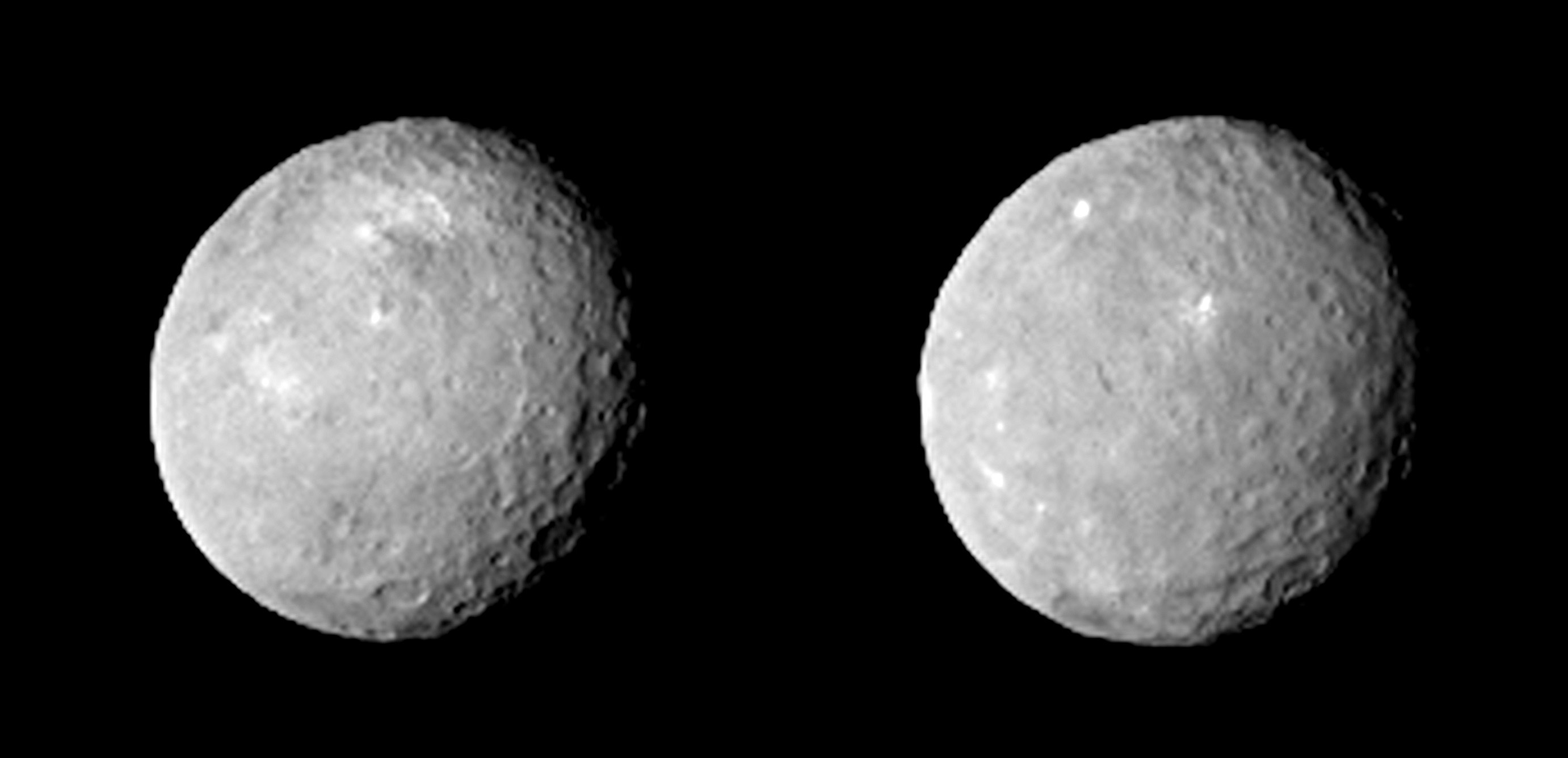
    Dawn Captures Sharper Images of Ceres
    These two views of Ceres were acquired by NASA’s Dawn spacecraft on February 12, 2015, from a distance of about 52,000 miles (83,000 kilometers) as the dwarf planet rotated. The images have been magnified from their original size. Credit: NASA/JPL-Caltech/UCLA/MPS/DLR/IDA

    This new image from NASA’s Dawn spacecraft reveals more details of the dwarf planet Ceres.

    Craters and mysterious bright spots are beginning to pop out in the latest images of Ceres from NASA’s Dawn spacecraft. These images, taken February 12 at a distance of 52,000 miles (83,000 kilometers) from the dwarf planet, pose intriguing questions for the science team to explore as the spacecraft nears its destination.

    “As we slowly approach the stage, our eyes transfixed on Ceres and her planetary dance, we find she has beguiled us but left us none the wiser,” said Chris Russell, principal investigator of the Dawn mission, based at UCLA. “We expected to be surprised; we did not expect to be this puzzled.”

    Dawn will be gently captured into orbit around Ceres on March 6. As the spacecraft delivers better images and other data, the science team will be investigating the nature and composition of the dwarf planet, including the nature of the craters and bright spots that are coming into focus. The latest images, which have a resolution of 4.9 miles (7.8 kilometers) per pixel, represent the sharpest views of Ceres to date.

    The spacecraft explored the giant asteroid Vesta for 14 months during 2011 and 2012. Scientists gained numerous insights about the geological history of this body and saw its cratered surface in fine detail. By comparing Vesta and Ceres, they will develop a better understanding of the formation of the solar system.

    Dawn’s mission to Vesta and Ceres is managed by the Jet Propulsion Laboratory for NASA’s Science Mission Directorate in Washington. Dawn is a project of the directorate’s Discovery Program, managed by NASA’s Marshall Space Flight Center in Huntsville, Alabama. UCLA is responsible for overall Dawn mission science. Orbital ATK, Inc., of Dulles, Virginia, designed and built the spacecraft. JPL is managed for NASA by the California Institute of Technology in Pasadena. The framing cameras were provided by the Max Planck Institute for Solar System Research, Gottingen, Germany, with significant contributions by the German Aerospace Center (DLR) Institute of Planetary Research, Berlin, and in coordination with the Institute of Computer and Communication Network Engineering, Braunschweig. The visible and infrared mapping spectrometer was provided by the Italian Space Agency and the Italian National Institute for Astrophysics, built by Selex ES, and is managed and operated by the Italian Institute for Space Astrophysics and Planetology, Rome. The gamma ray and neutron detector was built by Los Alamos National Laboratory, New Mexico, and is operated by the Planetary Science Institute, Tucson, Arizona.

    Never miss a breakthrough: Join the SciTechDaily newsletter.
    Follow us on Google and Google News.

    Astronomy Ceres Dawn Spacecraft Planetary Science Popular
    Share. Facebook Twitter Pinterest LinkedIn Email Reddit

    Related Articles

    New Images Reveal More Details on Ceres’ Craters

    NASA Reveals New Clues about Ceres’ Bright Spots and Origins

    What’s Creating Those Unusual Bright Spots on Ceres? Dawn Heads Toward Low-Altitude Mapping Orbit

    Dawn Spacecraft Reveals New Maps and Insights about Ceres

    New Up-Close View of the Bright Spots on Ceres

    NASA’s Dawn Reveals Topography of Dwarf Planet Ceres

    Ceres Spots Remain a Mystery in Latest Dawn Images

    New Color Map of Ceres Reveals Surface Diversity

    Dawn Spacecraft Shows Crater Shapes on Ceres’ Surface

    5 Comments

    1. Jess on February 17, 2015 12:09 pm

      Looks like the “Great White Spot” is coming into view

      Reply
      • Scotty Boman on February 17, 2015 5:52 pm

        It looks like a snow filled crater to me… or perhaps some solid Co2?

        Reply
    2. Obummer on February 17, 2015 12:48 pm

      Another waste of money by Fartbama and big government!!

      Reply
    3. Scotty Boman on February 17, 2015 5:42 pm

      Why are these in black and white? The HST images showed Ceres to have a reddish-brown tint. It’s 2015 and even Voyager gave us color pictures back in the 1980’s.

      Reply
    4. Kenneth on February 17, 2015 6:28 pm

      Amazing the things we can acomplish and what we shall if we can just not wipe ourselves out.

      Reply
    Leave A Reply Cancel Reply

    • Facebook
    • Twitter
    • Pinterest
    • YouTube

    Don't Miss a Discovery

    Subscribe for the Latest in Science & Tech!

    Trending News

    The Universe Is Expanding Too Fast and Scientists Can’t Explain Why

    “Like Liquid Metal”: Scientists Create Strange Shape-Shifting Material

    Early Warning Signals of Esophageal Cancer May Be Hiding in Plain Sight

    Common Blood Pressure Drug Shows Surprising Power Against Deadly Antibiotic-Resistant Superbug

    Scientists Uncover Dangerous Connection Between Serotonin and Heart Valve Disease

    Scientists Discover a “Protector” Protein That Could Help Reverse Hair Loss

    Bone-Strengthening Discovery Could Reverse Osteoporosis

    Scientists Uncover Hidden Trigger Behind Stem Cell Aging

    Follow SciTechDaily
    • Facebook
    • Twitter
    • YouTube
    • Pinterest
    • Newsletter
    • RSS
    SciTech News
    • Biology News
    • Chemistry News
    • Earth News
    • Health News
    • Physics News
    • Science News
    • Space News
    • Technology News
    Recent Posts
    • Scientists Overcome Major Quantum Bottleneck, Potentially Transforming Teleportation and Computing
    • Quantum Physics’ Strangest Problem May Hold the Key to Time Itself
    • Scientists Create “Liquid Gears” That Spin Without Touching
    • The Simple Habit That Could Help Prevent Cancer
    • Forgotten Medicinal Plant Shows Promise in Fighting Dangerous Superbugs
    Copyright © 1998 - 2026 SciTechDaily. All Rights Reserved.
    • Science News
    • About
    • Contact
    • Editorial Board
    • Privacy Policy
    • Terms of Use

    Type above and press Enter to search. Press Esc to cancel.