
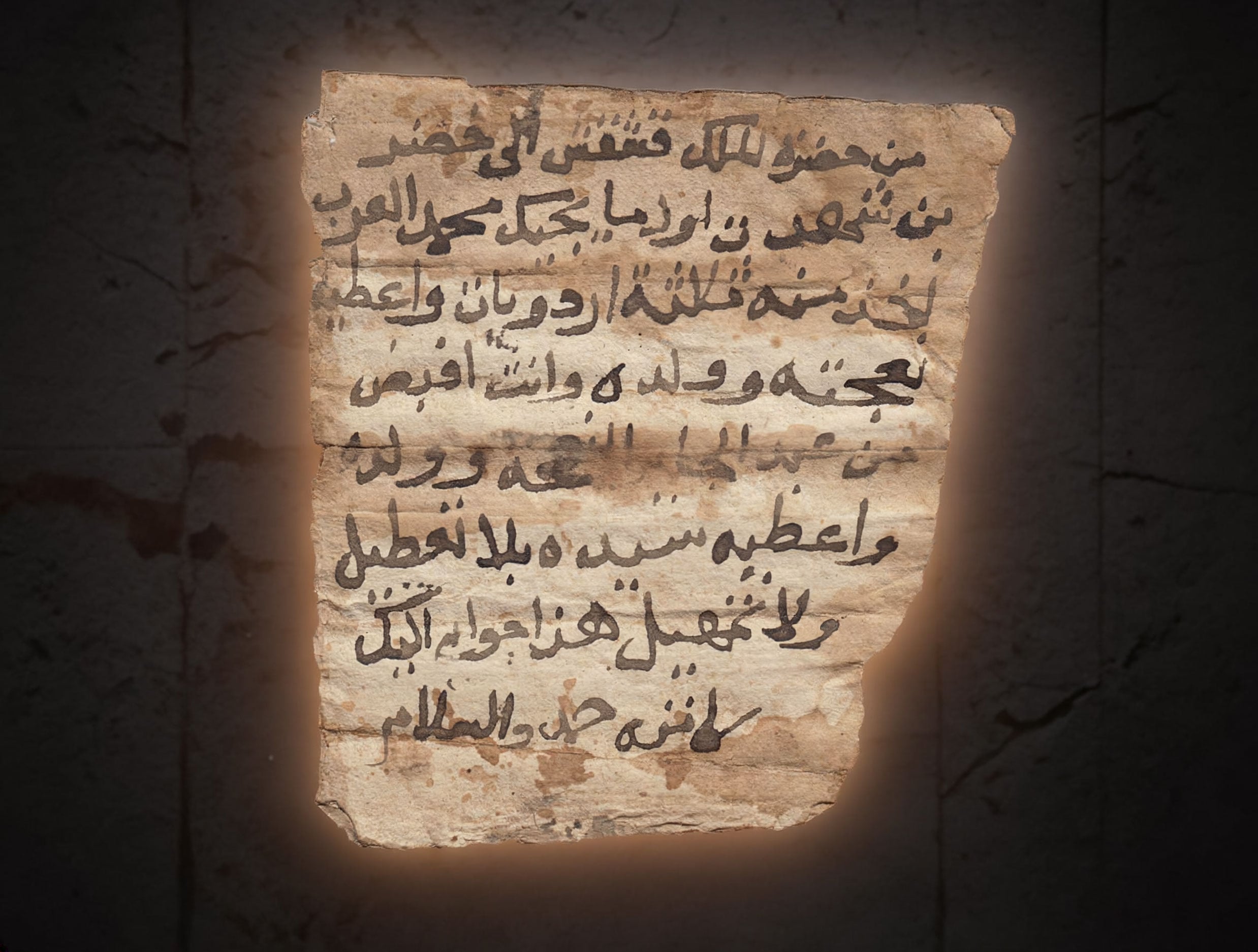
A small, newly uncovered document from ancient Dongola is reshaping what historians know about a little-understood period in Sudan’s past.
A small Arabic document found in the ruins of Old Dongola is helping confirm the existence of King Qashqash, a ruler long treated as legendary.
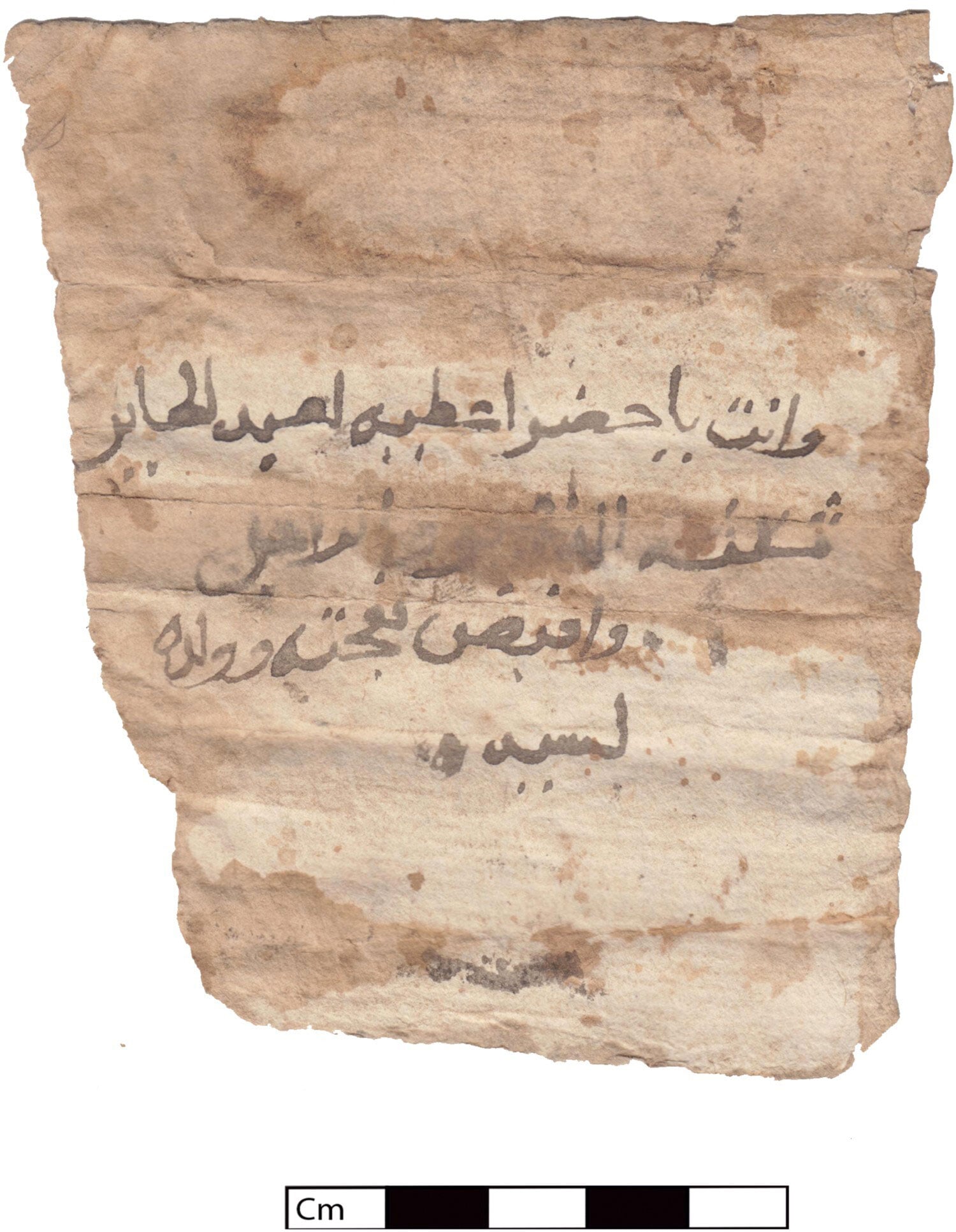
The study, published in Azania: Archaeological Research in Africa, examines a newly excavated order issued in Qashqash’s name. The text, found in an elite residence inside the city’s citadel, deals with the exchange of textiles and livestock. Although modest in appearance, it offers rare evidence for rulership, trade, social ties, and the spread of Arabic writing in Nubia during the Funj period.
The authors say the document provides a “rare glimpse into Sudanic kingship” during “one of the least-documented periods in Sudanese history.”
Dongola After Makuria
Old Dongola, in present-day northern Sudan, was once the capital of Makuria, a powerful Christian Nubian kingdom. By the mid-14th century, the city had lost that status, and the next several centuries remain difficult to reconstruct.
This was not a simple shift from a Christian past to an Islamic future. The authors stress that Arabization and Islamization unfolded slowly, with Nubian traditions, Arabic literacy, Islamic authority, and regional politics overlapping for generations.
During the Funj period (1504–1821), Dongola stood between Ottoman Egypt to the north and the Sultanate of Sennar to the south. Even after its decline as a capital, it remained connected to trade routes linking Cairo, Sennar, Darfur, and regions deeper into Africa.
A Royal Residence in the Citadel
The document was discovered in Building A.1, known locally as the House of the Mekk, meaning the ruler’s house. Archaeological evidence supports that tradition. The structure was larger and more complex than other homes at the site, and its contents point to elite life.
Excavators found cotton, linen, silk, leather shoes, a gold ring, and an ivory or rhinoceros horn dagger handle. They also uncovered lead balls and a cattle horn likely used as a gunpowder flask, suggesting the residents had access to firearms, which could serve as prestige objects in precolonial Nubia.
Between 2019 and 2021, researchers recovered 23 paper documents from the building, including letters, amulets, a legal text, and an administrative list. The king’s order came from Room U128, a space about 5 × 4 meters (16 × 13 feet), where the documents had been discarded in rubbish layers.
The paper itself measures only 10.5 × 9.5 centimeters (4.1 × 3.7 inches). Coins and radiocarbon dating show that it was thrown away sometime between the 17th and 18th centuries, but internal evidence suggests it was probably written earlier, in the late 16th or early 17th century.
A King Managing Everyday Power
Rather than issuing a dramatic royal decree, the order concerns a practical exchange involving a man named Khiḍr, who was told to handle goods between Muḥammad al-ʿArab and ʿAbd al-Jābir. The items included textiles, a ewe, and her offspring. One damaged passage may refer to cotton cloth or cotton headwear, which may have carried elite significance.
That ordinary subject is what makes the document valuable. Rather than showing a king at war, it shows a ruler managing relationships, obligations, and access to goods.
The authors say the exchange likely reflected “micropolitical actions aimed at strengthening social ties,” not simply profit-driven trade. They also say their aim is to show “the King of Nubia at work, not at war, but in everyday management.”
Turning Legend Into History
Before this discovery, Qashqash was known mainly from the Kitāb al-Ṭabaqāt, a 19th-century biographical dictionary based on oral traditions about Sudanese holy men. In that source, he appears in a genealogy connected to Sheikh Ḥilālī and Muḥammad b. ʿĪsā Suwār al-Dhahab, one of Sudan’s most revered religious figures.
Because that evidence came from later religious storytelling, Qashqash’s historical status was uncertain. The new document changes that. The study identifies him as the earliest known post-medieval king of Dongola and strengthens the case that King Ḥasan, described in later tradition as his son, was also a real ruler.
The authors say the order provides “a compelling argument for the historicity of both rulers.”
Arabic Writing in a Nubian Court
The document also captures a moment of linguistic change. It was written in Arabic, but not polished Classical Arabic. Its spelling and grammar include nonstandard forms, suggesting that Arabic was becoming central to written administration even though Nubian languages likely remained important in daily life.
The order names the scribe as Ḥamad, showing that Qashqash relied on literate specialists. Khiḍr, the recipient, may also have been able to read Arabic or had access to someone who could.
The authors say the find helps reveal “the linguistic transformations and cultural interactions that have shaped Nubia over time.”
The king’s order is only a scrap of paper, but it confirms that Qashqash was more than a legend. It also shows Dongola as an active political center after Makuria’s decline, where rulers managed trade, favors, and local power through everyday decisions.
Reference: “The King of Nubia at work: archaeological context and text edition of a sixteenth/seventeenth-century Arabic document from Old Dongola” by Tomasz Barański, Artur Obłuski and Maciej Wyżgoł, 6 February 2026, Azania: Archaeological Research in Africa.
DOI: 10.1080/0067270X.2026.2615518
Never miss a breakthrough: Join the SciTechDaily newsletter.
Follow us on Google and Google News.
6 Comments
People of African descent know that all of Africa and the Middle East were ruled by BLACK Kings and QUEENS! Truth cannot be erased by movies and cutting off the nose of the sphinx or that Jesus was BLACK! It is documented but it doesn’t matter because truth will always come to light. So no big discovery here, we always knew the many ancient BLACK KINGS that built all of the ancient worlds…….
False and fake. What you have written is exactly what is called the falsification of history. The middle east and North Africa were never ruled by black kings and what js talked about here is The Bubian kingdom which is in Northern Sudan and this African part was always black besides the Abissinyian kingdoms were ruled by Black but The Levantine area, Egypt and North Africa were never ruled by black people with the exception of the time of shishaq who was from the kingdom of Kush in modern day Sudan and the far Eastern part of Chad who ruled in Egypt for a short period. On the other hand, it was white Pharoahs who ruled Sudan for a long period and that is why the Northern Sudanese people are brown in color and some of them are even light brown in sharp contrast with the Southern Sudanese whose skin is much darker in color. Go learn before coming to write laughable foolishness that only betrays your ignorance and stupidity. How pathetic
You’re dr but with little knowledge of history. Well, northern Sudanese are not “light skin” because of contact with Egyptians but are Arab immigrants who entered sudan during the Abbasid caliphate. They’re mostly from Saudi Arabia and interacted with the Nilotic and Nubians to have their tribes like Jaali and Nubians. There’s long list of black kings ruling Egypt besides the whole kushite’s 25th dynasty. No identification of shishaq says he’s from Kush. Most of the dna from Christian era Nubians shows 60% Dinka ancestry, the Nubians who’re the only remnants of Kush in the north now still speak Nilo-Saharan language that’s classified under the same branch as western Nilotic. Study some history of Africa instead of embarrassing yourself trying to correct people.
“They shall reap what they sow!” Said the Lord
I see little differentiation between “climate (cooling) change then, and the warming climate change now – besides the fact that we are able – to some degree at least – to see that the ongoing (warming) change is occurring.
Neither are man-made (although many would have it that warming is)
Climate warming is not a new thing- it has clearly happened before, between the various Ice Ages, and would naturally increase – get warmer at an increasing rate – the more time passes since the last icing over of the polar extremes.
The only difference is that we now have records of temperatures going back around 100 years.
In neither scenario is there any way to avert it, and all that remains is to see how many manage to survive it.
None of us alive today will be around to witness the answer.
If any do, then archeologists and scientists a few thousand years from now may well be publishing theories on how misguided we were.
If you think modern day pollution from the use of fossil fuels doesn’t at least greatly add to the problem of global warming, either you’re a fool or in on it.