
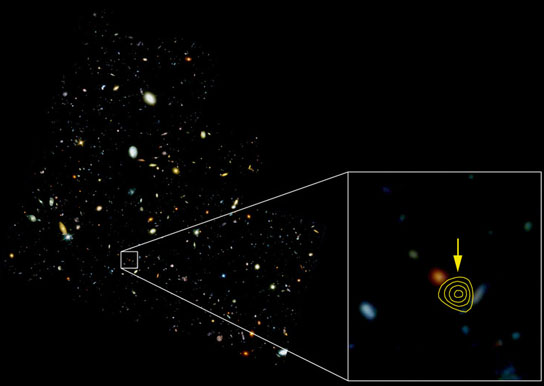
Using the IRAM interferometer on the Plateau de Bure, scientists from the Max Planck Institute were able to accurately measure the distance of galaxy HDF850.1, finding it to be 12.5 billion light-years away from Earth.
In observations with optical light telescopes, such as the Hubble Space Telescope, HDF850.1 is completely invisible. From other surveys, however, scientists knew that the object is one of the most productive star-forming galaxies in the observable universe – a Milky Way system with the extremely high stellar birth rate of 1,000 suns per year. A team of astronomers led by Fabian Walter of the Max Planck Institute for Astronomy has now managed for the first time to determine the distance of the galaxy HDF850.1. The light reaching us from it today started its voyage when the universe was less than 10% of its current age, i.e. 12.5 billion years ago. The galaxy appears to be part of a proto-galaxy cluster that formed within the first billion years of cosmic history after Big Bang.
The galaxy HDF850.1 was discovered in 1998. It is famous for producing new stars at a rate that is near-incredible even on astronomical scales: a combined mass of a thousand Suns per year. For comparison: an ordinary galaxy such as our own produces no more than one solar mass’s worth of new stars per year. Yet for more than a decade, HDF850.1 has remained strangely elusive – its location in space, specifically: its distance from Earth the subject of many studies, but ultimately unknown. How was that possible?
The “Hubble Deep Field”, where HDF850.1 is located, is a region in the sky that affords an almost unparalleled view into the deepest reaches of space. It was first studied extensively using the Hubble Space Telescope. Yet observations using visible light only reveal part of the cosmic picture, and astronomers were quick to follow-up at different wavelengths. In the late 1990s, astronomers using the James Clerk Maxwell Telescope on Hawaii surveyed the region using submillimeter radiation. This type of radiation, with wavelengths between a few tenths of a millimeter and a millimeter, is particularly suitable for detecting cool structures such as clouds of gas and dust.
The researchers found a surprise: HDF850.1, the brightest source of submillimeter emissions in the field by far; a galaxy that evidently produced more stars than all the other galaxies in the Hubble Deep Field together – and which was completely invisible in the observations of the Hubble Space Telescope!
The galaxy’s invisibility is no great mystery. Star formation takes place within dense clouds of gas and dust. These are opaque to visible light, hiding the galaxy from sight; submillimeter radiation can pass through those clouds unhindered, showing what is inside. But the lack of data from all but a very narrow range of the spectrum made it very difficult to determine the galaxy’s distance and, in consequence, its place in cosmic history.
Now, a group of researchers led by Fabian Walter of the Max Planck Institute for Astronomy has managed to solve the mystery. Taking advantage of recent upgrades to the IRAM interferometer on the Plateau de Bure, which combines six radio antennas that then act as a gigantic millimeter telescope, they identified the characteristic features (“spectral lines”) necessary for an accurate distance measurement.
The result is somewhat surprising: The galaxy is at a distance of 12.5 billion light-years from Earth (z ~ 5.2). We see it as it was 12.5 billion years ago, at a time when the universe itself was only 1.2 billion years old! HDF850.1’s intense star-forming activity thus belongs to a very early period of cosmic history, when the universe was less than 10% of its current age.
A combination with observations obtained at the National Science Foundation’s Karl Jansky Very Large Array (VLA) then revealed that a large fraction of the galaxy’s mass is in the form of molecules – the raw material for future stars. The fraction is much higher than what is found in galaxies in the local universe.
Once the distance was known, the researchers were also able to put the galaxy into context. Using additional data from published and unpublished surveys, they were able to show that the galaxy is part of what appears to be an early form of galaxy cluster – one of only two such clusters known to date.
The new work highlights the importance of ALMA, a new compound telescope for submillimeter and millimeter observations currently being built by an international consortium in the Atacama Desert of Chile. ALMA is set to cover the submillimeter- and millimeter range of wavelengths at an unprecedented level of detail, and should allow for distance determinations of a great number of further galaxies that remain invisible at optical wavelengths.
Reference: “The intense starburst HDF 850.1 in a galaxy overdensity at z ≈ 5.2 in the Hubble Deep Field” by Fabian Walter, Roberto Decarli, Chris Carilli, Frank Bertoldi, Pierre Cox, Elisabete Da Cunha, Emanuele Daddi, Mark Dickinson, Dennis Downes, David Elbaz, Richard Ellis, Jacqueline Hodge, Roberto Neri, Dominik A. Riechers, Axel Weiss, Eric Bell, Helmut Dannerbauer, Melanie Krips, Mark Krumholz, Lindley Lentati, Roberto Maiolino, Karl Menten, Hans-Walter Rix, Brant Robertson, Hyron Spinrad, Dan P. Stark and Daniel Stern, 13 June 2012, Nature.
DOI: 10.1038/nature11073
Never miss a breakthrough: Join the SciTechDaily newsletter.
Follow us on Google and Google News.