
Close Menu
    Facebook X (Twitter) Instagram
    SciTechDaily
    • Biology
    • Chemistry
    • Earth
    • Health
    • Physics
    • Science
    • Space
    • Technology
    Facebook X (Twitter) Pinterest YouTube RSS
    SciTechDaily
    Home»Space»Drive to Destruction: Simulating Burn-Up During Atmospheric Reentry
    Space

    Drive to Destruction: Simulating Burn-Up During Atmospheric Reentry

    By European Space Agency (ESA)June 19, 2021No Comments2 Mins Read
    Facebook Twitter Pinterest Telegram LinkedIn WhatsApp Email Reddit
    Share
    Facebook Twitter LinkedIn Pinterest Telegram Email Reddit
    Simulating Burn-Up During Atmospheric Reentry
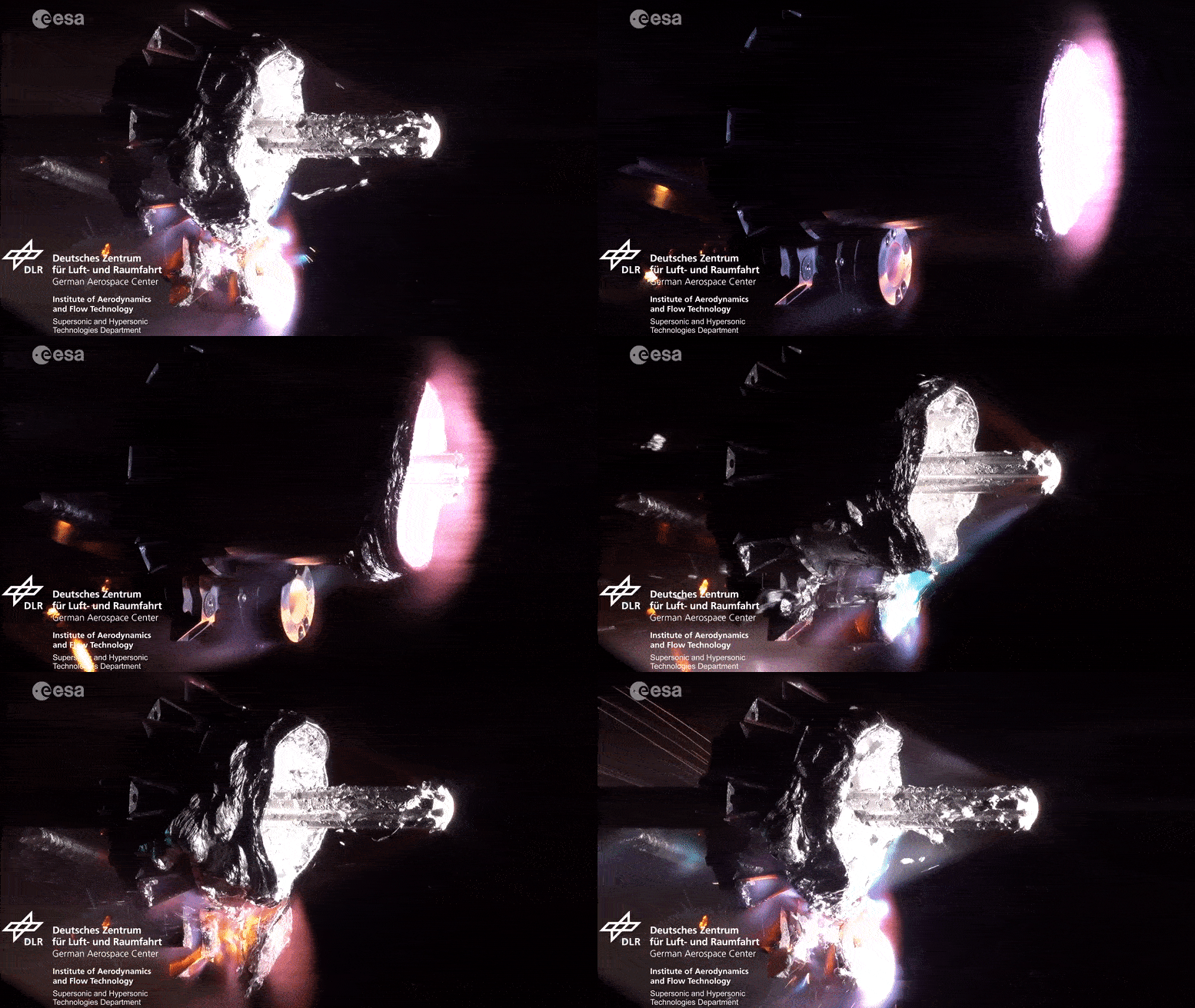
    Simulating the burn-up during atmospheric reentry of one of the bulkiest items aboard a typical satellite using a plasma wind tunnel. Credit: ESA/DLR

    Testing a bulky satellite part’s fiery reentry proves tweaks can ensure it disintegrates safely.

    Simulating the burn-up during atmospheric reentry of one of the bulkiest items aboard a typical satellite using a plasma wind tunnel.

    This Solar Array Drive Mechanism (SADM) has the essential task of keeping a satellite’s solar wings trained on the Sun, maintaining mission operations.

    But its bulky nature presents a problem in terms of space debris guidelines. When a spacecraft reenters on an uncontrolled basis, the spacecraft operator has to prove that the on-ground casualty risk posed by its satellite is lower than 1 in 10,000.

    So last year SADM manufacturer Kongsberg Defence & Aerospace (KDA) started an investigation supported by ESA, Hyperschall Technologie Göttingen GmbH (HTG), and the German Aerospace Center (DLR) to demonstrate the ‘desmisability’ of one of its satellite products.

    They began by modeling such a reentry using ESA’s dedicated SCARAB (Spacecraft Atmospheric Reentry and Aerothermal Break-up) software and comparable resources, tweaking the SADM by switching one screw to lower-melting-point aluminum to promote an earlier, higher-altitude breakup.

    Then their software model was compared to observed reality, by melting an actual SADM model inside DLR’s LK3 plasma wind tunnel in Cologne. Arc-heated gas in the test chamber reached speeds of several kilometers per second, reproducing reentry conditions.

    Following assessment of the results, HTG went on to build a model of the SADM using ESA’s DRAMA (Debris Risk Assessment and Mitigation Analysis) software tool, which will be available to other DRAMA users in the future.

    To read more details about the test program click here.

    As part of a larger effort called CleanSat, ESA is developing technologies and techniques to ensure future low-orbiting satellites are designed according to the concept of ‘D4D’ – Design for Demise.

    Never miss a breakthrough: Join the SciTechDaily newsletter.
    Follow us on Google and Google News.

    European Space Agency Popular Space Debris
    Share. Facebook Twitter Pinterest LinkedIn Email Reddit

    Related Articles

    The Final Orbit: Unraveling a Satellite’s Death Spiral

    ESA’s Aeolus: A Historic End to a Trailblazing Mission

    Swarm Spacecraft Dodges Collision With Space Junk During Climb To Escape Sun’s Wrath

    ESA’s Solar Orbiter Spacecraft Is Skimming Earth for a Gravity Assist – And It’s One of the Riskiest Planetary Flybys Ever

    Clean Space Initiative to Target Orbital Debris

    Herschel Image of the Vela C Region

    Researchers Discover First Intermediate-Mass Black Hole

    ESA’s Vega Rocket Has Launched on Its Maiden Voyage, Carries 9 Satellites

    ESA’s Hershel Space Telescope Captures Incredible Views of Eagle Nebula

    Leave A Reply Cancel Reply

    • Facebook
    • Twitter
    • Pinterest
    • YouTube

    Don't Miss a Discovery

    Subscribe for the Latest in Science & Tech!

    Trending News

    The Universe Is Expanding Too Fast and Scientists Can’t Explain Why

    “Like Liquid Metal”: Scientists Create Strange Shape-Shifting Material

    Early Warning Signals of Esophageal Cancer May Be Hiding in Plain Sight

    Common Blood Pressure Drug Shows Surprising Power Against Deadly Antibiotic-Resistant Superbug

    Scientists Uncover Dangerous Connection Between Serotonin and Heart Valve Disease

    Scientists Discover a “Protector” Protein That Could Help Reverse Hair Loss

    Bone-Strengthening Discovery Could Reverse Osteoporosis

    Scientists Uncover Hidden Trigger Behind Stem Cell Aging

    Follow SciTechDaily
    • Facebook
    • Twitter
    • YouTube
    • Pinterest
    • Newsletter
    • RSS
    SciTech News
    • Biology News
    • Chemistry News
    • Earth News
    • Health News
    • Physics News
    • Science News
    • Space News
    • Technology News
    Recent Posts
    • Scientists Overcome Major Quantum Bottleneck, Potentially Transforming Teleportation and Computing
    • Quantum Physics’ Strangest Problem May Hold the Key to Time Itself
    • Scientists Create “Liquid Gears” That Spin Without Touching
    • The Simple Habit That Could Help Prevent Cancer
    • Forgotten Medicinal Plant Shows Promise in Fighting Dangerous Superbugs
    Copyright © 1998 - 2026 SciTechDaily. All Rights Reserved.
    • Science News
    • About
    • Contact
    • Editorial Board
    • Privacy Policy
    • Terms of Use

    Type above and press Enter to search. Press Esc to cancel.