
Close Menu
    Facebook X (Twitter) Instagram
    SciTechDaily
    • Biology
    • Chemistry
    • Earth
    • Health
    • Physics
    • Science
    • Space
    • Technology
    Facebook X (Twitter) Pinterest YouTube RSS
    SciTechDaily
    Home»Space»A Decade Worth of Discovery from THEMIS
    Space

    A Decade Worth of Discovery from THEMIS

    By Robert Burnham, Arizona State University School of Earth and Space ExplorationMarch 1, 2012No Comments3 Mins Read
    Facebook Twitter Pinterest Telegram LinkedIn WhatsApp Email Reddit
    Share
    Facebook Twitter LinkedIn Pinterest Telegram Email Reddit
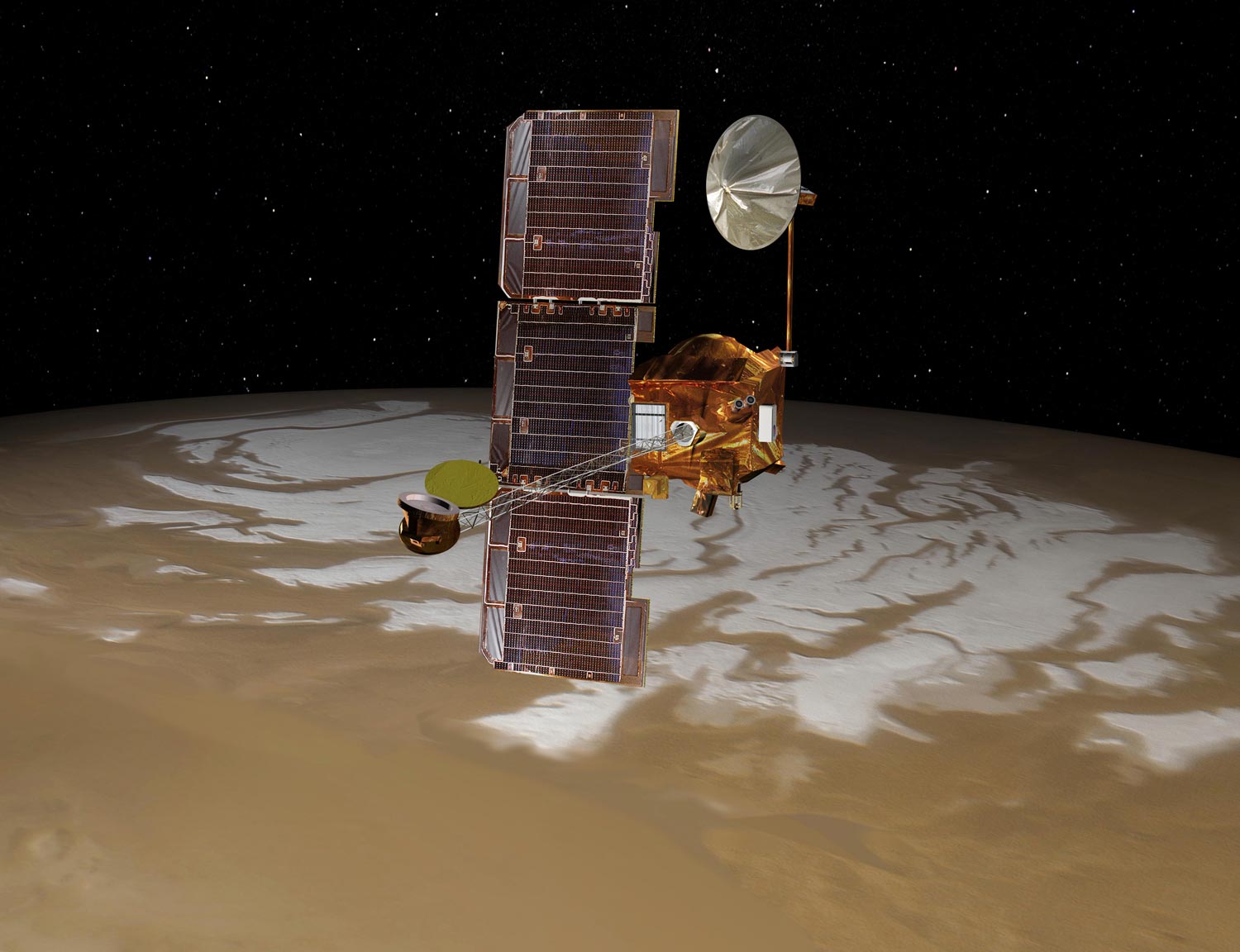
    Odyssey Spacecraft Over Mars' South Pole
    NASA’s Mars Odyssey spacecraft passes above Mars’ south pole in this artist’s concept illustration. The spacecraft has been orbiting Mars since October 24, 2001. Credit: NASA/JPL-Caltech

    Ten years and counting. The Thermal Emission Imaging System onboard NASA’s Mars Odyssey orbiter has taken nearly 500,000 images and circled Mars nearly 45,000 times in the last decade and scientists expect many more good years from it.

    Ten years ago, on February 19, 2002, the Thermal Emission Imaging System (THEMIS), a multi-band camera on NASA’s Mars Odyssey orbiter, began scientific operations at the Red Planet. Since then the camera has circled Mars nearly 45,000 times and taken more than half a million images at infrared and visible wavelengths.

    THEMIS camera on NASA's Mars Odyssey spacecraft has completed an unprecedented full decade of observing Mars
    THEMIS captured this image on February 19, 2012, 10 years to the day after the camera recorded its first view of Mars. This image covers an area 11 by 32 miles (19 by 52 kilometers) in the Nepenthes Mensae region north of the Martian equator. The view depicts a knobby landscape where the southern highlands are breaking up as the terrain descends into the northern lowlands. Credit: NASA/JPL-Caltech/ASU

    “THEMIS has proven itself a workhorse,” said Philip Christensen of Arizona State University, Tempe, the camera’s principal investigator and designer. “It’s especially gratifying to me to see the range of discoveries that have been made using this instrument.”

    Highlights of science results by THEMIS over the past 10 years include:

    • Confirming a mineral exposure selected as the landing site for NASA’s Mars Exploration Rover Opportunity
    • Discovering carbon-dioxide gas jets at the south polar ice cap in spring
    • Discovering chloride salt deposits across the planet
    • Making the best global image map of Mars ever done
    • Identifying safe landing sites for NASA’s Mars Phoenix lander by finding the locations with the fewest hazardous boulders
    • Monitoring dust activity in the Martian atmosphere
    • Discovering that a large crater, Aram Chaos, once contained a lake
    • Discovering that Mars has more water-carved channels than previously thought
    • Discovering dacite on Mars, a more evolved form of volcanic lava not previously known on the Red Planet

    THEMIS combines a five-wavelength visual imaging system with a nine-wavelength infrared imaging system. By comparing daytime and nighttime infrared images of an area, scientists can determine many of the physical properties of the rocks and soils on the ground.

    Mars Odyssey has a two-hour orbit that is nearly “sun-synchronous,” meaning that Odyssey passes over the same part of Mars at roughly the same local time each day. In September 2008 its orbit was shifted toward an earlier time of day, which enhanced THEMIS’ mineralogical detection capability.

    Says Christensen, “Both Odyssey and THEMIS are in excellent health and we look forward to years more science with them.”

    NASA launched the Mars Odyssey spacecraft on April 7, 2001. Odyssey arrived at Mars on October 24, 2001. After arrival, the spacecraft spent several months in a technique called aerobraking, which involved dipping into the Martian atmosphere to adjust its orbit. In February 2002, science operations began.

    Odyssey is managed by NASA’s Jet Propulsion Laboratory, Pasadena, for NASA’s Science Mission Directorate in Washington. Lockheed Martin Space Systems in Denver built the spacecraft. JPL and Lockheed Martin collaborate on operating the spacecraft. JPL is a division of the California Institute of Technology in Pasadena.

    Never miss a breakthrough: Join the SciTechDaily newsletter.
    Follow us on Google and Google News.

    JPL Mars Mars Odyssey Orbiter NASA THEMIS
    Share. Facebook Twitter Pinterest LinkedIn Email Reddit

    Related Articles

    New NASA Image Shows Giant Mars Volcano Surging Through Ice Cloud Belt

    100,000 Orbits Later: NASA’s Mars Odyssey Captures Huge Volcano in Breathtaking New View

    NASA Backs 12 Innovative Studies to Enhance Mars Exploration

    Astronaut’s Eye View: Breathtaking Mars Horizon Captured by NASA’s Odyssey Orbiter

    Sun’s Curtain Call: Mars Missions Go Rogue During Solar Conjunction

    Odyssey Over? Precarious Fuel Supply of NASA’s Oldest Mars Orbiter

    Solving the Baffling Mysteries of Invisible Frost and Dust Avalanches on Mars

    NASA’s Mars Odyssey Orbiter: 20 Historic Years of Mapping the Red Planet

    NASA’s Mars Odyssey Spacecraft Repositioned to Confirm Curiosity’s Landing

    Leave A Reply Cancel Reply

    • Facebook
    • Twitter
    • Pinterest
    • YouTube

    Don't Miss a Discovery

    Subscribe for the Latest in Science & Tech!

    Trending News

    Millions Take These IBS Drugs, But a New Study Finds Serious Risks

    Scientists Unlock Hidden Secrets of 2,300-Year-Old Mummies Using Cutting-Edge CT Scanner

    Bread Might Be Making You Gain Weight Even Without Eating More Calories

    Scientists Discover Massive Magma Reservoir Beneath Tuscany

    Europe’s Most Active Volcano Just Got Stranger – Here’s Why Scientists Are Rethinking It

    Alzheimer’s Symptoms May Start Outside the Brain, Study Finds

    Millions Take This Popular Supplement – Scientists Discover a Concerning Link to Heart Failure

    The Universe Is Expanding Too Fast and Scientists Can’t Explain Why

    Follow SciTechDaily
    • Facebook
    • Twitter
    • YouTube
    • Pinterest
    • Newsletter
    • RSS
    SciTech News
    • Biology News
    • Chemistry News
    • Earth News
    • Health News
    • Physics News
    • Science News
    • Space News
    • Technology News
    Recent Posts
    • Doctors Surprised by the Power of a Simple Drug Against Colon Cancer
    • Why Popular Diabetes Drugs Like Ozempic Don’t Work for Everyone: The “Genetic Glitch”
    • Scientists Create Improved Insulin Cells That Reverse Diabetes in Mice
    • Scientists Stunned After Finding Plant Thought Extinct for 60 Years
    • A Common Diabetes Drug May Hold the Key to Stopping HIV From Coming Back
    Copyright © 1998 - 2026 SciTechDaily. All Rights Reserved.
    • Science News
    • About
    • Contact
    • Editorial Board
    • Privacy Policy
    • Terms of Use

    Type above and press Enter to search. Press Esc to cancel.