
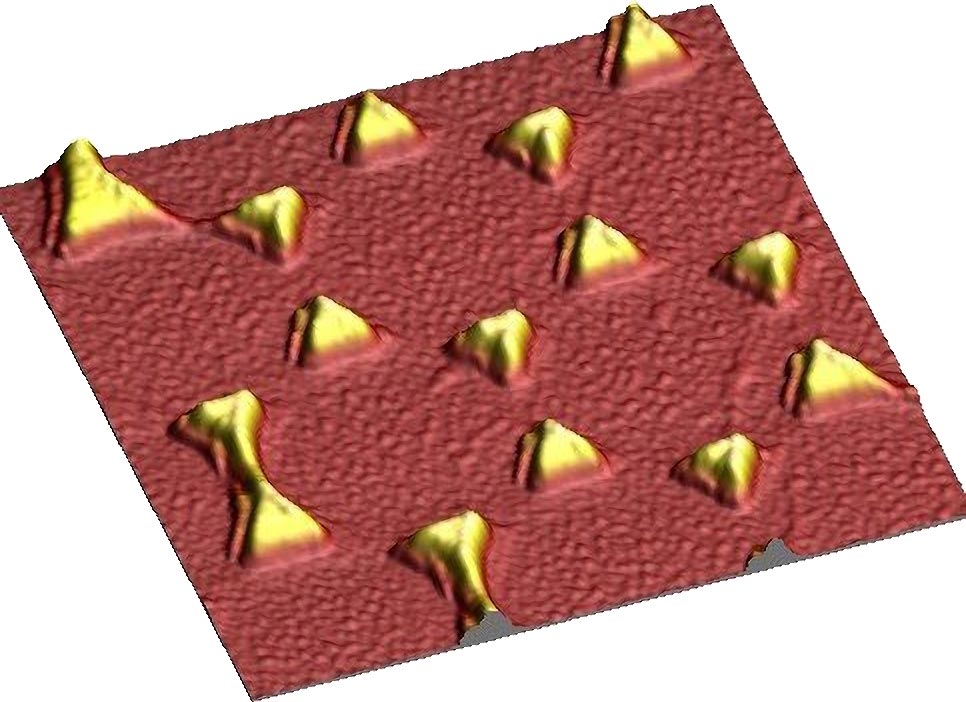
Physicists at the Max Planck Institute used a short electric pulse to change the magnetic transport properties of a material sandwich consisting of a ferroelectric layer between two ferromagnetic materials.
A new mechanism will make it possible to switch data storage in the future. Researchers at the Max Planck Institute of Microstructure Physics in Halle use a short electric pulse to change the magnetic transport properties of a material sandwich consisting of a ferroelectric layer between two ferromagnetic materials. It could be assumed that an electric pulse only influences the electric transport properties. With the help of the new switching mechanism, information can be placed in four instead of just two states of a storage point. This consequently increases storage density. This mechanism may also prove useful in spintronics. This type of electronics should be particularly efficient at processing data, as it does not just utilize the electrons’ charge, but also their spin, which could be regarded as their own spin momentum.
Such behavior would have quite curious effects for a light switch: In the case of a lamp dimmer switch, the connection, which the physicists at the Max Planck Institute of Microstructure Physics in Halle have discovered, would not only cause the light to change brightness, but also to change color – from green to red, for instance. Although both properties are characteristics of light, they cannot be manipulated with one switch simultaneously. However, the researchers in Halle have now succeeded in doing something similar with the tunnel current that flows between two ferromagnetic electrode layers of a multiferroic material sandwich.
In this case, multiferroic means that the parcel includes the two ferromagnetic substances, as well as a ferroelectric substance. In ferroelectric materials, voltage switches between the two directions of an electric polarization – depending on its polarity – not unlike when a magnetic field permanently reverses the polarity of a ferromagnet. As ions shift within the material structure during this process, the polarization remains intact, even after the voltage has been reduced. It is possible, however, to reverse the switch again with a similarly large voltage with reversed polarity.
Changing the direction of the polarization with electric and magnetic effects
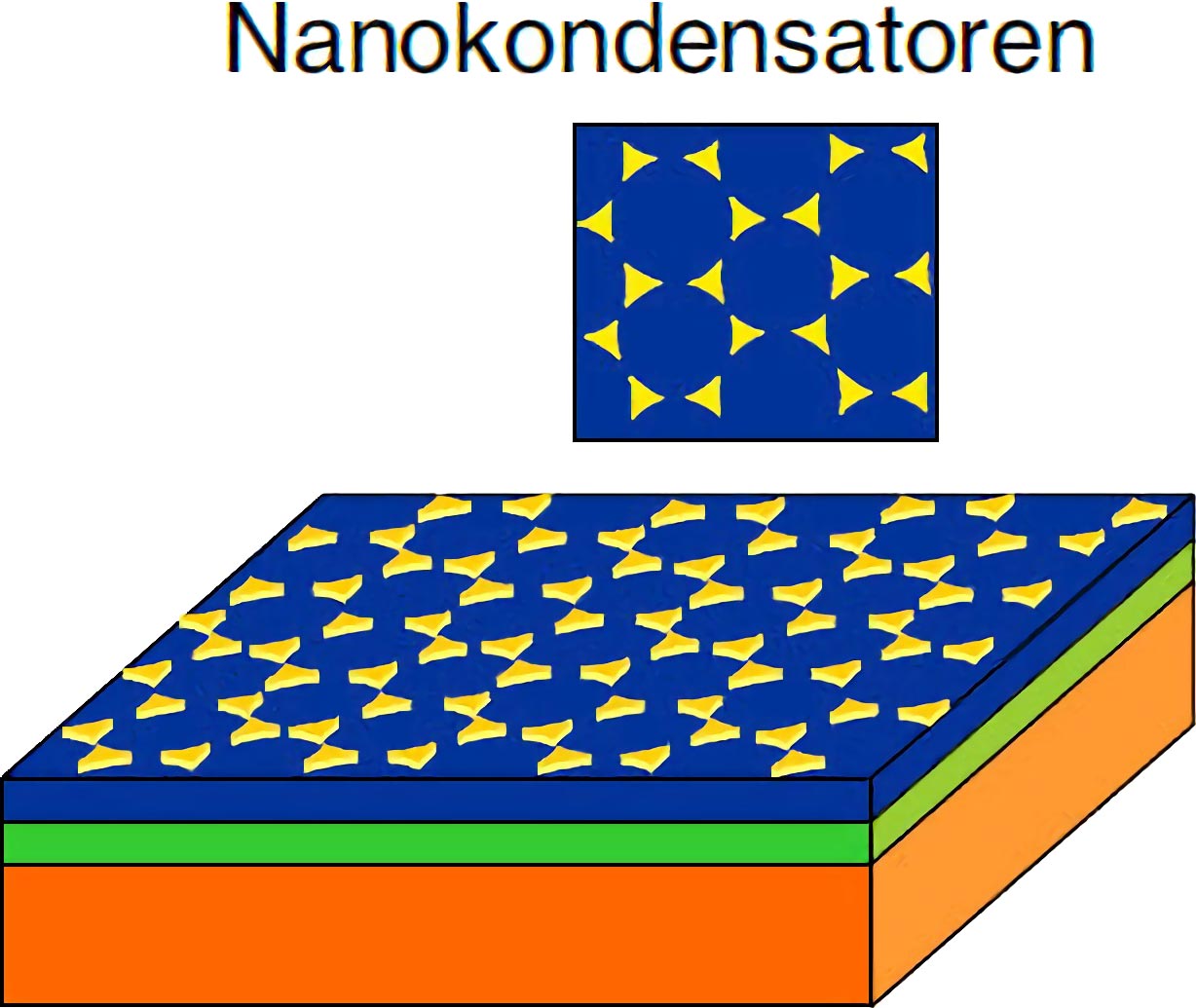
The Halle-based researchers prepared their multiferroic material sandwich by steaming an extremely accurately structured ferromagnetic lanthan strontium manganate (LSMO) layer on a base. The thickness of this layer is just under 30 nanometers − that is one-millionth of a millimeter. On top of that, they deposited a layer of ferroelectric lead zirconate titanite (PZT) only three nanometers thick and with a very regular structure; a top layer of ferromagnetic cobalt finished the sandwich.
The physicists then placed the tip of an atomic force microscope over the cobalt cover of the material stack to create voltage at the multiferroic sandwich. Although the non-conductive PZT layer prevents current flow in the traditional sense between cobalt and LSMO, some electrons may overcome the barrier in the quantum-physical tunnel process. The researchers in Halle were interested in precisely these properties of tunnel current.
The strength of this tunnel current depends on the polarization of the ferroelectric PZT. The polarization impacts the height of the tunnel barrier, meaning that the tunnel resistance is different for both polarization directions. The physicists also used electrical voltage to switch between the two polarization directions. To do this, they applied a voltage pulse, which was considerably stronger than the voltage needed for the tunnel current but lasted less than a millisecond.
“Surprisingly, not only the component of the tunnel junction resistance that depends on the direction of the polarization, but also the component that usually only depends on the direction of the magnetization of the electrodes, the so-called tunnel magnetoresistance, changes when reversing the polarity of the ferroelectric fluid,” says Dietrich Hesse, who heads the research team together with Marin Alexe. This tunnel magnetoresistance (TMR) always appears when electrons are tunneling between two different ferromagnets. It is usually smaller for two ferromagnetic electrodes that are magnetized in the same direction than for two electrodes that are magnetized in opposite directions – in this case, physicists talk of normal tunnel magnetoresistance.
A filter for electron spins
The physicists in Halle actually observed the normal tunnel magnetoresistance in one of the two electric polarization directions in the ferroelectric PZT layer. In the case of the other electric polarization direction, however, the conditions surprisingly reversed themselves – now there was inverted TMR. The tunnel connection conducts current with little resistance when both ferromagnets are magnetized in the opposite direction.
Apart from the effect on the electric resistance, the TMR also acts as an electron spin filter. In simple terms, the spin is the direction in which the electrons are spinning; it provides every electron with its own magnetic momentum, which may go one way, then the other. In the simplest case of normal TMR, only electrons whose magnetic momentum is going in the same direction as the magnetization of the two ferromagnetic electrodes manage to get through the PZT layer. “A change in the electric polarization direction, therefore, influences the strength of the tunnel current and also results in electrons with a certain spin being filtered out,” explains Marin Alexe. “We can achieve the same effect by changing the magnetization in both ferromagnetic layers with an external magnetic field, but this method uses a lot more energy.”
The influence of the electric polarization on the filter effect of the tunnel junction for electron spins and the electric resistance are interesting for applications, because, all in all, the multiferroic tunnel connection can take four differently sized electric resistances: two for each electric polarization direction, one for the same magnetization and one for opposite magnetization of both ferromagnets. “This enables us to deposit three times as much information in a multiferroic tunnel junction than in ordinary binary magnetic storage,” comments Marin Alexe. This means that the size of magnetic random access memories (MRAM) can be considerably reduced. MRAMs provide an alternative to conventional electrically operated RAMs. They would make it unnecessary to load data from the hard drive to a user memory when booting up a computer, and the device would be ready to use at the push of a button.
Better understanding to pave the way for spintronics
“As a filter that can be simply switched and sort electrons according to their spin direction, the multiferroic tunnel junction could also find use in spintronics,” says Dietrich Hesse. This could be a possible future development of electronics, which is why many physicists around the world are researching its basic principles. Spintronics uses both the charge and spin of the electrons to process data with a higher density than is possible in conventional electronics.
In order to advance the multiferroic material sandwich as a spin filter, physicists are first striving to understand precisely how a change of the PZT’s electric polarization direction affects the magnetic tunnel resistance. Up to now, they only know the details of what happens in the case of the electric polarization direction that goes hand in hand with the normal tunnel magnetoresistance. “We are unable as yet to explain exactly why the inverted tunnel magnetoresistance appears when the polarization direction is reversed,” comments Dietrich Hesse. One reason could be the interaction between the ferromagnetic cobalt and the adjoining titan ions in the PZT. The latter change their position with the polarization direction. When they get closer to the cobalt layer, they take on their own magnetic momentum on account of the intensive interaction. This magnetic momentum affects the spin direction of the tunneling electrons.
To explain this connection in detail, Dietrich Hesse and Marin Alexe asked theoretical physicists at the Institute and at the University of Halle for help. They will now calculate the magnetoelectric coupling due to the interaction between the titan ions of the PZT and the cobalt. However, the help of Dietrich Hesse’s and Marin Alexe’s team is still needed to draw a better comparison between the results of this calculation and the experiments. They are currently trying to steam the cobalt cover of their multiferroic material sandwich with a structure that is as regular as that of the other two layers. “Only if we understand exactly how the magnetoelectric coupling works in multiferroic tunnel junctions can we also use it for electronic applications.”
Reference: “Reversible electrical switching of spin polarization in multiferroic tunnel junctions” by D. Pantel, S. Goetze, D. Hesse and M. Alexe, 26 February 2012, Nature Materials.
DOI: 10.1038/nmat3254
Never miss a breakthrough: Join the SciTechDaily newsletter.
Follow us on Google and Google News.