
Scientists have discovered that distinct brain regions are involved in music and language processing, with specific areas engaged for complexity in melodies and sentences. The research was conducted during an awake craniotomy on a musician, with his musical and language function fully preserved post-surgery.
Distinct, though neighboring, areas of the brain are activated when processing music and language, with specific sub-regions engaged for simple melodies versus complex melodies, and for simple versus complex sentences, according to research from the University of Texas Health Science Center at Houston.
The study, led by co-first authors Meredith McCarty, PhD candidate in the Vivian L. Smith Department of Neurosurgery with McGovern Medical School at UTHealth Houston, and Elliot Murphy, PhD, postdoctoral research fellow in the department, was published recently in iScience. Nitin Tandon, MD, professor and chair ad interim of the department in the medical school, was senior author.
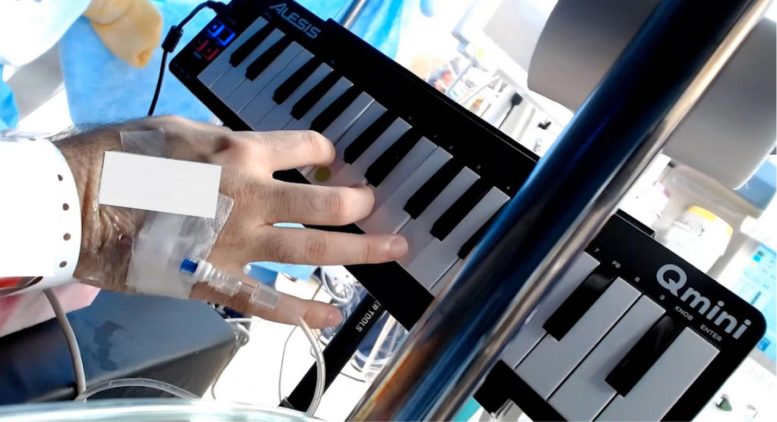
The research team used the opportunity provided during an awake craniotomy on a young musician with a tumor in the brain regions involved in language and music. The patient heard music and played a mini-keyboard piano to map his musical skills, heard and repeated sentences and heard descriptions of objects that he then named to map his language. Musical sequences were melodic or not melodic and differed in complexity, while auditory recordings of sentences differed in syntactic complexity.
Direct brain recordings with electrodes placed on the brain surface mapped out the location and characteristics of brain activity during music and language. Small currents were passed into the brain to localize regions critical for language and music perception and production.
“This allowed us not just to obtain novel insights into the neurobiology of music in the brain, but to enable us to protect these functions while performing a safe, maximal resection of the tumor,” said Tandon, the Nancy, Clive and Pierce Runnels Distinguished Chair in Neuroscience of the Vivian L. Smith Center for Neurologic Research and the BCMS Distinguished Professor in Neurological Disorders and Neurosurgery with McGovern Medical School and a member of the Texas Institute for Restorative Neurotechnologies (TIRN) at UTHealth Houston.
Unraveling Neural Differences Between Music and Language
“If we look purely at basic brain activation profiles for music and language, they often look pretty similar, but that’s not the full story,” said McCarty, who is also a graduate research assistant at The University of Texas MD Anderson Cancer Center UTHealth Houston Graduate School of Biomedical Sciences and a member of TIRN. “Once we look closer at how they assemble small parts into larger structures, some striking neural differences can be detected.”
Language and music involve the productive combination of basic units into structures. However, researchers wanted to study whether brain regions sensitive to linguistic and musical structure are co-localized, or exist in the same physical space.
“The unparalleled, high resolution of intracranial electrodes allows us to ask the kinds of questions about music and language processing that cognitive scientists have long awaited answers for, but were unable to address with traditional neuroimaging methods,” said Murphy, a member of TIRN. “This work also truly highlights the generosity of patients who work closely with researchers during their stay at the hospital.”
Overall, they found shared temporal lobe activity for music and language, but when examining features of melodic complexity and grammatical complexity, they discovered different temporal lobe sites to be engaged. Therefore, music and language activation at the basic level is shared, however when the researchers examined comparing basic melodies vs. complex melodies, or simple sentences versus complex sentences, different areas show distinct sensitivities.
Key Brain Areas Modulating Music and Language Complexity
Specifically, cortical stimulation mapping of the posterior superior temporal gyrus (pSTG) disrupted music perception and production, along with speech production. The pSTG and posterior middle temporal gyrus (pMTG) activated for language and music. While pMTG activity was modulated by musical complexity, pSTG activity was modulated by syntactic complexity.
Tandon resected the patient’s mid-temporal lobe tumor at Memorial Hermann-Texas Medical Center. At his four-month follow-up, the patient was confirmed to have fully preserved musical and language function, without evidence of deterioration.
Reference: “Intraoperative cortical localization of music and language reveals signatures of structural complexity in posterior temporal cortex” by Meredith J. McCarty, Elliot Murphy, Xavier Scherschligt, Oscar Woolnough, Cale W. Morse, Kathryn Snyder, Bradford Z. Mahon and Nitin Tandon, 28 June 2023, iScience.
DOI: 10.1016/j.isci.2023.107223
The study was funded by the National Institute of Neurological Disorders and Stroke (NS098981), part of the National Institutes of Health.
Co-authors on the study included Xavier Scherschligt; Oscar Woolnough, PhD; Cale Morse; and Kathryn Snyder, all with the Vivian L. Smith Department of Neurosurgery at McGovern Medical School and TIRN. Tandon is also a faculty member at the MD Anderson UTHealth Houston Graduate School, and Snyder is a student at the school. Bradford Mahon, PhD, with the Department of Psychology and Neuroscience Institute at Carnegie Mellon University in Pittsburgh, also contributed.
Never miss a breakthrough: Join the SciTechDaily newsletter.
Follow us on Google and Google News.