
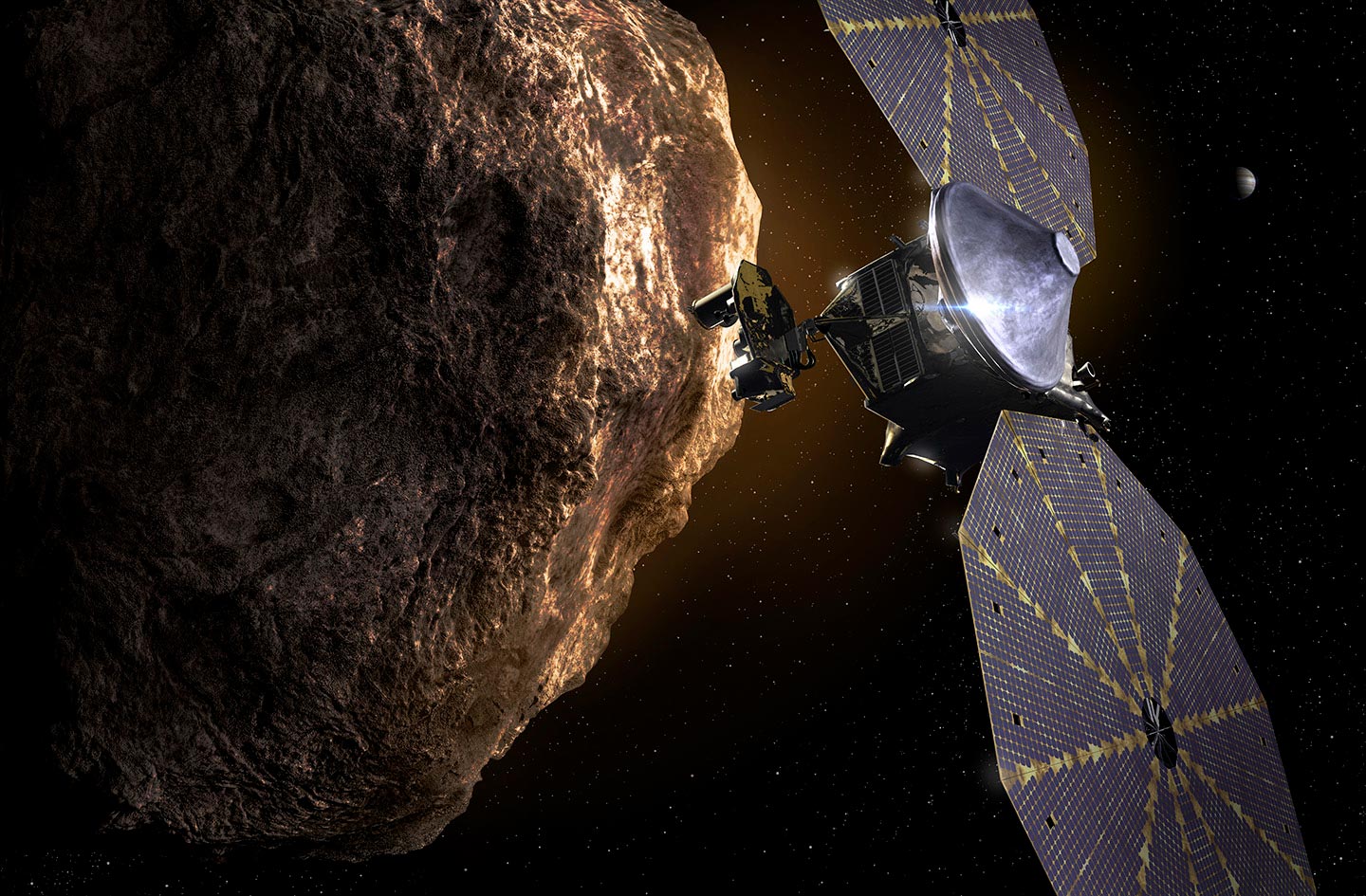
Before the NASA Lucy mission can begin its long journey to the Trojan asteroids, the first scientific camera to be delivered to the spacecraft had to take a 1,500 mile journey across the continental United States.
The Lucy LOng Range Reconnaissance Imager (L’LORRI) traveled from the Johns Hopkins Applied Physics Laboratory (APL), in Laurel, Maryland, where it was built and tested, to Lockheed Martin Space, in Littleton, Colorado, where the spacecraft is being assembled. It was received safely at Lockheed Martin on October 25 and was successfully integrated onto the spacecraft on October 30, 2020.
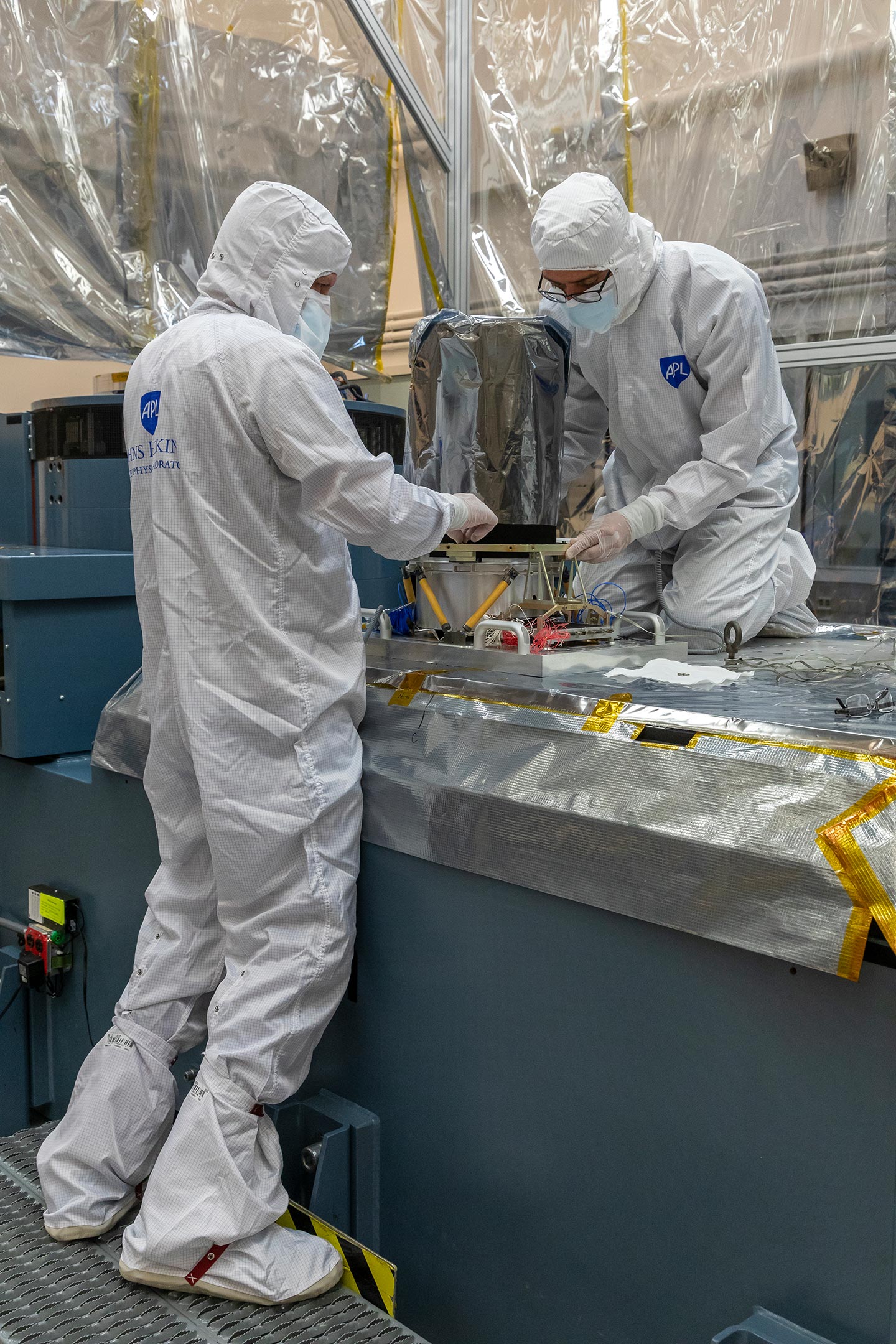
“Lucy is an amazing spacecraft, but I’m always looking forward to the day when we start getting data from these never before seen fossils of the solar system,” says Lucy principal investigator, Hal Levison. “Now that we have installed the first scientific instrument, we are one step closer to that day. I would like to thank the APL team for all their hard work getting the instrument to the spacecraft on time during the COVID19 pandemic.”
The Trojan asteroids are two groups of asteroids that lead and trail Jupiter in its orbit around the Sun. Scientists have evidence that these asteroids may have been scattered from all over the outer solar system early in the solar system’s history, and have been trapped in these stable locations for over four billion years. No spacecraft has ever been to this population of small bodies, and Lucy will fly by seven of these Trojan asteroids, plus a main belt asteroid, allowing it to survey the diversity of this population in a single record-breaking mission.
L’LORRI is the first scientific instrument to be installed on Lucy. L’LORRI is sometimes referred to as Lucy’s “eagle eyes” because it has the highest spatial resolution of all of Lucy’s cameras. This instrument, which is panchromatic (covering 0.35 to 0.85 microns), will produce black and white images that will provide the most detailed views of the surfaces of these never before seen bodies.
“L’LORRI is quite similar to its predecessor, the LORRI instrument that flew on New Horizons and sent back incredible images of the Pluto system and the Kuiper belt object Arrokoth,” says Hal Weaver, lead of the instrument team at APL. “I can’t wait to see the images from this L’LORRI instrument and what they will teach us about the Trojan asteroids.”
In addition to L’LORRI, two more scientific instruments will be added to Lucy over the next few months. L’TES (the Lucy Thermal Emission Spectrometer), is being built at Arizona State University in Tempe, Arizona. L’Ralph, which is being built at NASA’s Goddard Space Flight Center in Greenbelt Maryland, is two instruments in one, a color visible imager (the Multi-spectral Visible Imaging Camera, MVIC) and an infrared imaging spectrometer (Linear Etalon Imaging Spectral Array, LEISA). Together, along with the Terminal Tracking cameras T2CAM and the High Gain Antenna, which will facilitate both communications and radio science, these instruments will reveal this never before explored population of asteroids in unprecedented detail.
“The L’LORRI Pre-Environmental Review was held back in early August and to see what this team has accomplished over the last several months, under a pandemic, is astonishing,” said Donya Douglas-Bradshaw, Lucy project manager from NASA’s Goddard Space Flight Center in Greenbelt, Maryland. “I commend the L’LORRI team for their hard work, resiliency, and dedication. I’m looking forward to the first time we power up L’LORRI on the spacecraft.”
Southwest Research Institute’s Hal Levison and Cathy Olkin are the principal investigator and deputy principal investigator of the Lucy Mission. NASA’s Goddard Space Flight Center provides overall mission management, systems engineering and safety and mission assurance. Lockheed Martin Space is building the spacecraft. Lucy is the 13th mission in NASA’s Discovery Program. NASA’s Marshall Space Flight Center in Huntsville, Alabama, manages the Discovery Program for the agency’s Science Mission Directorate in Washington, D.C.
Never miss a breakthrough: Join the SciTechDaily newsletter.
Follow us on Google and Google News.