

Close Menu
    Facebook X (Twitter) Instagram
    SciTechDaily
    • Biology
    • Chemistry
    • Earth
    • Health
    • Physics
    • Science
    • Space
    • Technology
    Facebook X (Twitter) Pinterest YouTube RSS
    SciTechDaily
    Home»Technology»AI Accurately Predicts Material Properties To Break Down a Previously Insurmountable Wall
    Technology

    AI Accurately Predicts Material Properties To Break Down a Previously Insurmountable Wall

    By Institute of Industrial Science, University of TokyoOctober 15, 2021No Comments3 Mins Read
    Facebook Twitter Pinterest Telegram LinkedIn WhatsApp Email Reddit
    Share
    Facebook Twitter LinkedIn Pinterest Telegram Email Reddit
    AI Materials Science Concept
    Researchers employed core-loss spectroscopy and machine learning to determine the properties of organic molecules.

    AI models trained on spectroscopy data can predict material properties, offering a new path to accelerate materials discovery and innovation.

    If the properties of materials can be reliably predicted, then the process of developing new products for a huge range of industries can be streamlined and accelerated. In a study published in Advanced Intelligent Systems, researchers from The University of Tokyo Institute of Industrial Science used core-loss spectroscopy to determine the properties of organic molecules using machine learning.

    The spectroscopy techniques energy loss near-edge structure (ELNES) and X-ray near-edge structure (XANES) are used to determine information about the electrons, and through that the atoms, in materials. They have high sensitivity and high resolution and have been used to investigate a range of materials from electronic devices to drug delivery systems.

    However, connecting spectral data to the properties of a material—things like optical properties, electron conductivity, density, and stability—remains ambiguous. Machine learning (ML) approaches have been used to extract information for large complex sets of data. Such approaches use artificial neural networks, which are based on how our brains work, to constantly learn to solve problems. Although the group previously used ELNES/XANES spectra and ML to find out information about materials, what they found did not relate to the properties of the material itself. Therefore, the information could not be easily translated into developments.
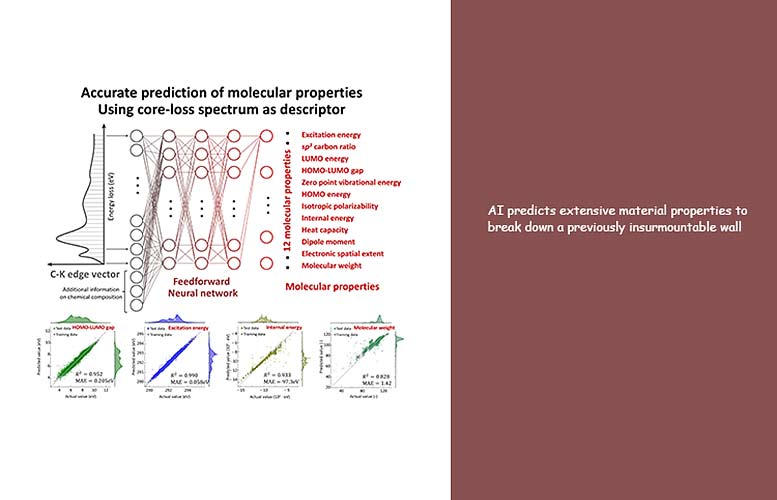
    AI Predicts Extensive Material Properties
    Researchers from The University of Tokyo Institute of Industrial Science use a machine learning approach to successfully predict material properties that have never before been determined. Credit: Institute of Industrial Science, the University of Tokyo

    Now the team has used ML to reveal information hidden in the simulated ELNES/XANES spectra of 22,155 organic molecules. “The ELNES/XANES spectra of the molecules, or their “descriptors” in this scenario, were then input into the system,” explains lead author Kakeru Kikumasa. “This descriptor is something that can be directly measured in experiments and can therefore be determined with high sensitivity and resolution. This method is highly beneficial for materials development because it has the potential to reveal where, when, and how certain material properties arise.”

    Predicting Intensive vs. Extensive Properties

    A model created from the spectra alone was able to successfully predict what are known as intensive properties. However, it was unable to predict extensive properties, which are dependent on the molecular size. Therefore, to improve the prediction, the new model was constructed by including the ratios of three elements in relation to carbon (which is present in all organic molecules) as extra parameters to allow extensive properties such as the molecular weight to be correctly predicted.

    “Our ML learning treatment of core-loss spectra provides accurate prediction of extensive material properties, such as internal energy and molecular weight. The link between core-loss spectra and extensive properties has previously never been made; however, artificial intelligence was able to unveil the hidden connections. Our approach might also be applied to predict the properties of new materials and functions” says senior author Teruyasu Mizoguchi. “We believe that our model will be a very useful tool for the high-throughput development of materials in a wide range of industries.”

    Reference: “Quantification of the Properties of Organic Molecules Using Core-Loss Spectra as Neural Network Descriptors” by Kakeru Kikumasa, Shin Kiyohara, Kiyou Shibata, and Teruyasu Mizoguchi, 13 October 2021, Advanced Intelligent Systems.
    DOI: 10.1002/aisy.202100103

    Never miss a breakthrough: Join the SciTechDaily newsletter.
    Follow us on Google and Google News.

    Artificial Intelligence Machine Learning Materials Science University of Tokyo
    Share. Facebook Twitter Pinterest LinkedIn Email Reddit

    Related Articles

    Electronic Renaissance: How Machine Learning Reimagines Material Modeling

    MIT’s AI System Reveals Internal Structure of Materials From Surface Observations

    Merging Artificial Intelligence and Physics Simulations To Design Innovative Materials

    AI Used To Predict Synthesis of Complex Novel Materials – “Materials No Chemist Could Predict”

    MIT Uses AI To Accelerate the Discovery of New Materials for 3D Printing

    Novel Machine Learning Technique To Identify Structural Similarities and Trends in Materials

    Isaac Newton May Have Met His Match: New AI Tool Calculates Materials’ Stress and Strain Based on Photos

    Machine Learning Boosts the Search for New “Superhard” Materials

    Chaotic Itinerancy: Robotic AI Learns to Be Spontaneous

    Leave A Reply Cancel Reply

    • Facebook
    • Twitter
    • Pinterest
    • YouTube

    Don't Miss a Discovery

    Subscribe for the Latest in Science & Tech!

    Trending News

    Researchers Have Found a Dietary Compound That Increases Longevity

    Scientists Baffled by Bizarre “Living Fossil” From 275 Million Years Ago

    Your IQ at 23 Could Predict Your Wealth at 27, Study Finds

    320 Light-Years Away, a Planet Confirms a Fundamental Cosmic Assumption

    The Crown Jewel of Dentistry? Breakthrough Tech Could Transform Tooth Repair

    Python Blood Could Hold the Secret to Weight Loss Without Side Effects

    Naturally Occurring Bacteria Completely Eradicate Tumors in Mice With a Single Dose

    New “Nanozyme Hypothesis” Could Rewrite the Story of Life’s Origins

    Follow SciTechDaily
    • Facebook
    • Twitter
    • YouTube
    • Pinterest
    • Newsletter
    • RSS
    SciTech News
    • Biology News
    • Chemistry News
    • Earth News
    • Health News
    • Physics News
    • Science News
    • Space News
    • Technology News
    Recent Posts
    • How Quantum Mechanics Went From Baffling Theory to Revolutionizing Modern Technology
    • Scientists May Have Found the Key to Jupiter and Saturn’s Moon Mystery
    • Scientists Uncover Hidden Clues to the Origin of the Genetic Code
    • Scientists Discover Unexpected Role of Alzheimer’s Protein in Cell Division
    • Scientists Uncover Brain Changes That Link Pain to Depression
    Copyright © 1998 - 2026 SciTechDaily. All Rights Reserved.
    • Science News
    • About
    • Contact
    • Editorial Board
    • Privacy Policy
    • Terms of Use

    Type above and press Enter to search. Press Esc to cancel.