
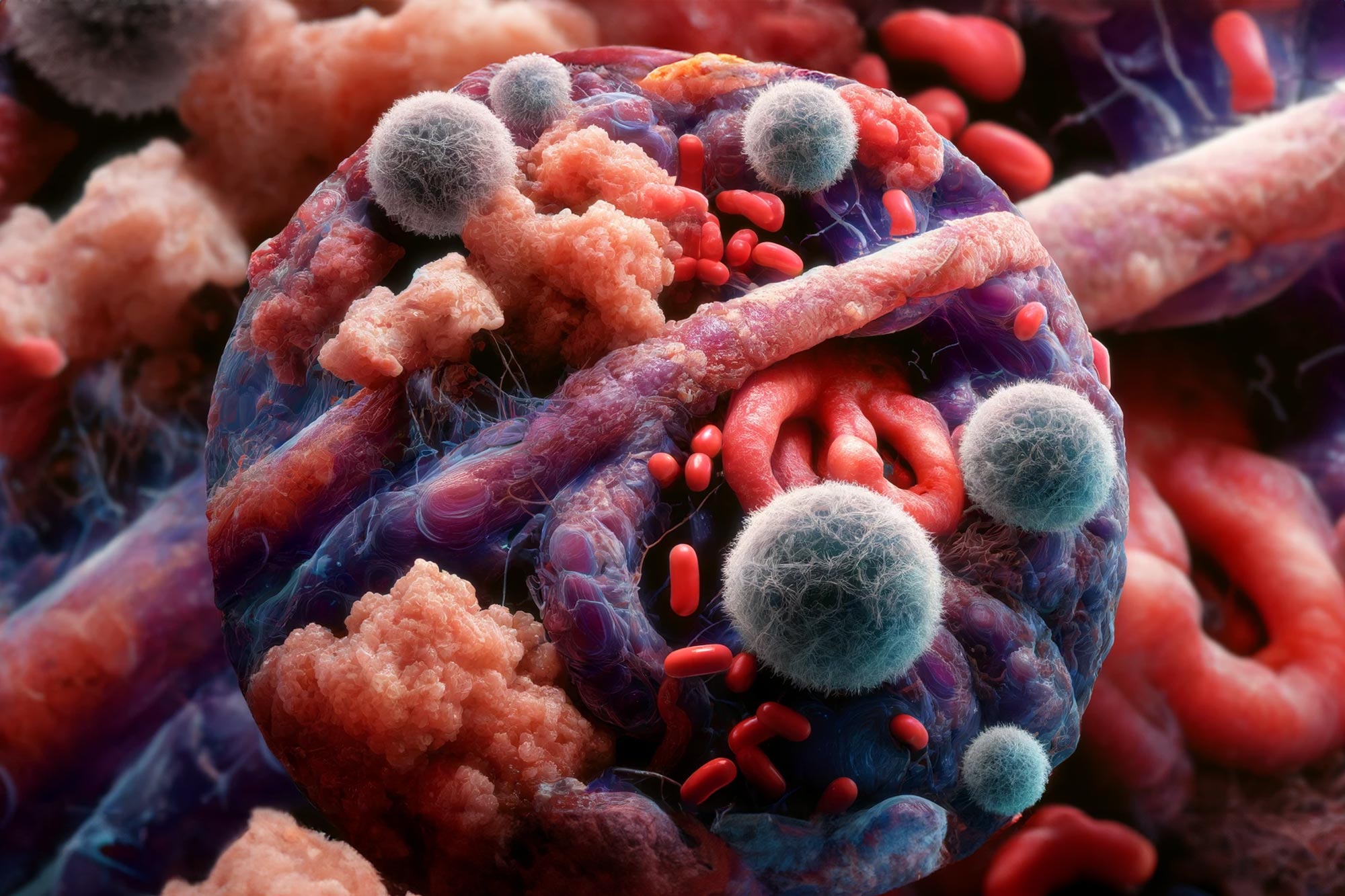
Researchers at the Netherlands Cancer Institute have compiled a detailed catalog of bacteria living in cancer metastases. Having analyzed over 4000 tumors, they shed light on the diversity of these co-inhabitants and how they might interact with cancer cells and their surroundings. For example, certain bacteria were linked to a worse response to immunotherapy. This study paves the way to a better understanding of how bacteria help or hinder cancer (therapy), and how we can use this for patients’ advantage. The researchers publish their findings today in the scientific journal Cell.
On and in our bodies live billions of microorganisms: bacteria, viruses, and yeasts — our microbiome. We need them, and they need us. Bacteria help us digest our food, for example, and cooperate with our immune system in the fight against pathogens. Gut bacteria in particular have been extensively studied, including in the context of cancer. For example, they can influence the effectiveness of immunotherapy and chemotherapy.
Bacteria in Metastases
But these tiny co-inhabitants also house outside the gut. Bacteria are found in tumors, for example. With new techniques, researchers are getting better at finding out which microbes they are. But how bacteria get to a tumor and what exactly they do there remains largely unknown, making it unclear how important they are to disease and the effect of treatments.
26 Cancer Types
Because many patients eventually die from metastases, and many treatments target them, the research groups of Emile Voest and Lodewyk Wessels took a closer look at those metastases. After all, little was known about bacteria in these tumors. Together with their colleagues at, among others, the Netherlands Cancer Institute and Oncode Institute they have now mapped which bacteria are present in cancer metastases. Both groups are
In tissue from more than 4,000 metastases of 26 types of cancer, the researchers analyzed the code of the DNA present. From that genetic material you can see not only which human cells are there, but also which bacteria — because these also have DNA. For this purpose, they used clinical information and DNA data generated by Hartwig Medical Foundation.
Data Analysis and Findings
With that unimaginably large mountain of information (400 terabytes), they used computer power to figure out which bacteria congregate in which places (see figure). This required a lot of clever programming, because there is relatively little bacterial DNA in such a piece of tissue.
“Surprisingly, it’s not just metastases from colon cancer that contain a lot of bacteria,” says researcher Thomas Battaglia. One might expect that because most of our bacteria reside in the colon, from where they could possibly travel along during metastasis to elsewhere in the body. “Also, which bacteria are present in a metastasis is strongly related to the location in the body, the conditions there, and the cancer type.”
Bacteria and Treatment Efficacy
They also discovered a link between bacteria and therapy efficacy. Patients with lung cancer and Fusobacterium in their metastasis, for example, responded worse to immunotherapy than peers without that bacteria. Thomas: “We also noted that the more diverse the bacterial community, the more active the adjacent tumor cells.”
“Our work opens doors for exploring new forms of treatments, for example against bacteria that might help the tumor,” co-author Iris Mimpen says. “It helps us understand how the complex environment of tumors works, an environment in which all kinds of cells — including bacteria — live together and influence each other.”
Reference: “A pan-cancer analysis of the microbiome in metastatic cancer” by Thomas W. Battaglia, Iris L. Mimpen, Joleen J.H. Traets, Arne van Hoeck, Laurien J. Zeverijn, Birgit S. Geurts, Gijs F. de Wit, Michaël Noë, Ingrid Hofland, Joris L. Vos, Sten Cornelissen, Maartje Alkemade, Annegien Broeks, Charlotte L. Zuur, Edwin Cuppen, Lodewyk Wessels, Joris van de Haar and Emile Voest, 9 April 2024, Cell.
DOI: 10.1016/j.cell.2024.03.021
This research was financially supported by the AVL Foundation, KWF Dutch Cancer Society and Oncode Institute.
Never miss a breakthrough: Join the SciTechDaily newsletter.
Follow us on Google and Google News.