
Close Menu
    Facebook X (Twitter) Instagram
    SciTechDaily
    • Biology
    • Chemistry
    • Earth
    • Health
    • Physics
    • Science
    • Space
    • Technology
    Facebook X (Twitter) Pinterest YouTube RSS
    SciTechDaily
    Home»Space»A Guide to Solar Flares: What Does It Take To Be X-Class?
    Space

    A Guide to Solar Flares: What Does It Take To Be X-Class?

    By Karen C. Fox, NASA's Goddard Space Flight CenterNovember 4, 20212 Comments3 Mins Read
    Facebook Twitter Pinterest Telegram LinkedIn WhatsApp Email Reddit
    Share
    Facebook Twitter LinkedIn Pinterest Telegram Email Reddit
    Active Sun Solar Flares
    Active Sun Solar Flares

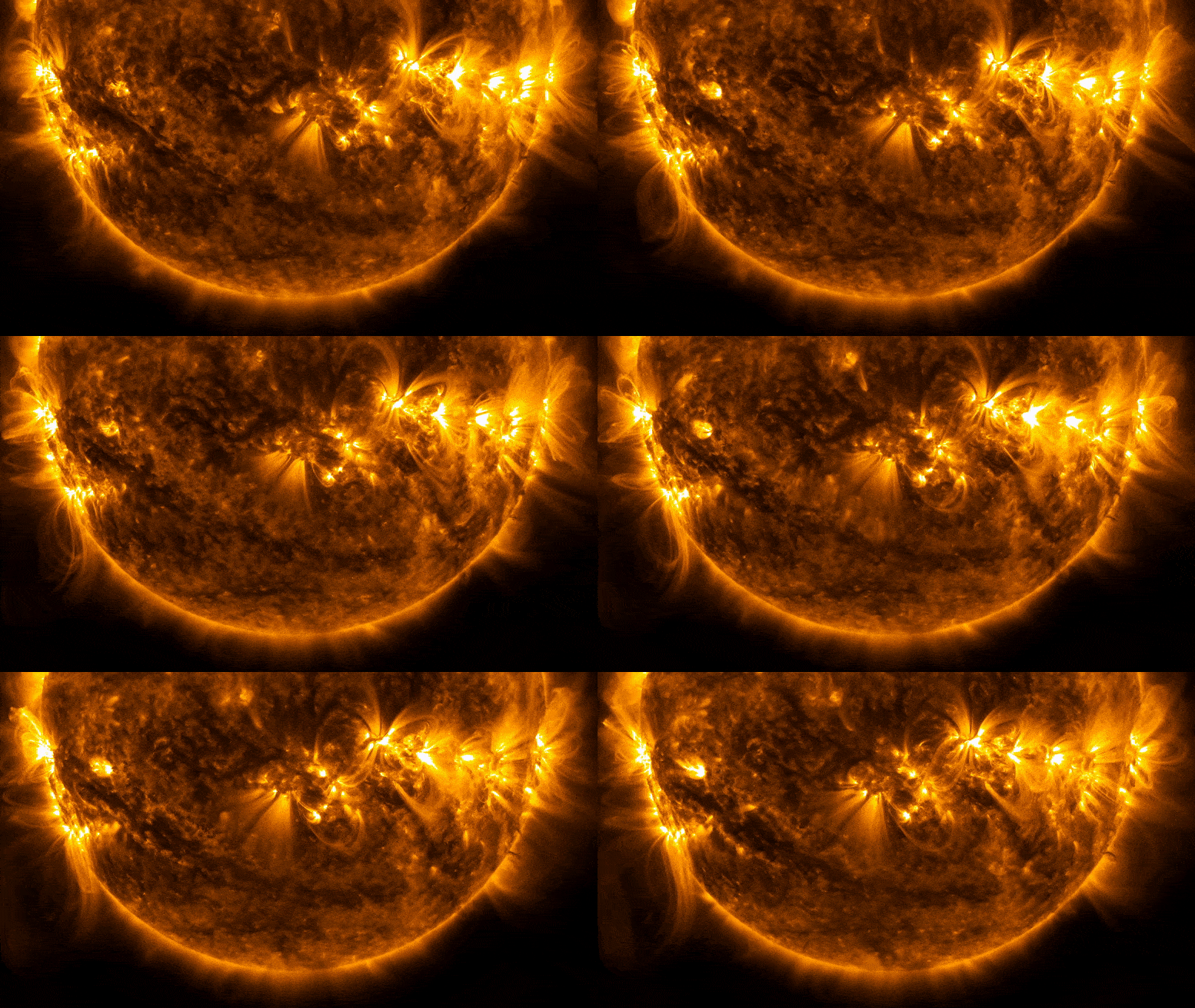
    Solar flares, ranked from A to X, can disrupt radio, satellites, and power systems. Monitoring by NASA and NOAA helps protect technology when these giant storms are directed at Earth.

    Solar flares are giant explosions on the sun that send energy, light, and high speed particles into space. These flares are often associated with solar magnetic storms known as coronal mass ejections (CMEs). The number of solar flares increases approximately every 11 years, and the sun is currently moving towards another solar maximum, likely in 2013. That means more flares will be coming, some small and some big enough to send their radiation all the way to Earth.

    The biggest flares are known as “X-class flares” based on a classification system that divides solar flares according to their strength. The smallest ones are A-class (near background levels), followed by B, C, M and X. Similar to the Richter scale for earthquakes, each letter represents a 10-fold increase in energy output. So an X is ten times an M and 100 times a C. Within each letter class there is a finer scale from 1 to 9.


    Solar flares are classified according to their strength. The smallest ones are A-class, followed by B, C, M and X, the largest. Credit: NASA/Goddard/S. Wiessinger

    C-class and smaller flares are too weak to noticeably affect Earth. M-class flares can cause brief radio blackouts at the poles and minor radiation storms that might endanger astronauts.
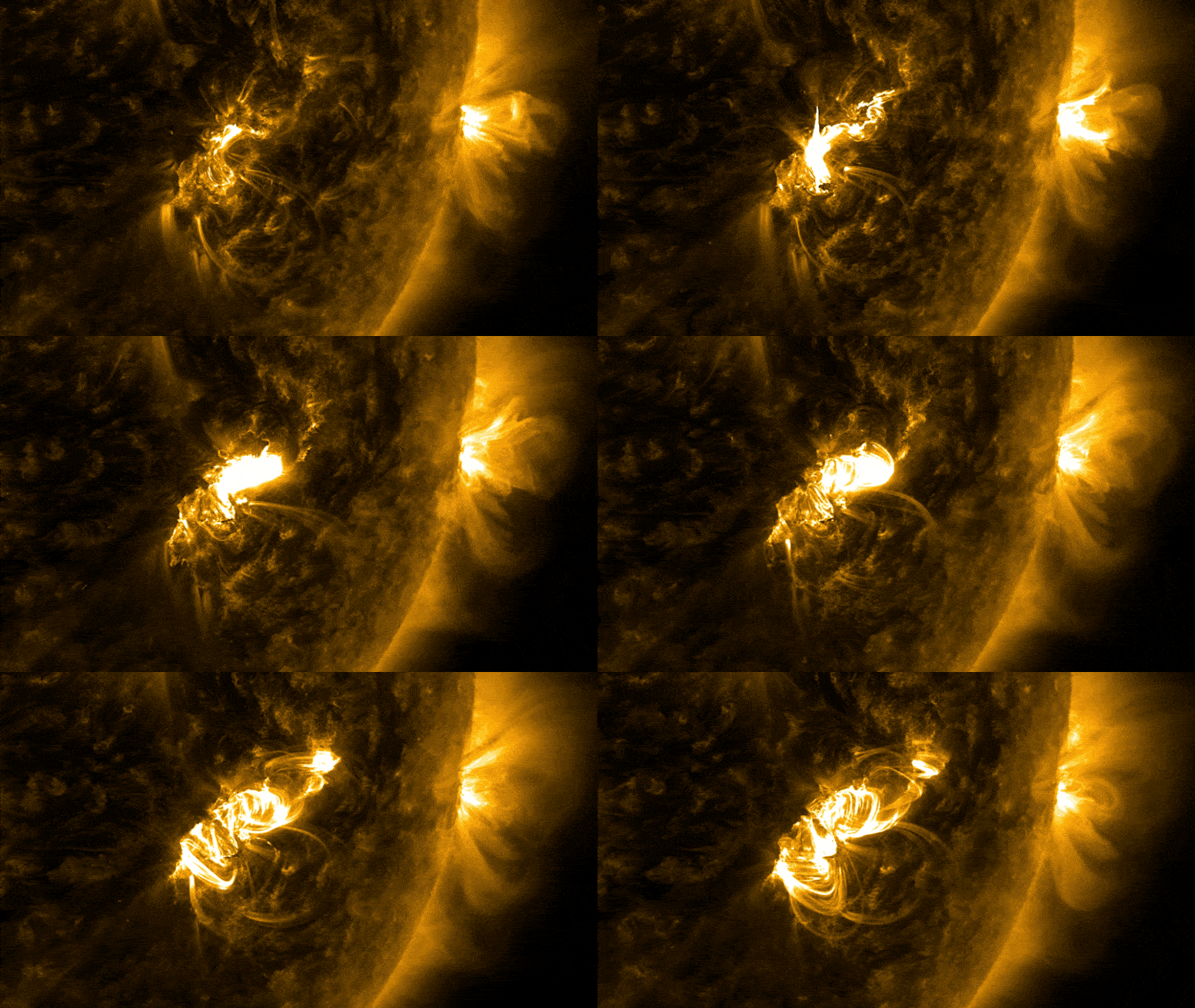
    X-Class Solar Flare NASA SDO
    An X-class solar flare (X9.3) emitted on September 6, 2017, and captured by NASA’s Solar Dynamics Observatory in extreme ultraviolet light. Credit: NASA/GSFC/SDO

    And then come the X-class flares. Although X is the last letter, there are flares more than 10 times the power of an X1, so X-class flares can go higher than 9. The most powerful flare measured with modern methods was in 2003, during the last solar maximum, and it was so powerful that it overloaded the sensors measuring it. The sensors cut out at X28.
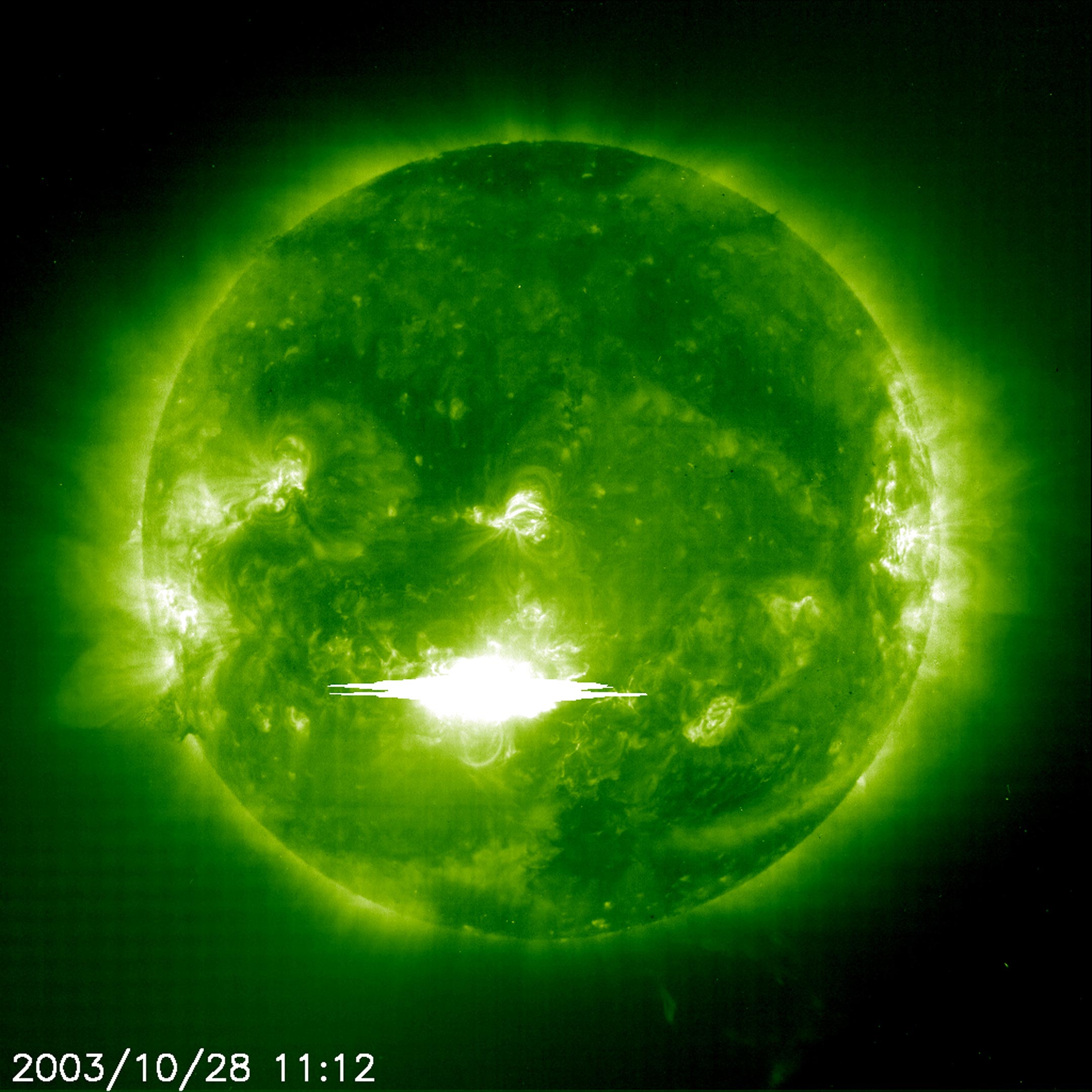
    SOHO Solar Flare 2003
    The Solar and Heliospheric Observatory (SOHO) spacecraft captured this image of a solar flare as it erupted from the sun early on Tuesday, October 28, 2003. Credit: ESA & NASA/SOHO

    The biggest X-class flares are by far the largest explosions in the solar system and are awesome to watch. Loops tens of times the size of Earth leap up off the sun’s surface when the sun’s magnetic fields cross over each other and reconnect. In the biggest events, this reconnection process can produce as much energy as a billion hydrogen bombs.

    If they’re directed at Earth, such flares and associated CMEs can create long-lasting radiation storms that can harm satellites, communications systems, and even ground-based technologies and power grids. X-class flares on December 5 and December 6, 2006, for example, triggered a CME that interfered with GPS signals being sent to ground-based receivers.
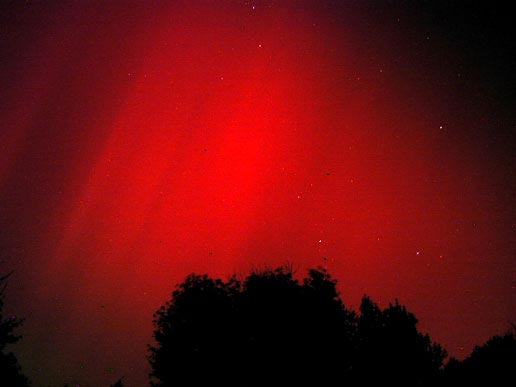
    Halloween Solar Storms of 2003
    The Halloween solar storms of 2003 resulted in this aurora visible in Mt. Airy, Maryland. Credit:
    NASA/George Varros

    NASA and NOAA – as well as the US Air Force Weather Agency (AFWA) and others — keep a constant watch on the sun to monitor for X-class flares and their associated magnetic storms. With advance warning many satellites and spacecraft can be protected from the worst effects.

    Never miss a breakthrough: Join the SciTechDaily newsletter.
    Follow us on Google and Google News.

    NASA NASA Goddard Space Flight Center SOHO Solar Flares
    Share. Facebook Twitter Pinterest LinkedIn Email Reddit

    Related Articles

    NASA Just Found the Sun’s Secret Warning Before Massive Solar Flares

    NASA Just Captured Stunning Images of a Comet’s Fiery Tail

    A Small, Bright Surprise: Two Views of a Sungrazing Comet

    ESA/NASA Solar and Heliospheric Observatory Celebrates a Quarter-Century in Space

    NASA’s Solar Dynamics Observatory Spots Burst of Light and Energy on the Sun: A B-Class Flare

    Citizen Scientist Spots Never-Before-Seen Comet – The 4,000th Comet Discovery Using Solar and Heliospheric Observatory

    ESA/NASA SOHO Spacecraft Has Discovered Thousands of Comets – What Makes It So Good at It?

    NASA’s Solar and Heliospheric Observatory Celebrates 20 Years of Science

    Solar Flare Causes Powerful Solar Radiation Storm

    2 Comments

    1. JT on February 17, 2022 5:51 am

      in the first paragraph it says 2013, this year is 2022

      Reply
    2. Tommy Samuel on April 14, 2024 9:39 pm

      What class solar flare caused the Carrington Event (1859 )

      Reply
    Leave A Reply Cancel Reply

    • Facebook
    • Twitter
    • Pinterest
    • YouTube

    Don't Miss a Discovery

    Subscribe for the Latest in Science & Tech!

    Trending News

    Scientists Discover 132-Million-Year-Old Dinosaur Tracks on South Africa’s Coast

    Scientists Uncover the Secret Ingredient Behind the Spark That May Have Started Life on Earth

    Physicists Observe Matter in Two Places at Once in Mind-Bending Quantum Experiment

    Stanford Scientists Discover Hidden Brain Circuit That Fuels Chronic Pain

    New Study Reveals Why Ozempic Works Better for Some People Than Others

    Climate Change Is Altering a Key Greenhouse Gas in a Way Scientists Didn’t Expect

    New Study Suggests Gravitational Waves May Have Created Dark Matter

    Scientists Discover Why the Brain Gets Stuck in Schizophrenia

    Follow SciTechDaily
    • Facebook
    • Twitter
    • YouTube
    • Pinterest
    • Newsletter
    • RSS
    SciTech News
    • Biology News
    • Chemistry News
    • Earth News
    • Health News
    • Physics News
    • Science News
    • Space News
    • Technology News
    Recent Posts
    • The Crown Jewel of Dentistry? Breakthrough Tech Could Transform Tooth Repair
    • The Surprising Non-Medical Factor That Determines Cancer Survival
    • Python Blood Could Hold the Secret to Weight Loss Without Side Effects
    • Naturally Occurring Bacteria Completely Eradicate Tumors in Mice With a Single Dose
    • The Ideal Temperature for Storing Mangoes Isn’t What You Think
    Copyright © 1998 - 2026 SciTechDaily. All Rights Reserved.
    • Science News
    • About
    • Contact
    • Editorial Board
    • Privacy Policy
    • Terms of Use

    Type above and press Enter to search. Press Esc to cancel.