
Close Menu
    Facebook X (Twitter) Instagram
    SciTechDaily
    • Biology
    • Chemistry
    • Earth
    • Health
    • Physics
    • Science
    • Space
    • Technology
    Facebook X (Twitter) Pinterest YouTube RSS
    SciTechDaily
    Home»Space»Astronomy & Astrophysics 101: Solar Flares (Radio Blackouts)
    Space

    Astronomy & Astrophysics 101: Solar Flares (Radio Blackouts)

    By NOAA Space Weather Prediction CenterMarch 31, 2022No Comments3 Mins Read
    Facebook Twitter Pinterest Telegram LinkedIn WhatsApp Email Reddit
    Share
    Facebook Twitter LinkedIn Pinterest Telegram Email Reddit
    Solar Flares Eject Radiation
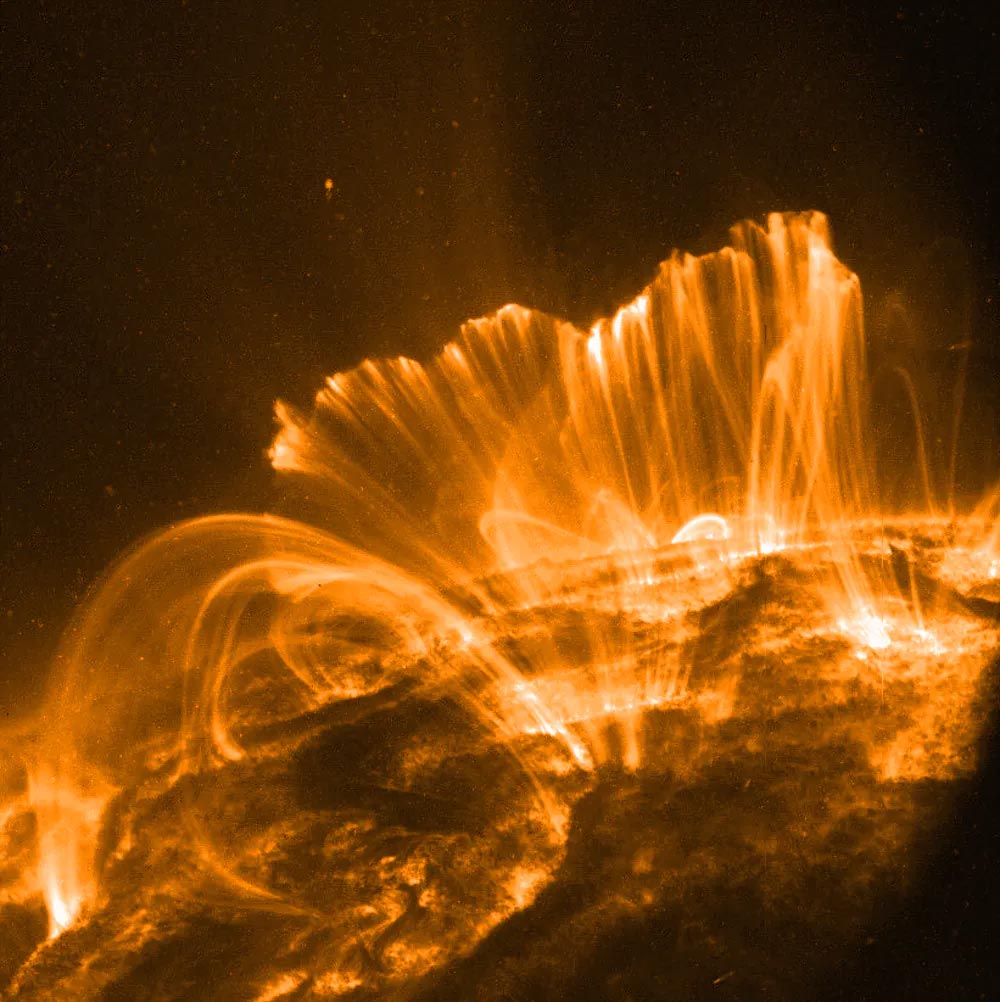
    Solar flares – like this one captured by a NASA satellite orbiting the Sun – eject huge amounts of radiation. Credit: NASA

    What Are Solar Flares?

    Solar flares are large eruptions of electromagnetic radiation from the Sun lasting from minutes to hours. The sudden outburst of electromagnetic energy travels at the speed of light, therefore any effect upon the sunlit side of Earth’s exposed outer atmosphere occurs at the same time the event is observed. The increased level of X-ray and extreme ultraviolet (EUV) radiation results in ionization in the lower layers of the ionosphere on the sunlit side of Earth.

    Under normal conditions, high frequency (HF) radio waves are able to support communication over long distances by refraction via the upper layers of the ionosphere. When a strong enough solar flare occurs, ionization is produced in the lower, more dense layers of the ionosphere (the D-layer), and radio waves that interact with electrons in layers lose energy due to the more frequent collisions that occur in the higher density environment of the D-layer. This can cause HF radio signals to become degraded or completely absorbed. This results in a radio blackout – the absence of HF communication, primarily impacting the 3 to 30 MHz band. The D-RAP (D-Region Absorption Prediction) product correlates flare intensity to D-layer absorption strength and spread.

    Solar flares usually take place in active regions, which are areas on the Sun marked by the presence of strong magnetic fields; typically associated with sunspot groups. As these magnetic fields evolve, they can reach a point of instability and release energy in a variety of forms. These include electromagnetic radiation, which are observed as solar flares.

    Solar flare intensities cover a large range and are classified in terms of peak emission in the 0.1 – 0.8 nm spectral band (soft x-rays) of the NOAA/GOES XRS. The X-ray flux levels start with the “A” level (nominally starting at 10-8 W/m2). The next level, ten times higher, is the “B” level (≥ 10-7 W/m2); followed by “C” flares (10-6 W/m2), “M” flares (10-5 W/m2), and finally “X” flares (10-4 W/m2).

    Radio blackouts are classified using a five-level NOAA Space Weather Scale, directly related to the flare’s max peak in soft X-rays reached or expected. SWPC currently forecasts the probability of C, M, and X-class flares and relates it to the probability of an R1-R2, and R3 or greater events as part of our 3-day forecast and forecast discussion products. SWPC also issues an alert when an M5 (R2) flare occurs.

    The table below provides the correlation between radio blackouts, solar flares, nominal energy flux (watts per square meter), and the designated severity event descriptor.

    Radio Blackout X-ray Flare Flux (W/m2) Severity Descriptor
    R1 M1 0.00001 Minor
    R2 M5 0.00005 Moderate
    R3 X1 0.0001 Strong
    R4 X10 0.001 Severe
    R5 X20 0.002 Extreme

    Never miss a breakthrough: Join the SciTechDaily newsletter.
    Follow us on Google and Google News.

    NOAA Solar Flares Space Weather Sun
    Share. Facebook Twitter Pinterest LinkedIn Email Reddit

    Related Articles

    Massive Solar Eruption Captured by Solar Orbiter Spacecraft

    Mysterious Solar Storm Occurred 9,200 Years Ago – Revealed by Ancient Ice

    Geomagnetic Storm: Solar Eruption Arrives at Earth

    Solar Cycle 25 Has Begun. Experts From NASA and NOAA Explain What It Means

    Space Weather Satellite Set to Go Where No Mission Has Gone Before

    NASA’s SDO Reveals Images of X4.9-Class Solar Flare

    NASA Spacecraft Observe Magnetic Reconnection in Action

    New Light Shed on the Origins of Extreme Space Storms

    NASA Continues to Monitor Solar Flares

    Leave A Reply Cancel Reply

    • Facebook
    • Twitter
    • Pinterest
    • YouTube

    Don't Miss a Discovery

    Subscribe for the Latest in Science & Tech!

    Trending News

    New Study Reveals Why Ozempic Works Better for Some People Than Others

    Climate Change Is Altering a Key Greenhouse Gas in a Way Scientists Didn’t Expect

    New Study Suggests Gravitational Waves May Have Created Dark Matter

    Scientists Discover Why the Brain Gets Stuck in Schizophrenia

    Scientists Engineer “Tumor-Eating” Bacteria That Devour Cancer From Within

    Even “Failed” Diets May Deliver Long-Term Health Gains, Study Finds

    NIH Scientists Discover Powerful New Opioid That Relieves Pain Without Dangerous Side Effects

    Collapsing Plasma May Hold the Key to Cosmic Magnetism

    Follow SciTechDaily
    • Facebook
    • Twitter
    • YouTube
    • Pinterest
    • Newsletter
    • RSS
    SciTech News
    • Biology News
    • Chemistry News
    • Earth News
    • Health News
    • Physics News
    • Science News
    • Space News
    • Technology News
    Recent Posts
    • 35-Million-Year-Old Mystery: Strange Arachnid Discovered Preserved in Amber
    • Revolutionary Gas Turbine Generates Power Without Air Compression
    • Is AI Really Just a Tool? It Could Be Altering How You See Reality
    • JWST Reveals a “Forbidden” Planet With a Baffling Composition
    • New Research Challenges 30-Year-Old Theory of Eye Development
    Copyright © 1998 - 2026 SciTechDaily. All Rights Reserved.
    • Science News
    • About
    • Contact
    • Editorial Board
    • Privacy Policy
    • Terms of Use

    Type above and press Enter to search. Press Esc to cancel.