
Close Menu
    Facebook X (Twitter) Instagram
    SciTechDaily
    • Biology
    • Chemistry
    • Earth
    • Health
    • Physics
    • Science
    • Space
    • Technology
    Facebook X (Twitter) Pinterest YouTube RSS
    SciTechDaily
    Home»Space»First Physics-Based Method for Predicting Large Solar Flares
    Space

    First Physics-Based Method for Predicting Large Solar Flares

    By Nagoya UniversityAugust 30, 2020No Comments4 Mins Read
    Facebook Twitter Pinterest Telegram LinkedIn WhatsApp Email Reddit
    Share
    Facebook Twitter LinkedIn Pinterest Telegram Email Reddit
    Solar Flare Production Process
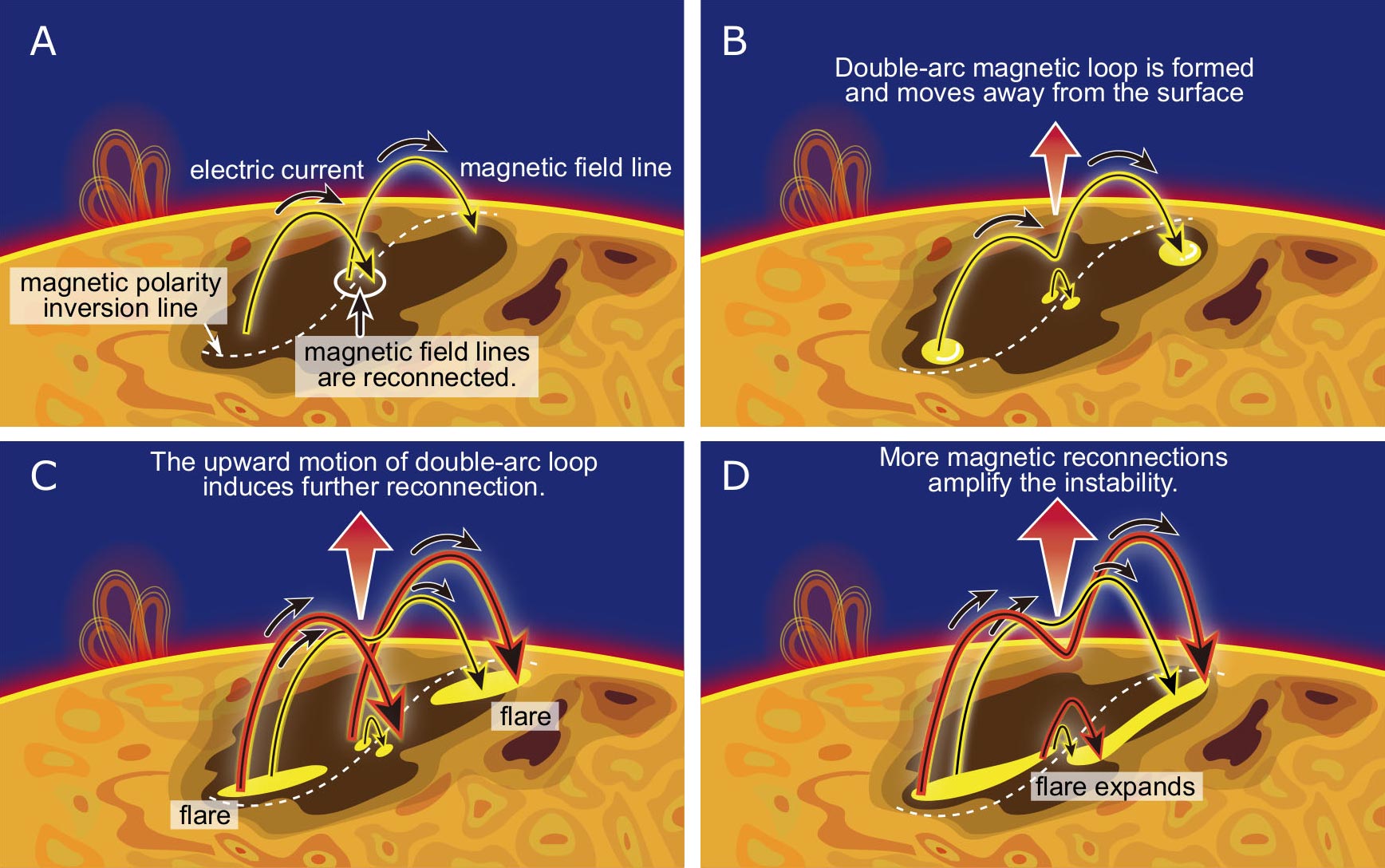
    Figure 1. The process of solar flare production in the physics-based prediction method. A: Electric currents flow along magnetic field lines across the magnetic polarity inversion line on the solar surface, where the magnetic field changes its polarity. B: Magnetic field lines are reconnected and form a double-arc loop that moves away from the surface due magnetohydrodynamic instability. C: The upward motion of the double-arc loop induces further magnetic reconnection. A solar flare begins to burst out from the base points of the reconnected field lines. D: More magnetic reconnections amplify the instability and the solar flare expands. Credit: Institute for Space-Earth Environmental Research, Nagoya University

    Solar flares emit sudden, strong bursts of electromagnetic radiation from the Sun’s surface and its atmosphere, and eject plasma and energetic particles into inter-planetary space. Since large solar flares can cause severe space weather disturbances affecting Earth, to mitigate their impact their occurrence needs to be predicted. However, as the onset mechanism of solar flares is unclear, most flare prediction methods so far have relied on empirical methods.

    The research team led by Professor Kanya Kusano (Director of the Institute for Space-Earth Environmental Research, Nagoya University) recently succeeded in developing the first physics-based model that can accurately predict imminent large solar flares. The work was published in the journal Science on July 31, 2020.

    The new method of flare prediction, called the kappa scheme, is based on the theory of “double-arc instability,” that is a magnetohydrodynamic (MHD) instability triggered by magnetic reconnection. The researchers assumed that a small-scale reconnection of magnetic field lines can form a double-arc (m-shape) magnetic field and trigger the onset of a solar flare (Figure 1). The kappa scheme can predict how a small magnetic reconnection triggers a large flare and how a large solar flare can occur.
    Magnetic Field on the Solar Surface
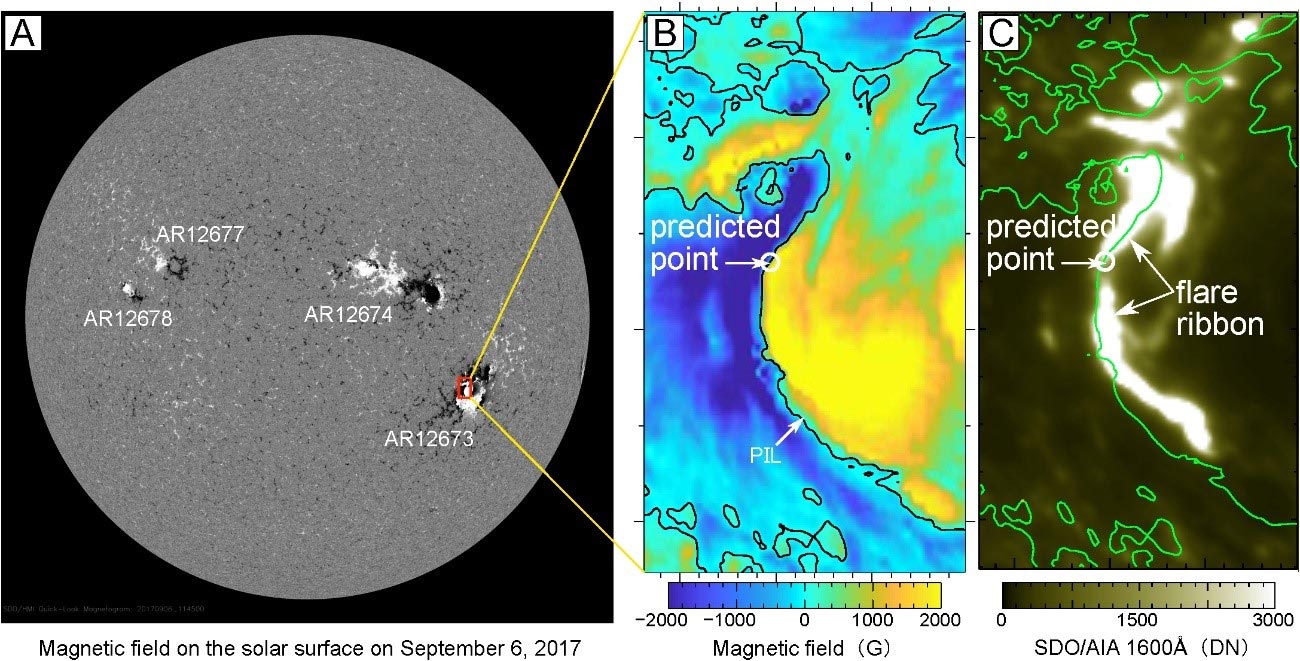
    Figure 2. The magnetic field on the solar surface and the initial brightening of the largest solar flare (GOES class X9.3) during solar cycle 24 in NOAA Active Region (AR) 12673 on September 6, 2017. This was observed by the Helioseismic and Magnetic Imager (HMI) and the Atmospheric Imaging Assembly (AIA) onboard NASA’s Solar Dynamics Observatory (SDO) satellite. A: The magnetic field on the solar surface before the onset of the large flare at 11:45 UT. White and black indicates the intensity of the magnetic field along the line of sight out of and toward the plane. B: An expanded view of the vertical magnetic field in AR 12673. A white circle indicates the location where a large flare was predicted by this study. The black contour shows the magnetic polarity inversion (PIL). C: Bright flare ribbon observed by SDO/AIA1600Å at 11:52 UT. Figures B and C are based on Figure 3 of the research paper by Kusano et al. (2020), published in Science. Credit: Courtesy of NASA/SDO the AIA and HMI science teams

    The predictive model was tested on about 200 active regions during solar cycle 24 from 2008 to 2019 using data obtained by NASA’s Solar Dynamics Observatory (SDO) satellite. It was demonstrated that with few exceptions, the kappa-scheme predicts the most imminent solar flares, as well as the precise location they will emerge from (Figure 2). The researchers also discovered that a new parameter — the “magnetic twist flux density” close to a magnetic polarity inversion line on the solar surface — determines when and where solar flares probably occur and how large they are likely to be.

    Previous flare prediction methods have relied on empirical relations in which the predictions of the previous day tend to continue into the next day even if flare activity changes. In contrast, the kappa-scheme predicts large solar flares through a physics-based approach regardless of previous flare activity. While it takes a lot more work to implement the scheme in real-time operational forecasting, this study shows that the physics-based approach may open a new direction for flare prediction research.

    Reference: “A physics-based method that can predict imminent large solar flares” by Kanya Kusano, Tomoya Iju, Yumi Bamba and Satoshi Inoue, 31 July 2020, Science.
    DOI: 10.1126/science.aaz2511

    Never miss a breakthrough: Join the SciTechDaily newsletter.
    Follow us on Google and Google News.

    Astrophysics Nagoya University Solar Flares Stars Sun
    Share. Facebook Twitter Pinterest LinkedIn Email Reddit

    Related Articles

    Our Sun May Have Escaped the Milky Way’s Dangerous Center Billions of Years Ago

    First Glimpse of a “Young Sun” Super-Eruption Captured by Astronomers

    It Rains on the Sun, and Scientists Finally Know Why

    Solar Flares Are 6.5 Times Hotter Than We Thought

    Astronomers Reveal How a Magnetic Cage Stopped a Solar Eruption

    VLA Provides New Insights into Solar Flares

    Astronomers Observe a Long-Hypothesized Mechanism for Coronal Heating

    NASA Spacecraft Observe Magnetic Reconnection in Action

    New Light Shed on the Origins of Extreme Space Storms

    Leave A Reply Cancel Reply

    • Facebook
    • Twitter
    • Pinterest
    • YouTube

    Don't Miss a Discovery

    Subscribe for the Latest in Science & Tech!

    Trending News

    Scientists Warn That This Common Pet Fish Can Wreck Entire Ecosystems

    Scientists Make Breakthrough in Turning Plastic Trash Into Clean Fuel Using Sunlight

    This Popular Supplement May Interfere With Cancer Treatment, Scientists Warn

    Scientists Finally Solved One of Water’s Biggest Mysteries

    Could This New Weight-Loss Pill Disrupt the Entire Market? Here’s What You Should Know About Orforglipron

    Earth’s Crust Is Tearing Open in Africa, and It Could Form a New Ocean

    Breakthrough Bowel Cancer Trial Leaves Patients Cancer-Free for Nearly 3 Years

    Natural Compound Shows Powerful Potential Against Rheumatoid Arthritis

    Follow SciTechDaily
    • Facebook
    • Twitter
    • YouTube
    • Pinterest
    • Newsletter
    • RSS
    SciTech News
    • Biology News
    • Chemistry News
    • Earth News
    • Health News
    • Physics News
    • Science News
    • Space News
    • Technology News
    Recent Posts
    • AI Detects “Invisible” Signs of Pancreatic Cancer Years Before Diagnosis
    • Kratom Use Explodes in the US, With Life-Changing Consequences
    • Scientists Uncover Fatal Weakness in “Zombie Cells” Linked to Cancer
    • World-First Study Reveals Human Hearts Can Regenerate After a Heart Attack
    • Why Your Dreams Feel So Real Sometimes and So Strange Other Times
    Copyright © 1998 - 2026 SciTechDaily. All Rights Reserved.
    • Science News
    • About
    • Contact
    • Editorial Board
    • Privacy Policy
    • Terms of Use

    Type above and press Enter to search. Press Esc to cancel.