
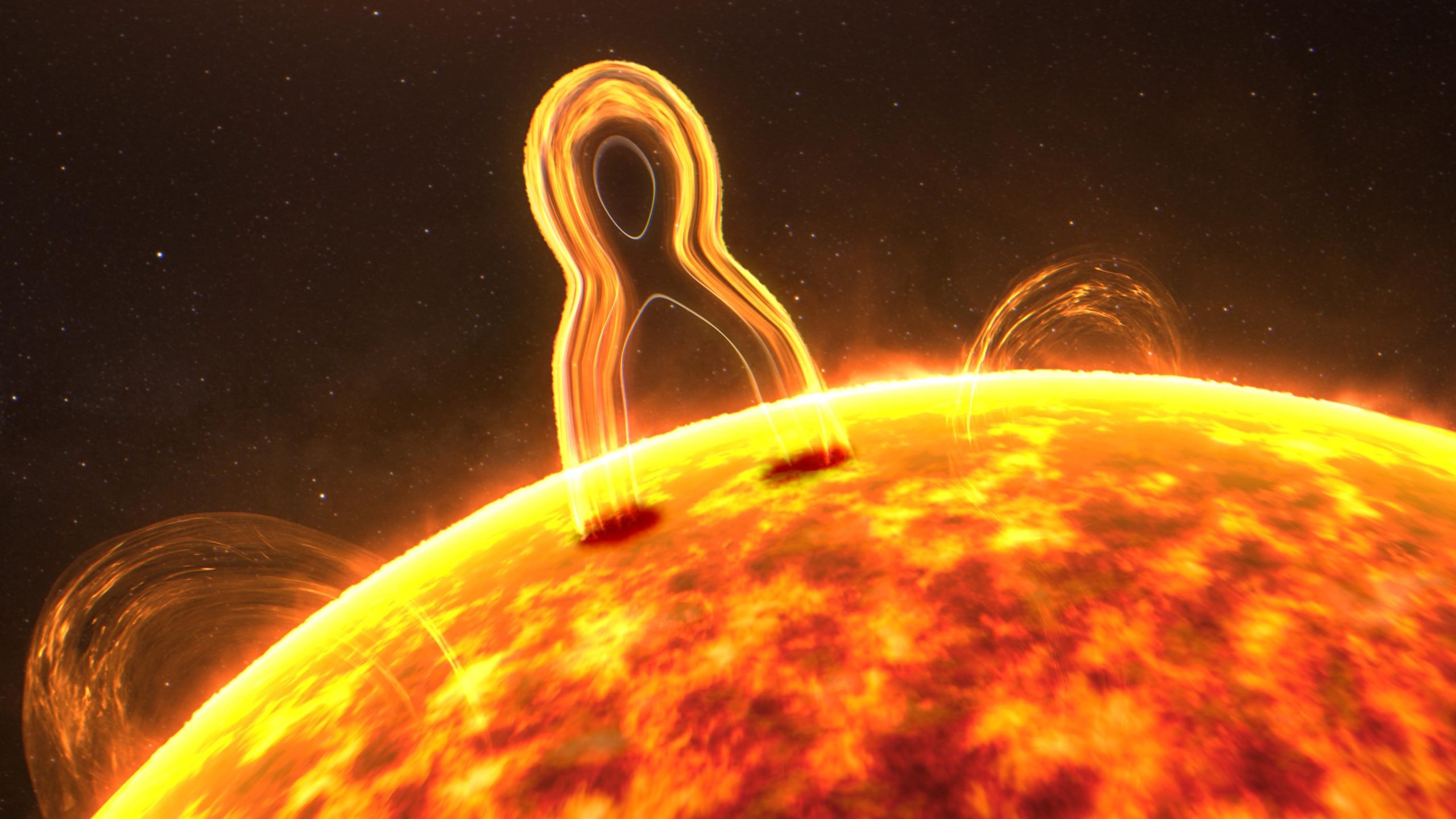
NASA researchers discovered that fast magnetic reconnection, responsible for solar flares, is driven by the Hall effect. This process creates an energy vacuum that releases immense energy.
In just minutes, a flare on the Sun can release enough energy to power the entire world for 20,000 years. These solar flares are triggered by an explosive process known as magnetic reconnection, and scientists have spent the last half-century attempting to figure out how it works.
It’s not merely a scientific curiosity either: A more complete understanding of magnetic reconnection could enable insights into nuclear fusion and provide better predictions of particle storms from the Sun that can affect Earth-orbiting technology.
Now, scientists with NASA’s Magnetospheric Multiscale Mission, or MMS, think they’ve figured it out. The researchers have developed a theory that explains how the most explosive type of magnetic reconnection – called fast reconnection – occurs and why it happens at a consistent speed. The new theory uses a common magnetic effect that’s used in household devices, such as sensors that time vehicle anti-lock braking systems and know when a cell phone flip cover is closed.
“We finally understand what makes this type of magnetic reconnection so fast,” said lead author on the new study Yi-Hsin Liu, a physics professor at Dartmouth College in New Hampshire and the deputy-lead of MMS’ theory and modeling team. “We now have a theory to explain it fully.”
Magnetic Reconnection and Plasma
Magnetic reconnection is a process that occurs in plasma, sometimes called the fourth state of matter. Plasma forms when a gas has been energized enough to break apart its atoms, leaving a motley of negatively charged electrons and positively charged ions existing side-by-side. This energetic, fluid-like material is exquisitely sensitive to magnetic fields.
From flares on the Sun, to near-Earth space, to black holes, plasmas throughout the universe undergo magnetic reconnection, which rapidly converts magnetic energy into heat and acceleration. While there are several types of magnetic reconnection, one particularly puzzling variant is known as fast reconnection, which occurs at a predictable rate.
“We have known for a while that fast reconnection happens at a certain rate that seems to be pretty constant,” said Barbara Giles, project scientist for MMS and research scientist at NASA’s Goddard Space Flight Center in Greenbelt, Maryland. “But what really drives that rate has been a mystery, until now.”
This visualization shows the Hall effect, which occurs when the motion of the heavier ions (blue) decouple from the lighter electrons (red) as they enter the region with strong electric currents (golden region). Credit: Tom Bridgman/NASA’s Scientific Visualization Studio
The new research, published in a paper in Nature’s Communications Physics journal and funded in part by the National Science Foundation, explains how fast reconnection occurs specifically in collisionless plasmas – a type of plasma whose particles are spread out enough that the individual particles don’t collide with one another. Where reconnection happens in space, most plasma is in this collisionless state, including the plasma in solar flares and the space around Earth.
The Hall Effect and Fast Magnetic Reconnection
The new theory shows how and why fast reconnection is likely sped up by the Hall effect, which describes the interaction between magnetic fields and electric currents. The Hall effect is a common magnetic phenomenon that’s used in everyday technology, like vehicle wheel speed sensors and 3D printers, where sensors measure speed, proximity, positioning, or electrical currents.
During fast magnetic reconnection, charged particles in a plasma – namely ions and electrons – stop moving as a group. As the ions and electrons begin moving separately, they give rise to the Hall effect, creating an unstable energy vacuum where reconnection happens. Pressure from the magnetic fields around the energy vacuum causes the vacuum to implode, which quickly releases immense amounts of energy at a predictable rate.
The new theory will be tested in the coming years with MMS, which uses four spacecraft flown around Earth in a pyramid formation to study magnetic reconnection in collisionless plasmas. In this unique space laboratory, MMS can study magnetic reconnection at a higher resolution than would be possible on Earth.
“Ultimately, if we can understand how magnetic reconnection operates, then we can better predict events that can impact us at Earth, like geomagnetic storms and solar flares,” Giles said. “And if we can understand how reconnection is initiated, it will also help energy research because researchers could better control magnetic fields in fusion devices.”
For more on this research, see Rapid Magnetic Explosions in Space: Explaining Mystery Behind Fast Magnetic Reconnection.
Reference: “First-principles theory of the rate of magnetic reconnection in magnetospheric and solar plasmas” by Yi-Hsin Liu, Paul Cassak, Xiaocan Li, Michael Hesse, Shan-Chang Lin and Kevin Genestreti, 28 April 2022, Communications Physics.
DOI: 10.1038/s42005-022-00854-x
Never miss a breakthrough: Join the SciTechDaily newsletter.
Follow us on Google and Google News.